
Auction: 9022 - Orders, Decorations, Medals & Militaria
Lot: 217
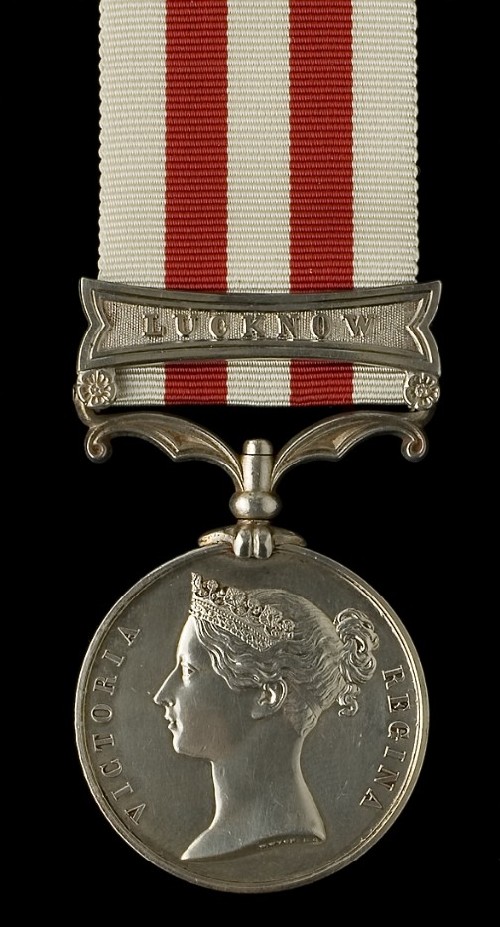
x The Historically Interesting Indian Mutiny Medal to Lieutenant, Later Major-General, H.H. Stansfeld, Whose Extant Letters, Which Are Held By the National Army Museum, Chronicle His Service in Great Detail From When His Parent Regiment the 8th Bengal Native Infantry Mutinied at Dinapore, 25.7.1857, Through to His Attachement With the 10th Foot, Including Bloody Hand to Hand Fighting in Lucknow Indian Mutiny 1857-58, one clasp, Lucknow (Lieut. H.H. Stansfeld, Attd. To. 1st Bn. 10th Foot), very fine, with 83 pages of typescript copies of letters from the recipient to members of his family, covering and recounting his service during the Indian Mutiny, January 1857 - November 1858, the original letters are in the collection of the National Army Museum Estimate £ 600-800 Major-General Henry Hamer Stansfeld (1839-1914), educated at Bonchurch College, Isle of Wight and at Mr. R. Williams Military Academy, Addlestone, Surrey; commissioned Ensign Indian Army, 1856, and was posted to the 8th Bengal Native Infantry at Dinapore, later that year; in a letter to his father, dated 13.6.1857, Stansfeld offers insight into the atmosphere in India at the time, ´´Since I last wrote to you a fortnight ago things have been worse than ever... We were very nearly having a row here last Sunday night, the plot was for the sepoys to go to all the Messes, murder their officers and plunder the treasury at Patna... but fortunately on Sunday afternoon our Adjutant got wind of this, instantly told the Colonel, who reported it to the General, and at half an hour´´s notice a parade was ordered, to read to the troops an order that the obnoxious cartridges were not to be given to them..... At this moment 36 out of the 74 Regiments have mutinied... I should not have told you all about these mutinies for fear of alarming you but I think last Sunday was the crisis here and that it is passed´´; unfortunately Stansfeld was to be proved wrong, when on 25.7.1857, his regiment mutinied in conjunction with the 7th N.I. at Dinapore, ´´we had just had tiffin and I was playing at Billiards, when there was a tremendous row and all the officers rushed from the Mess, I was in the billiard room and did not get away directly as I had to get my sword, when I did so I ran about 100 yards into the square, as I expected to see the sepoys show their ugly faces in the Mess directly... we went down towards the lines to see what was going on, we got opposite the 40th lines which were nearest and saw the 7th and 8th Regiments had left their lines and were all standing and shouting with their muskets in their hands by the magazine.... When we showed ourselves they fired at us.... When the Europeans on the top of the hospital saw this they gave them a volley and kept firing´´; the mutinous sepoys retreated into the surrounding countryside - leaving Stansfeld with no regiment, ´´there is no 8th N.I. now, and at present I belong to the irregular cavalry here, all the officers of the three regiments here have lots to do as the 10th is very weak in officers... so that many of us are posted to do duty with the corps´´; he was attached to the 1st Battalion 10th Foot, and saw service with them as a Company Commander during the siege of Lucknow; he served at Lucknow from the 4th -28th March, and in particular in and around the Kaiser Bagh, including the eventual capture of the palace, ´´my company was sent out to a mosque at this time and we stopped there all night, the smell here was something horrible, 250 sepoys having been killed here the day before and many were not buried, it was impossible to sleep, what with mosquitoes and every 5 minutes our 10 inch mortars firing and shaking the place tremendously, we had the enemy pretty close to this mosque and the shots came whistling about´´; in a letter dated the 13th March he relates further the situation in and around the palace, ´´I was woke up at 11 and sent out with the company to hold a mosque in front [Kaiser Bagh], we marched down there.... I certainly never relieved guard under such a musketry fire in my life, the enemy being within 50 yards on three sides under splendid cover, there was a ladder up to the top of the dome for our sentry to go up... I was standing against the ladder seeing the sentry placed when a bullet hit the ladder just above my head disagreeably close, I never spent such an unpleasant night in my life, expecting an attack every minute´´; Stansfeld continued to be involved in the savage hand to hand fighting after the Kaiser Bagh had fallen,´´ we heard a noise in the rear, three sepoys rushed past us, fired their muskets into us and began cutting about with their swords, coming from the rear we were unprepared for them, as they came up quietly at first, and everyone took them for servants in the dusk, I don´´t think when it was found out who they were, there was single person that did not stick his bayonet or sword into them, in fact, they were hacked to atoms´´; he also took part in several skirmishes in the Oude, Azimghor and the Jugdespore District; he returned to service with the Indian Army after the Mutiny and was promoted Captain 1866; served as Private Secretary (A.D.C.) to Governor Sir Ashley Eden of Bengal, from 1879; advanced Colonel 1881; Major-General 1890; he died at his residence in 4 Royal Park, Clifton, Bristol.
Sold for
£2,700


Watch, listen and bid as if you were in the room. Now available for auctions worldwide.
Click here to bid live
An exclusive and confidential service for the discerning collector or vendor.
View the Gallery
Download every Spink catalogue on your iPad, iPod or iPhone using free Spink app.
Download From iTunes© 2026 Spink & Son. All rights reserved.