
Auction: 26002 - Orders, Decorations and Medals
Lot: 211
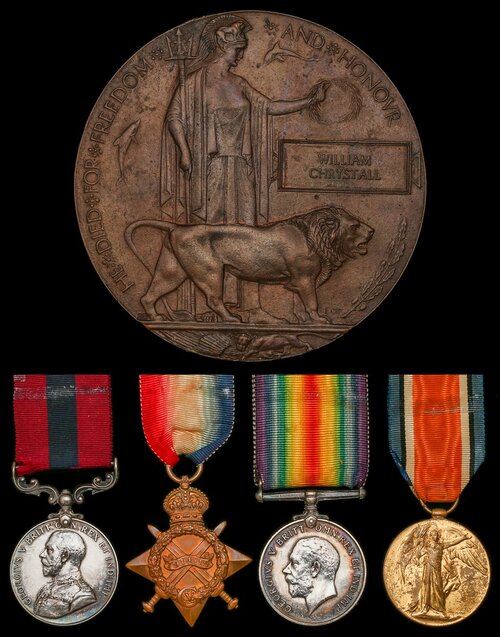
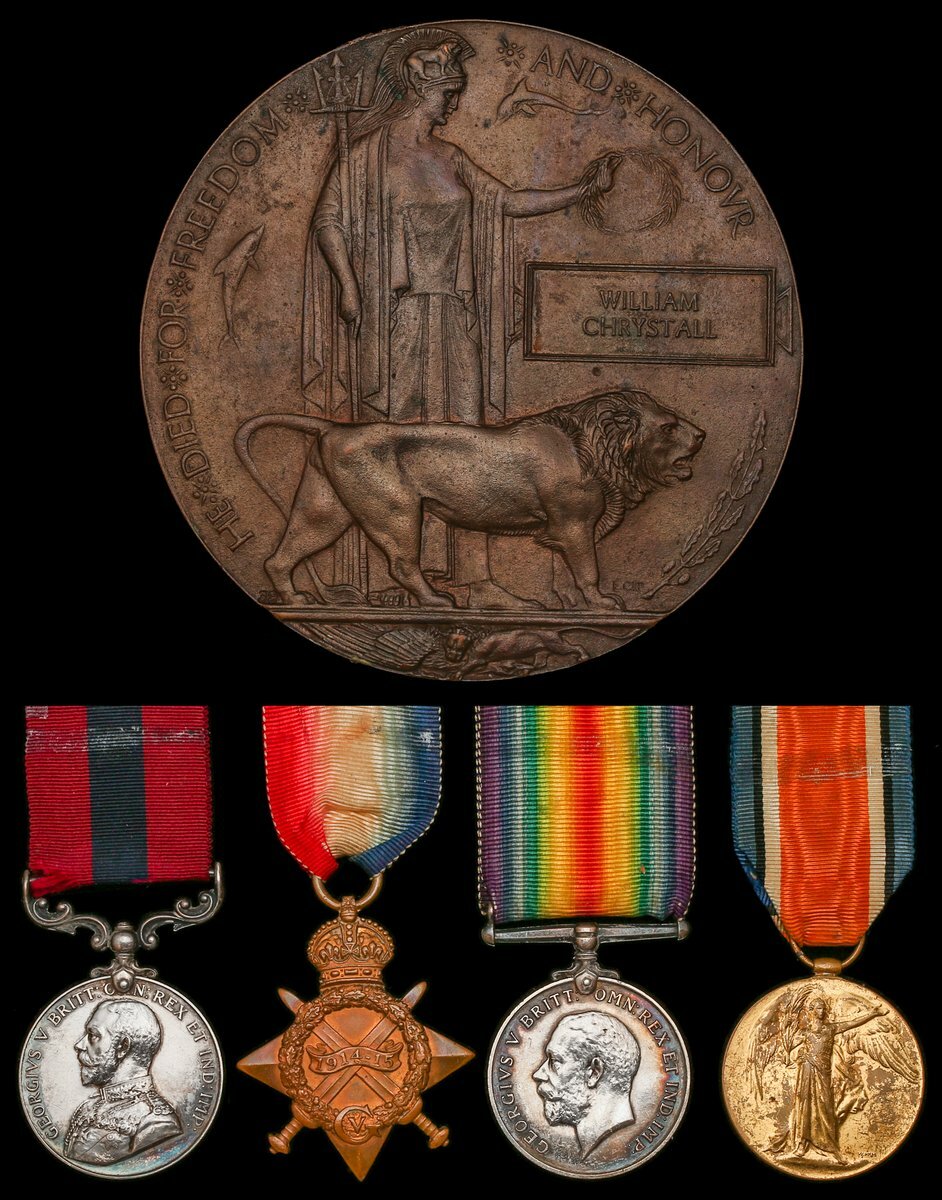
A Great War D.C.M. group of four to Sergeant W. Chrystall, Royal Artillery, who was killed in action at Cambrai on 30 November 1917 during the German counter-attack
Distinguished Conduct Medal, G.V.R. (630119 Sjt: W. Chrystall. 255/High:Bde: R.F.A. -T.F.); 1914-15 Star (3424. Far. Sjt. W. C. Chrystall, R.F.A.); British War and Victory Medals (3424 Sjt. W. Chrystall. R.A.); Great War Bronze Memorial Plaque (William Chrystall), with Memorial Scroll in postage tube, good very fine throughout (Lot)
D.C.M. London Gazette 17 April 1918.
'For conspicuous gallantry and devotion to duty. He invariably displayed great courage and coolness under fire, and set a fine example to all ranks with him.'
William Chrystall was the son of William Chrystall of 496 King Street, Aberdeen and was born at Aberdeen on 13 February 1887. He was educated at Foveran, Newburgh and at Aberdeen and became a farmer. He enlisted into the 1st Highland Brigade, Royal Field Artillery in August 1914 at Aberdeen. Chrystall entered the war in France on 2 May 1915. He was killed in action at Cambrai on 30 November 1917 and is buried at Metz-en-Couture cemetery, north of Gouzeaucourt and south-east of Bapaume.
His Major wrote: "He was an excellent fellow in every way. He was brave to a degree, always bright and cheerful. His devotion to duty and his brave conduct were a fine example to all of us. I have lost a very good friend"; and the Battery Sergt.-Major: " Never was there one who was a greater favourite to his confreres. Your husband was a true hero". He left a wife, Eliza A. Chrysall, who he married on 13 June 1908 and two daughters.
The Battle of Cambrai, the German Counter-Attack
The Germans counter-attacked on 30 November 1917. On the right flank, south of the Gouzeaucourt-Bonavis road, the break into British positions was swift. The defending 55 (2/West Lancashire) Division and much of 12 (Eastern) and 20 (Light) Divisions seemed to evaporate, and Snow called for reinforcements as early as 9am. Many artillery batteries soon came within range of advancing German infantry. Both they and units hurriedly ordered to shore up the clearly splintering defence were shocked at what they saw. Not least of them was the Guards Division, still recuperating from a mauling in Fontaine Notre Dame and now heading into what would become a bitter fight to hold the enemy at Gouzeaucourt.
The German plan was simply to cut of the neck of the salient by attacking on each side, with the strongest blow to come on the southern side. The blow fell at 7.30am on the 30th November, and was devastatingly fast and effective. By 9am, the Germans had penetrated almost 3 miles towards Havrincourt Wood. Byng’s Third Army faced disaster, with the real prospect of several divisions being cut off in the trap. The first attack fell on the 55th (West Lancashire) and 12th (Eastern) Division on the south-eastern side of the salient. The Germans climbed the slope to re-take Lateau Wood, pushed up the complex of shallow ravines south of Banteux, moved through Villers Guislain and past Gouzeaucourt. Amongst the troops defending the artillery positions at Gouzeaucourt were the11th United States Engineer Company. The direction of the assault was across British divisional boundaries, and the command structure rapidly broke down as the troops became mixed up.
Three German divisions attacked to the north, supported by an intense Phosgene barrage, intending to cut the Bapaume-Cambrai road near Anneux Chapel. They were repulsed by the machine gun barrage of the 47th (London), 2nd and 56th (London) Divisions, who had relieved the 36th and 40th. No Germans reached the road. Fierce fighting continued in the southern area for Gonnelieu, Les Rues Vertes and Masnieres.
Subject to 20% VAT on Buyer’s Premium. For more information please view Terms and Conditions for Buyers.
Estimate
£800 to £1,200
Starting price
£600

Watch, listen and bid as if you were in the room. Now available for auctions worldwide.
Click here to bid live
An exclusive and confidential service for the discerning collector or vendor.
View the Gallery
Download every Spink catalogue on your iPad, iPod or iPhone using free Spink app.
Download From iTunes© 2026 Spink & Son. All rights reserved.