
Auction: 26002 - Orders, Decorations and Medals
Lot: 164
Sold by Order of a Direct Descendant
'We do not know, we never shall know, what were the thoughts of Admiral Cradock when it became evident that, outgunned and outranged, success was an impossibility. We shall never know what he felt when the setting sun on that evening threw his own ships up clearly against the bright Western sky, a mark for his enemies, and at the same time rendered his own fire difficult and ineffective by placing them in the shade. He must have realized then that his hopes were dashed for ever to the ground, that his plan had failed. In the face of death, certain and imminent, I doubt not that he thought, if only for a moment, of how his friends and his countrymen would judge his action. If he did, I feel sure that he realized, what is the truth, that he could safely leave his fame to the admiring justice of his countrymen…'
Arthur J. Balfour, First Lord of the Admiralty, paying tribute to the gallant end of Rear-Admiral Sir Christopher Cradock.
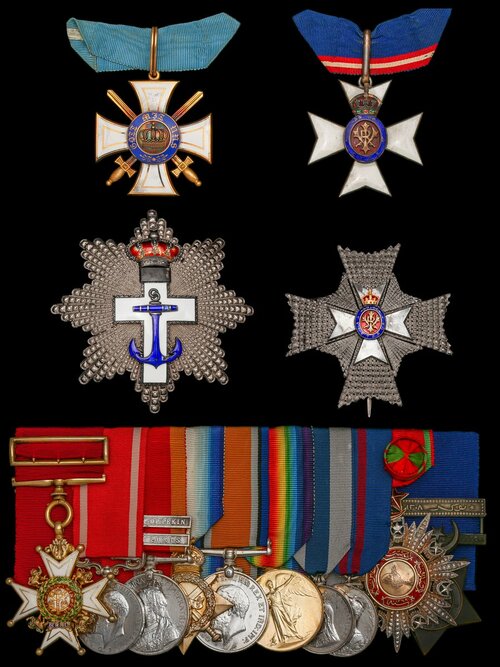
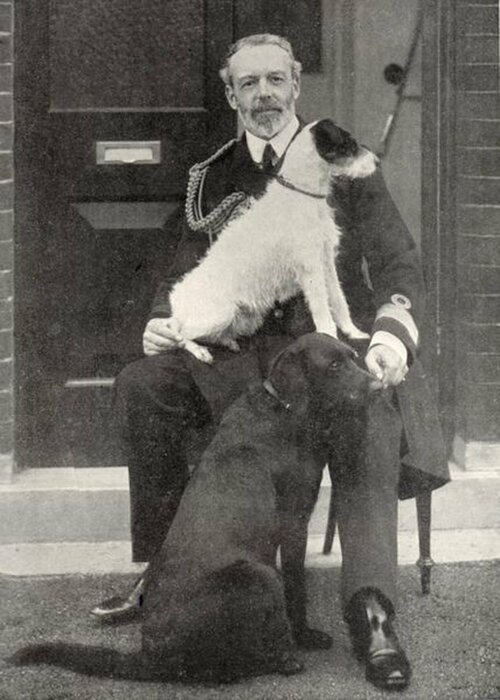
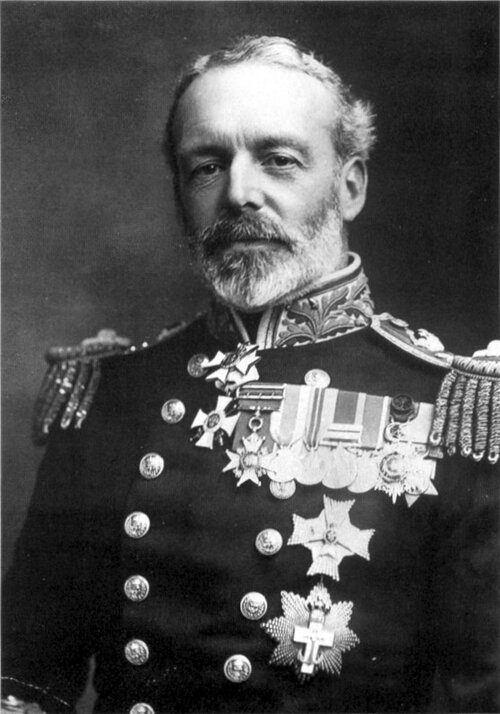
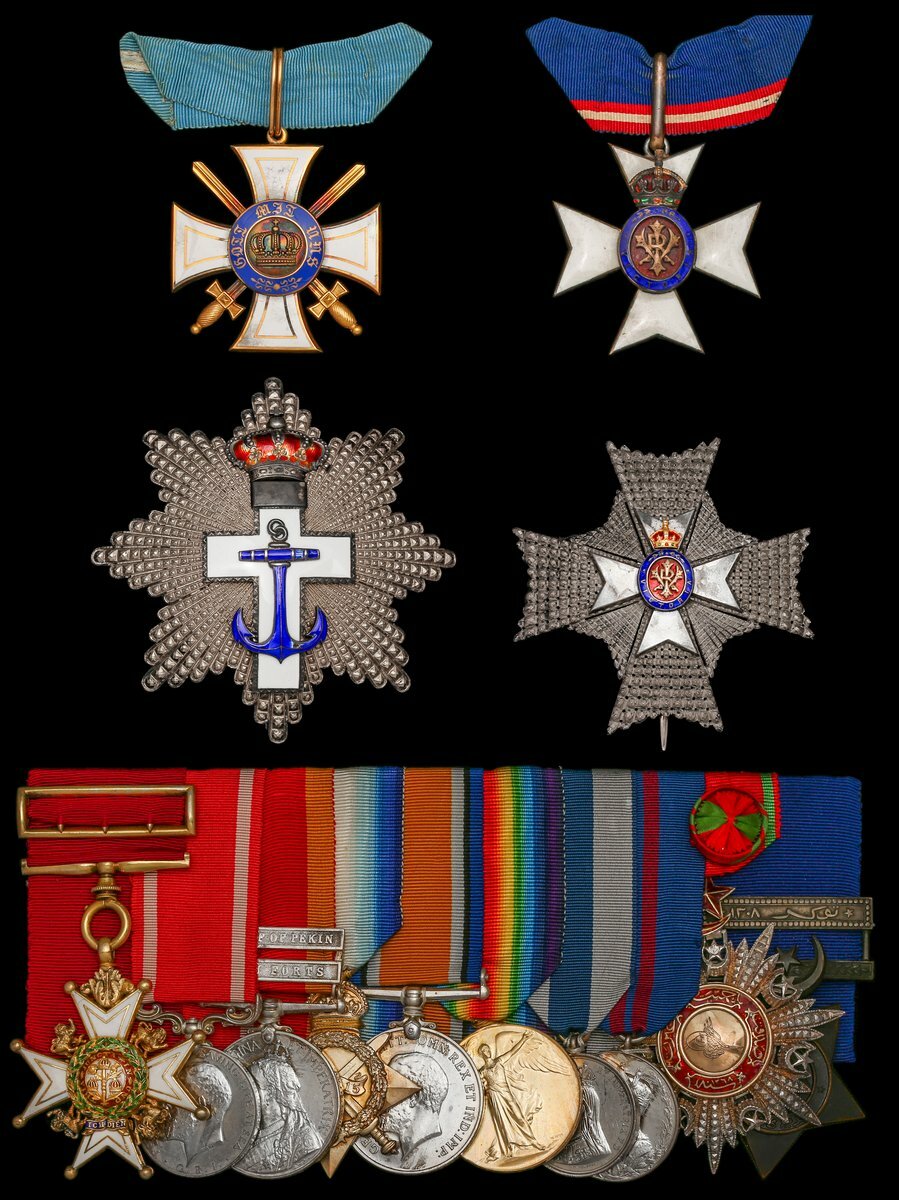
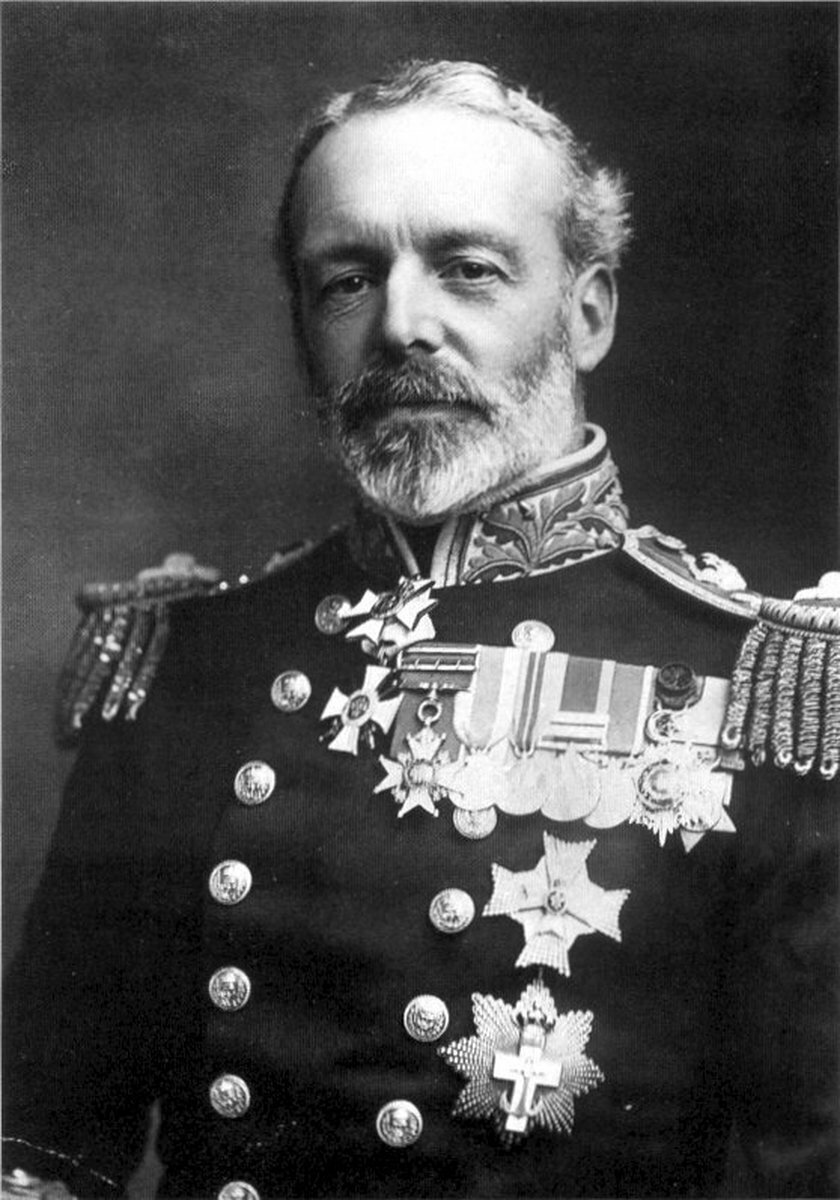
The important K.C.V.O., C.B., S.G.M. group of fifteen awarded to Rear-Admiral Sir C. G. F. M. 'Kit' Cradock, Royal Navy, who was killed in action at the Battle of the Coronel, alongside some 1,600 of his officers and ratings
Unquestionably a brave officer who had previously taken his Knighthood and the S.G.M. for a Royal rescue that included a Duke and a triplet of Princesses - who once observed that he would prefer to die in action or as a result of a hunting accident - he was ultimately let down by a spate of ambiguous Admiralty instructions, so much so that he confided in the Governor of the Falklands that he did not expect to live
And so it proved off Coronel on All Saints' Day 1914 when, in a typically gallant gesture, he elected to engage an overwhelming enemy force, thereby upholding the highest traditions of his beloved Senior Service: chief among his mourners was King George V, who deeply deplored the loss of 'Kit', with whom 'had very strong personal feelings of friendship'
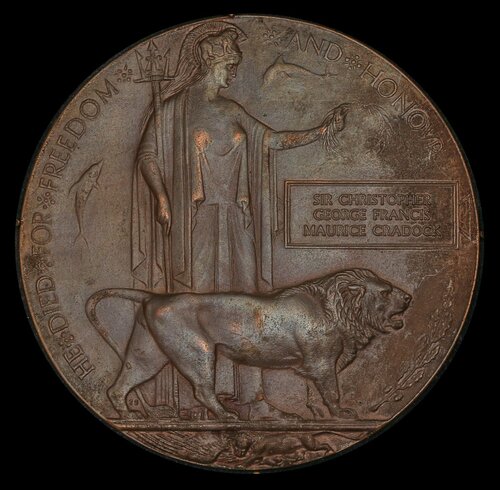
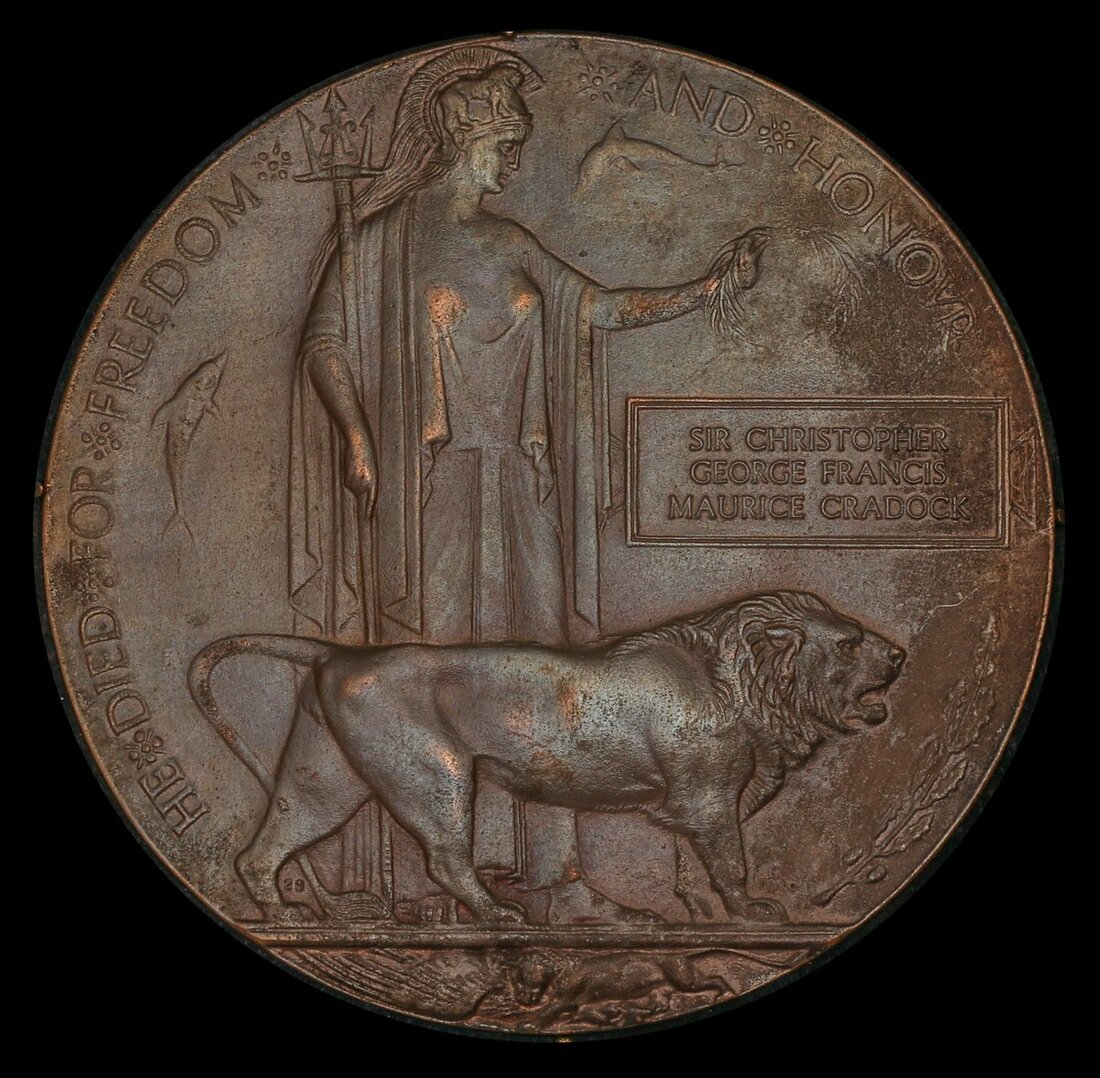
The Royal Victorian Order, Knight Commander's (K.C.V.O.) set of Insignia, by Collingwood & Co., London, comprising neck Badge, silver-gilt and enamel, reverse officially numbered 'K290'; breast Star, gold, silver-gilt and enamel, the reverse officially numbered '290', with section of riband as worn, in its case of issue, this also numbered 'K290'; The Royal Victorian Order, Member's (M.V.O.) breast Badge, the reverse officially numbered '109'; The Most Honourable Order of the Bath, Military Division, Companion's (C.B.) breast Badge, silver-gilt and enamel, with riband buckle and case of issue, reverse centre adapted for mounting; Sea Gallantry Medal, G.V.R., silver issue (Rear Admiral Sir Chrisr. Geo. F. M. Cradock. K.C.V.O. C.B. "Delhi" 13 Dec. 1911.); China 1900, 2 clasps, Taku Forts, Relief of Pekin (Commr. C. G. F. M. Cradock. R.N., H.M.S. Alacrity.), clasps adapted for mounting; 1914-15 Star (R. Adml. C. G. F. M. Cradock. K.C.V.O. C.B. R.N.); British War and Victory Medals (R. Adm. Sir C. G. F. M. Cradock.); Jubilee 1897; Coronation 1911; Turkey, Ottoman Empire, Order of the Medjidie, breast Badge, with rosette upon riband; Khedive’s Star, undated, with Tokar clasp; Spain, Kingdom, Order of Naval Merit, breast Star, silver-gilt and enamel; Germany, Prussia, Order of the Crown, Commander's neck Badge, by Wagner, Berlin, gold and enamel; Great War Bronze Memorial Plaque (Sir Christopher George Francis Maurice Cradock), breast medals mounted court-style by Spink & Son, Spanish and German awards housed in fitted leather case by Spink & Son, 17 & 18 Piccadilly & 30 Cornhill, London, Great War Plaque in fitted leather case, good very fine unless stated otherwise and a most remarkable combination of awards (Lot)
K.C.V.O. London Gazette 28 February 1912 and personally invested on 6 March 1912 at Buckingham Palace.
C.B. London Gazette 26 June 1902.
M.V.O. London Gazette 2 June 1903 (Royal Visit to Malta).
S.G.M. invested on 10 October 1912 at Buckingham Palace.
Christopher George Francis Maurice Cradock was born in Richmond, Yorkshire on 2 July 1862, the fourth son of Christopher Cradock, of Hartforth Hall, by his wife, Georgina, daughter of Major Gordon Duff, 92nd Highlanders.
Entering Britannia as a Cadet in January 1875, young Christopher's first seagoing appointment was in the corvette H.M.S. Pallas, in which he was appointed a Midshipman in December 1877. Having then also seen service in the frigate Minotaur, and in the corvette Cleopatra on the China Station, he returned home as a Sub. Lieutenant to attend the Royal Naval College, Greenwich in July 1882.
Early Career - Bluejacket
His studies completed, he was advanced to Lieutenant in June 1885 and joined the sloop Dolphin, from which he came ashore in Upper Egypt during the Mahdist troubles. Hence his part in the battle of Tokar in April 1891, in which he was commended for his zeal and resource. He was awarded the Turkish Order of Medjidie, Fourth Class, and the Khedive's Star for Tokar, and next took up duties as A.D.C. to the Governor-General of the Red Sea.
Back in home waters, Cradock next served in the battleship Howe and the corvette Volage, in addition to the royal yacht Victoria and Albert, in which he was advanced to Commander in August 1896 and awarded the Jubilee Medal. Next appointed to the prestigious command of Britannia, he published his first book about this time, namely Sporting Notes from the East.
Then, shortly before the advent of the Boxer Rebellion in 1900, he was appointed to the command of the cruiser Alacrity and he subsequently led the Naval Brigade at the storming of the Taku Forts on 17 July 1900, where he was noted for his gallantry and early promotion. Later, and still in command of the Naval Brigade, he also directed the American, Japanese and Italian forces in the advance to relieve Tientsin, and he took part in the subsequent relief of Sir Edward Seymour's column at Siku, in addition to assisting at the capture of the Pei-vang arsenal at Tientsin. He was awarded the C.B. and Prussian Order of the Crown, Second Class, with Swords, in addition to being promoted to Captain.
Royal Visits - Royal Rescue
Next appointed to the command of the cruiser Bacchante, Cradock added the M.V.O. to his accolades on the occasion of King Edward VII's visit to Malta in Spring 1903, the same year in which he also received the Spanish Order of Naval Merit, and from July 1906 to August 1908, he commanded the battleship Swiftsure.
It was about this time he published another book, Whispers from the Fleet, a publication partly prompted by an ongoing feud that existed between the reformer Jackie Fisher and the traditionalist Lord Charles Beresford. It seems Cradock was firmly embedded in the latter camp:
'We require - and quickly too - some strong Imperial body of men who will straightway choke the irrepressible utterings of a certain class of individuals who, to their shame, are endeavouring to break down the complete loyalty and good comradeship that now exists in the service between the officers and the men; and who are also willing to commit the heinous crime of trifling with the sacred laws of naval discipline.'
Senior command now beckoned and, in July 1909, he was appointed C.O. of the naval establishment in Portsmouth in the rank Commodore, Second Class, a role in which he entertained visiting dignitaries. He also picked up a £2 fine for 'driving to the common danger' and failing to stop his motor car after a collision with a motor cyclist.
Advanced to Rear-Admiral in August 1910, and having been appointed an A.D.C. to the King, Cradock was awarded the Coronation Medal in the following year after attending the Naval Review at Spithead, in which he was detailed to attend visitors on the chartered ship S.S. Rewa.
Then in December of the same year, in his new appointment as Second-in-Command of the Atlantic Fleet, he lent valuable service in his flagship London in rescuing passengers from the stricken P. & O. liner Delhi, which had run aground off Cape Spartel in northern Morocco. The passengers famously included the Duke of Fife and his wife, the Princess Royal, and their children, the Princesses Alexandra and Maud. In recognition of his services, he was appointed K.C.V.O. and awarded the Sea Gallantry Medal in Silver.
The fateful path to the Coronel
At the outbreak of the Great War, Cradock faced difficulties in fulfilling his brief as C.O. of the Fourth Light Cruiser Squadron, in which he initially flew his flag in the Suffolk. He may have had superiority in numbers - just two enemy cruisers pitched against him - but the area he had to patrol stretched from St. Lawrence to Brazil, with additional responsibility for shadowing enemy merchant ships from the Atlantic ports.
Notwithstanding that challenging prospect, he got off to a good start, driving the enemy cruisers off the trade routes and very nearly managing to get to grips with one of them. In fact, by mid-August 1914, the Admiralty sent a message to the French stating, 'the passage across the Atlantic is safe; British trade is running as usual.'
Transferring his pennant to the Good Hope, Cradock now pursued his opponents to the South Atlantic, but on arriving at Pernambuco in Brazil in September 1914, he received an Admiralty message that stated the enemy's China squadron, under Admiral von Spee, was heading his way, the Falklands being a likely destination. Not for the first time, the Admiralty's intervention was a game changer, Cradock now having to face off a powerful enemy squadron, as well as keeping an eye on old adversaries, which were still at large. In consequence, he telegraphed the Admiralty to say needed two forces, one to deploy to the west, and the other to the east of the Magellan Straits. But the Admiralty prevaricated and said he should meanwhile continue to prioritise the protection of trade.
At that moment in time, aside from his own command Good Hope, he had just the Monmouth and Glasgow to hand, together with the armed merchantman Otranto, although the ancient battleship Canopus was apparently on her way to join him. That, Cradock informed the Admiralty, was a pointless exercise, for she would reduce the speed of his squadron to a mere 12 knots. Left in the lurch, and under painfully ambiguous instructions, Cradock eventually opted to seek out and engage the enemy. But as Captain Heathcoat Grant of the Canopus later revealed, he 'was under no delusions as to the relative strength of the force under his command' versus Spee's powerful squadron. The contrary.
On 20 October 1914, Grant and Cradock went for a walk in the Falklands countryside. The former takes up the story:
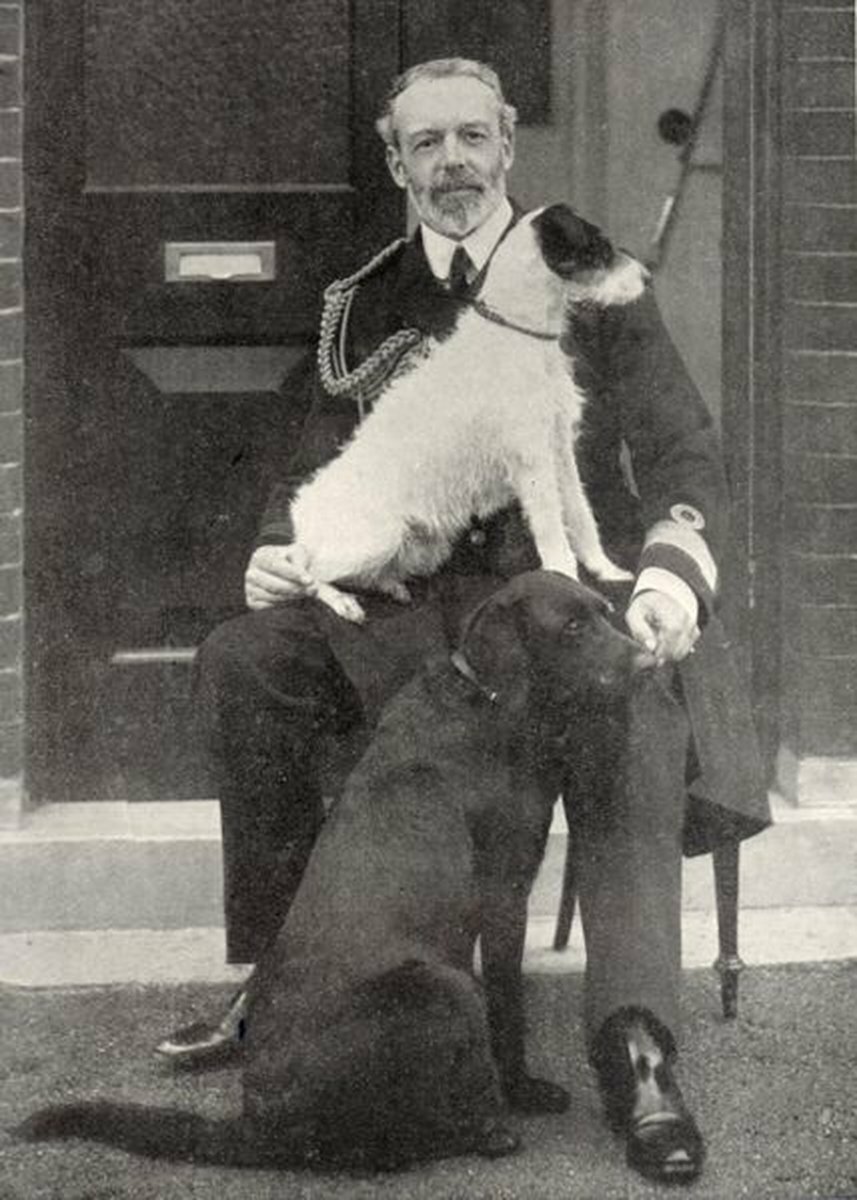
'It was a lovely day, and I think the Admiral enjoyed it as much as myself. He had been rather depressed with what he considered his poor chances of catching the enemy under favourable conditions, if at all, and no wonder with a scratch squadron such as he had, most of the neighbouring coast and ports full of German spies, the Pacific Ocean open to them, and all the innumerable hiding places round the Straits of Magellan, in which they could safely conceal themselves before their probable attempts to break through to the Atlantic side … later we came on a big colony of penguins who had just landed and were very busy making preparations for their future nurseries. Cradock's dog, Jack, made a determined attack on the penguin army and was with difficulty restrained from despatching a pugnacious old cock bird…'
Cradock finally departed Port Stanley on 22 October and arrived with his squadron off Coronel on the coast of Chile a week or so later. Meanwhile the Admiralty, having finally woken up to his predicament, sent a message to say he would be joined by the powerful armoured cruiser Defence and that he was not expected to go into battle with the ancient Canopus. Sadly, the new orders never reached him.
And, so, at 1620hrs on 1 November 1914, he fell in with Admiral von Spee's squadron, the latter comprising the Scharnhorst, Gneisenau, Leipzig, Dresden and Nurnberg, a formidable force that outmatched Cradock's force in gun power, armour and speed. But the latter felt bound to engage as soon as possible, to try and take advantage of the light, but von Spee, making use of his squadron's superior speed, kept his squadron between Cradock and the land until sunset at 1900hrs.
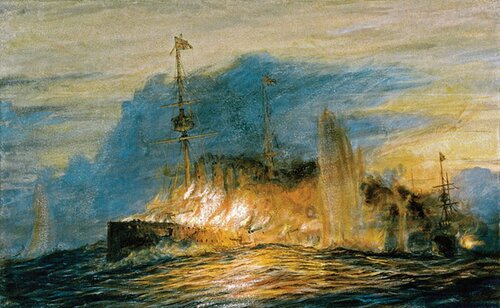
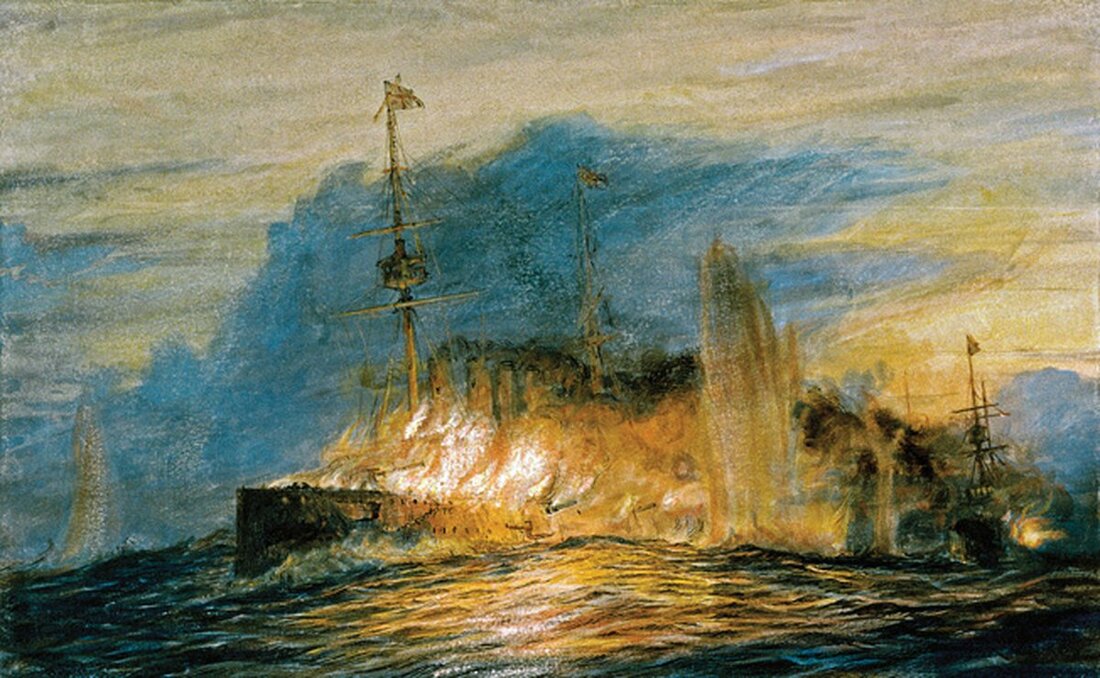
Then, with his ships blending in against the dark backdrop of the coast, von Spee opened fire on Cradock's squadron, the whole silhouetted in the glow of the western sky. And that combination of evening light and superior enemy fire power proved fatal, the engagement lasting but an hour.
The end of the Good Hope was a gallant one and came just before 2000hrs, she was seen to be totally ablaze and it finally reached her magazine. A massive explosion cost the lives of the entire crew with not one survivor. Flames reached 200 feet above the deck. The explosion was so great that crewmen aboard Nürnberg, six miles away, were forced to hold their hands over their ears. Monmouth, after trying to escape the scene of battle, capsized at 2100hrs. There were no survivors. Only the Glasgow and Otranto got away, and only then because von Spee received intelligence that the Canopus was somewhere in the vicinity; in fact, owing to her inferior speed, she was around 300 nautical miles away as the action commenced.
Back home news of the defeat attracted ill-informed criticism but, as evidenced by later investigation, it was patently obvious that Cradock had been sorely let down by the Admiralty. But it seems there was another catalyst for Cradock's actions off Coronel, as revealed by a letter he left with the Governor of the Falklands, a letter addressed to his friend, Admiral Hedworth Meux. In it, he quoted the case of Rear-Admiral Ernest Troubridge, who had been court-martialled in August 1914 during the pursuit of the Breslau and Goeben, for failing to engage the enemy despite the odds being severely stacked against him. That, stated Cradock, was a fate he would never suffer.
A memorial service was held at Christ Church, London on 13 November 1914, the King being represented by Commander Sir Charles Cust and the Queen Alexandra by General Sir Dighton Probyn. The Princess Royal sent a wreath. A memorial tablet was set up in the Parish Church of St. Agatha at Hartforth, the Cradock family seat.
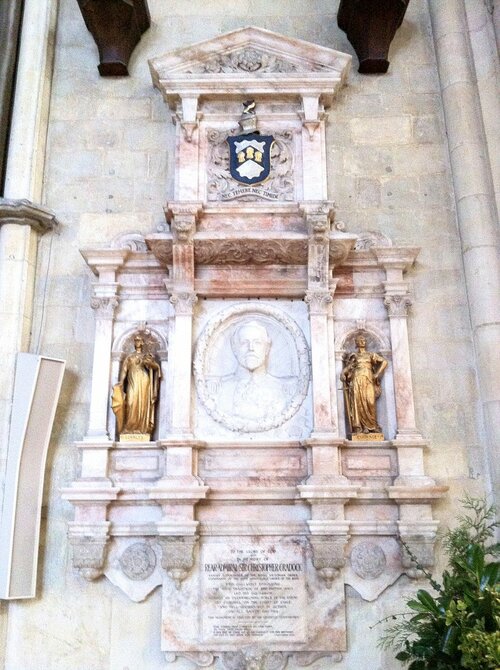
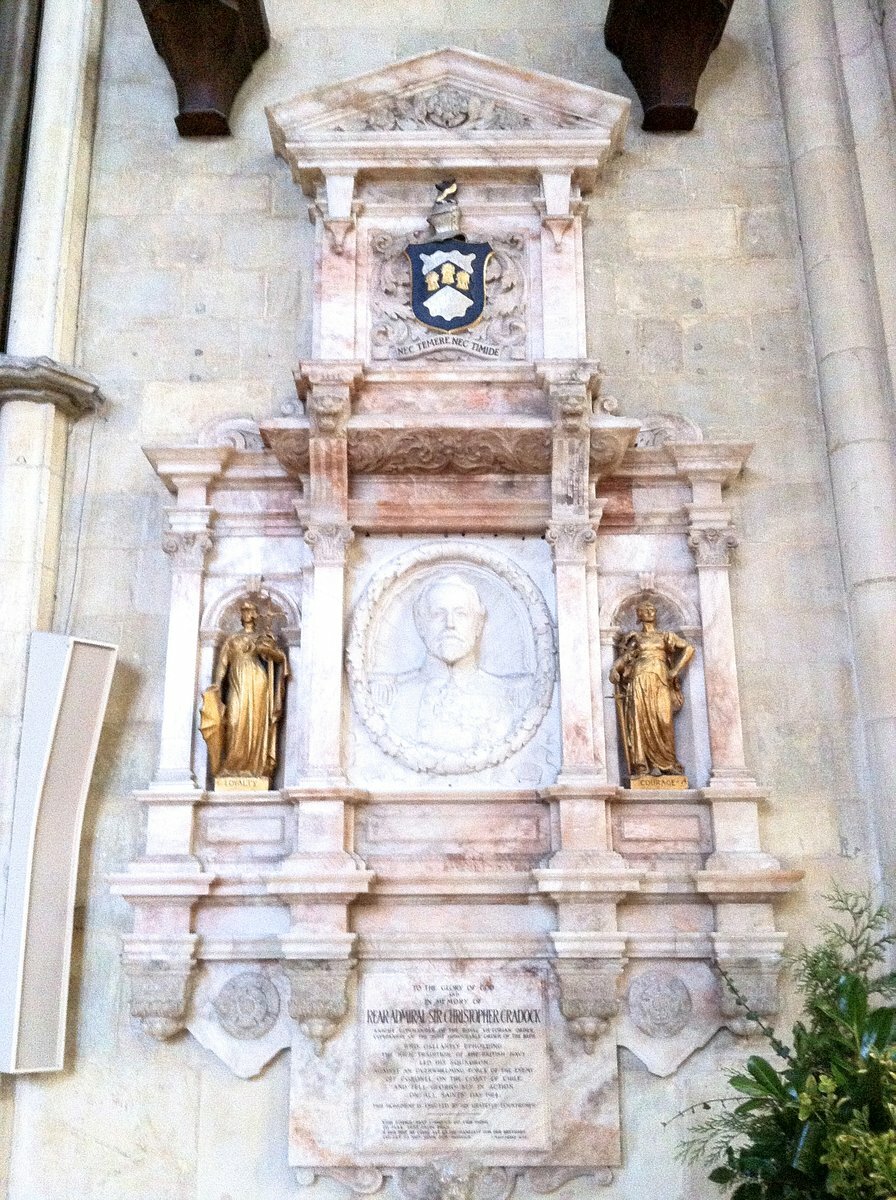
In January 1915 a committee was set up for creating a memorial to Cradock at York Minster. The subsequent mural, designed by F. W. Pomeroy, A.R.A., was unveiled by the Marquess of Zetland on 16 June 1916, when the gathered throng was addressed by Arthur J. Balfleur, the First Lord of the Admiralty.
Sold with an impressive, valuable and unpublished archive of original documentation and photographs, and related uniform, including:
(i)
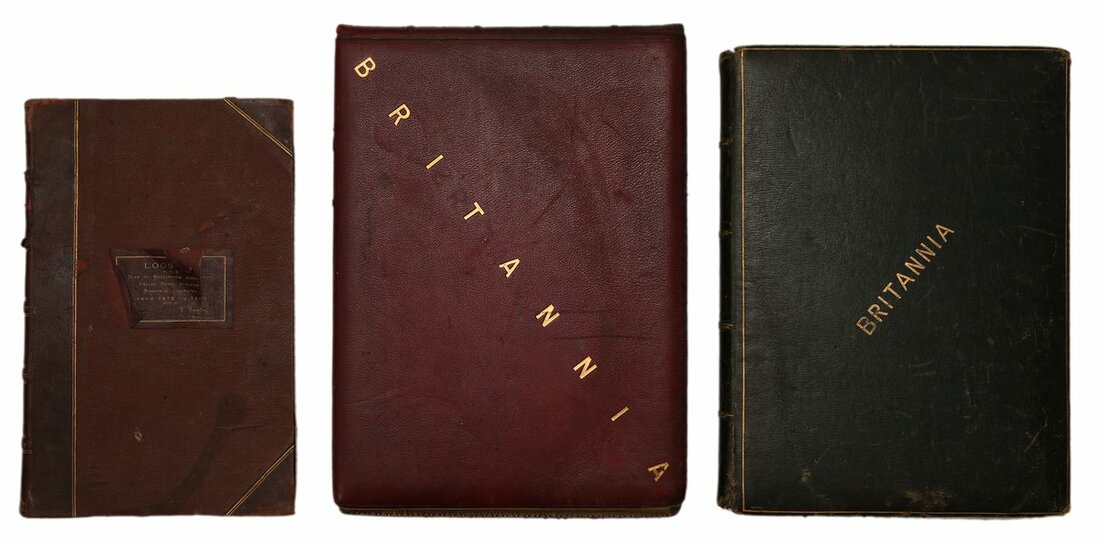
A leather-bound album, the title page inscribed, 'Logs of H.M.S. Duke of Wellington, Alexandra, Minotaur, Pallas and Alexandra, Royal Adelaide, kept by C. Cradock (1876-1881)', namely his Midshipman's journals with immaculate entries, including drawings and sketches in ink and watercolour, and related maps.
(ii)
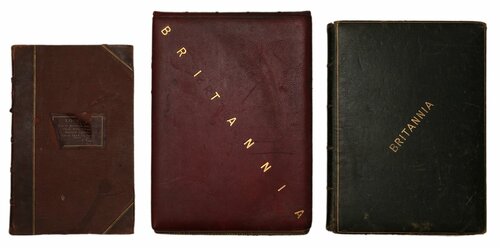
A large photograph album, red leather bound with 'Britannia' gilt title, comprising some 170 images from the naval college in the period 1898-99, namely an impressive range of captioned images of cadets, sports, royal visits, Britannia's mascots and much besides.
(iii)
Another comparable photograph album, green leather bound with 'Britannia' gilt title, this with around 110 images, with a comparable selection of subject matter.
(iv)
A folding double-sided leather photograph frame, with gilt 'RNB' letters affixed to the right hand image, both being scenes of a royal visit by Queen Alexandra's to Britannia, and one including the recipient and a college wolf hound; together with a small silver framed image of H.M.S. Andromeda at Malta in April 1902, and a leather framed watercolour of H.M.S. Swiftsure, another of Cradock's pre-Great War commands.
(v)
A quantity of letters relating to Cradock's loss and memorial service, including a letter from the King's Private Secretary, Lord Stamfordham, to Colonel M. Cradock, C.B., C.M.G., dated at Buckingham Place on 9 February 1915, in which he laments 'Kit's' death, adding, 'His Majesty had very strong personal feelings of friendship for you brother, whose loss he deeply deplored'; together with a quantity of letters from 'Kit' to his Aunt Maria, mainly sent from Britannia as a Cadet, and a 'Britannia Beagles' leather-bound fixtures booklet with gilt title, 'Season 1898-99'.
(vi)
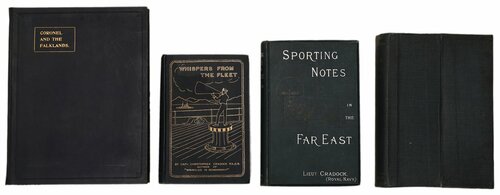
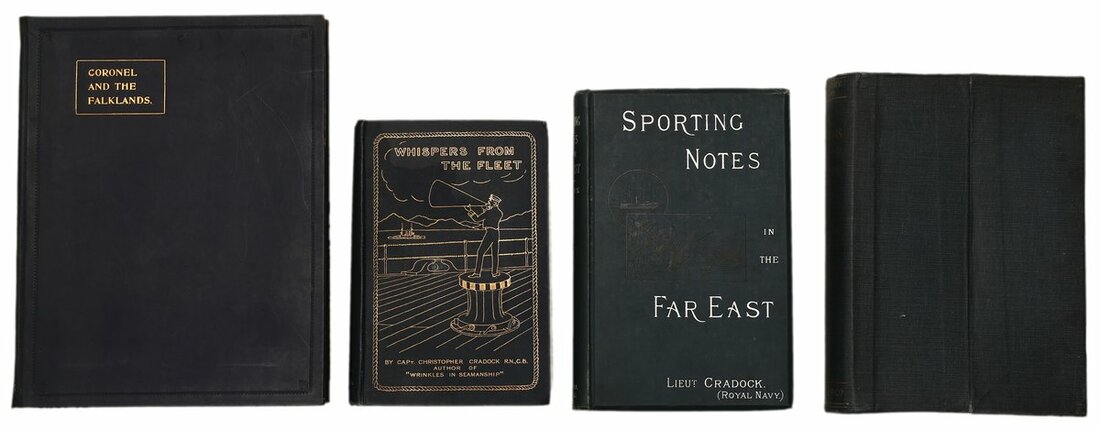
Assorted books, comprising copies of Cradock's Sporting Events in the East and Whispers from the Fleet, the latter with his presentation inscription to Lady Balnaly, dated in July 1907; a copy of Corbett's Official History of Naval Operations, Vol. I (Maps), and a leather-bound typescript of The Coronel and the Falklands from Combats, Batailles Sur Mer, 1925, as translated by Captain W. de Geijer 'For Private Circulation Only'.
(vii)
A quantity of uniform, comprising the recipient's full-dress epaulettes, gilt bullion, with Rear-Admiral's rank insignia, by Walton & Co. Limited, Gosport, a related pair of shoulder boards by the same tailor, and his gilt bullion A.D.C.'s aiguilettes.
(viii)
A wooden box with metalled lid inscription, 'Victoria', as formed from timber taken from the battleship.
(ix)
A Victorian court sword, by Hill Brothers, Old Bond Street, London.
For the recipient's dress miniatures, please see Lot 271.
Subject to 20% VAT on Buyer’s Premium. For more information please view Terms and Conditions for Buyers.
Estimate
£10,000 to £14,000
Starting price
£9500

Watch, listen and bid as if you were in the room. Now available for auctions worldwide.
Click here to bid live
An exclusive and confidential service for the discerning collector or vendor.
View the Gallery
Download every Spink catalogue on your iPad, iPod or iPhone using free Spink app.
Download From iTunes© 2026 Spink & Son. All rights reserved.