
Auction: 26002 - Orders, Decorations and Medals
Lot: 165
'I saw a line of enemy battleships on the port bow. They opened fire and almost at once we were hit by a 5-9-inch shell which struck the base of the foremast cutting it in two, blowing the galley to bits, killing two officers and five ratings and wounding a further eight ratings. For a moment, from my post at the after 4-inch gun, I thought the foremost gun had fired, then I saw the foremast swaying and realised we had been hit. All communications on the bridge were cut so we had no information until wounded began to arrive aft … '
Carnage and chaos aboard the destroyer Nessus at the battle of Jutland, as recalled by Sub. Lieutenant Eric Lees, R.N.
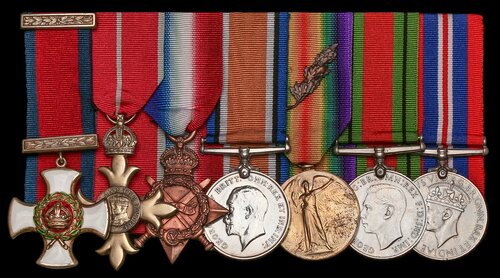
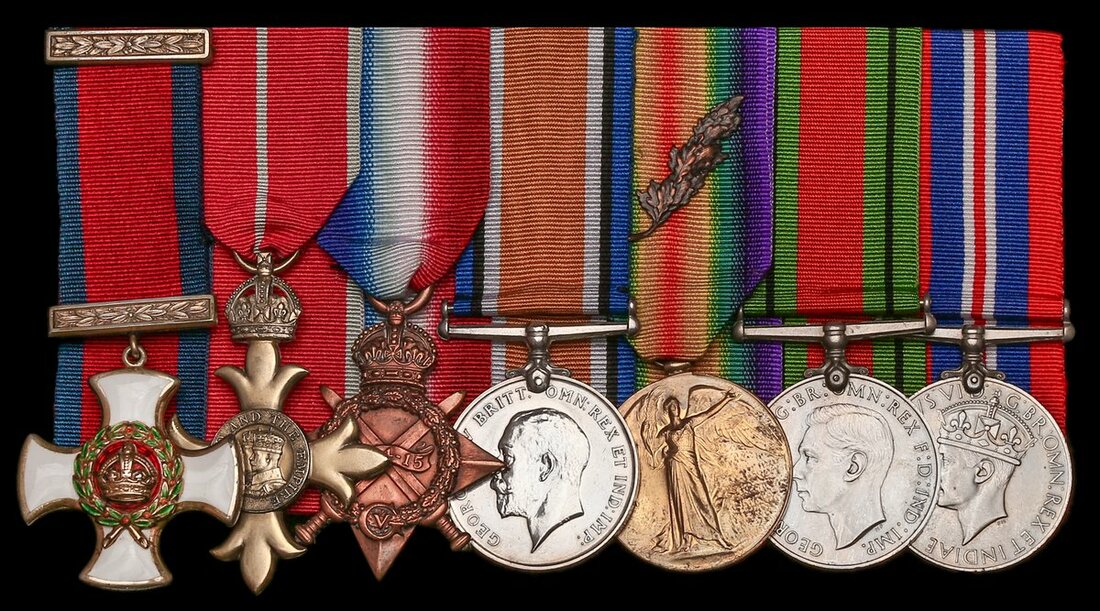
A fine Great War D.S.O., Second World War O.B.E. group of seven awarded to Captain (E.) E. C. Green, Royal Navy, who came under heavy fire in the destroyer H.M.S. Nessus at the Battle of Jutland
Described by Admiral of the Fleet Sir Dudley Pound as 'the right man in a difficult job', Green certainly lived up to expectations at Jutland, when Nessus was engaged - and severely damaged - by the enemy battleship Grosser Kerfust
Distinguished Service Order, G.V.R., silver-gilt and enamel; The Most Excellent Order of the British Empire, Military Division, Officer's (O.B.E.) breast Badge, 2nd Type, silver-gilt; 1914-15 Star (Eng. Lt. Cr. E. C. Green, R.N.); British War and Victory Medals, with M.I.D. oak leaves (Eng. Commr. E. C. Green, R.N.); Defence and War Medals 1939-45, minor enamel damage to reverse centre of the D.S.O., generally good very fine (7)
D.S.O. London Gazette 17 March 1919:
'For services in destroyers of the Grand Fleet Flotillas between 1 July and 11 November 1918.'
However, significantly, the original recommendation states only:
'For continuous good service in Grand Fleet Flotillas since the outbreak of the war, and being present at the Battle of Jutland in H.M.S. Nessus, the ship coming under heavy fire and sustaining 21 casualties.'
O.B.E. London Gazette 1 July 1941.
Edward Clarke Green was born in North Shields, Northumberland on 19 November 1878 and entered the Royal Navy as an Assistant Engineer in July 1902. Having been advanced Lieutenant-Commander (E.) by the outbreak of hostilities in August 1914, he served in the destroyers Saracen and Martial in the Dover Patrol, prior to joining another destroyer, Nessus, in August 1915. It was aboard the latter ship that he would distinguish himself at Jutland, when she made for the enemy in the 2nd Division of the 12th Destroyer Flotilla.
As related above, Nessus was subjected to heavy and accurate fire - in her case from enemy battleship Grosser Kurfust - with two of her officers and five of her ratings killed in addition to eight others wounded. The treatment of the latter proved problematic, since the ship's surgeon was among those killed. Sub. Lieutenant Eric Lees continues:
'I sent one of my gun crew to tell the doctor but he returned to say he couldn't find him and it was not until I sent a Petty Officer forward that I found out the doctor had been killed. Our two worst cases were a young Ordinary Seaman who had a piece of shell in his head, which I was quite unqualified to remove, and an Able Seaman with one shoulder completely shattered. We did our best - I was most ably assisted by our Coxswain when he was able to leave the wheel - but we were badly handicapped as we dare not give morphia at that time supplied in large bottles. Though I found the doctor's syringe, a search of his medical books failed to produce the answer to the problem of how much to give. I was afraid of giving an overdose…'
Of Nessus's original departure from Scapa Flow, and subsequent return on 2 June 1916, Lees further noted:
'When we cast off, the depot ship had their large gramophone on deck playing "We don't want to lose you, but we think you ought to go!" Three days later, when we came alongside again to repair action damage and evacuate wounded, the gramophone was again in evidence playing "We're glad your back dear lady!" '
In May 1917, Green joined the Whitley, in which capacity he was advanced to Commander (E.) in November 1918 and recommended by the Commander in Chief of the Grand Fleet for his D.S.O., a distinction that he received at a Buckingham Palace investiture held in May 1919.
Post-war he was advanced to Captain (E.) prior to being placed on the Retired List in November 1928, but he was re-employed in the following year with an appointment at the Royal Marine Barracks, Eastney, and was still serving there on the renewal of hostilities in September 1939. His subsequent award of the O.B.E., however, was for his services as Chief Mechanical Officer at the Technical Training Depot, Portsmouth Division, R.M., which insignia he received at a Buckingham Palace investiture held in November 1941.
The Captain died in Penzance, Cornwall in July 1969.
Subject to 20% VAT on Buyer’s Premium. For more information please view Terms and Conditions for Buyers.
Estimate
£1,600 to £1,800
Starting price
£1200

Watch, listen and bid as if you were in the room. Now available for auctions worldwide.
Click here to bid live
An exclusive and confidential service for the discerning collector or vendor.
View the Gallery
Download every Spink catalogue on your iPad, iPod or iPhone using free Spink app.
Download From iTunes© 2026 Spink & Son. All rights reserved.