
Auction: 26002 - Orders, Decorations and Medals
Lot: 132
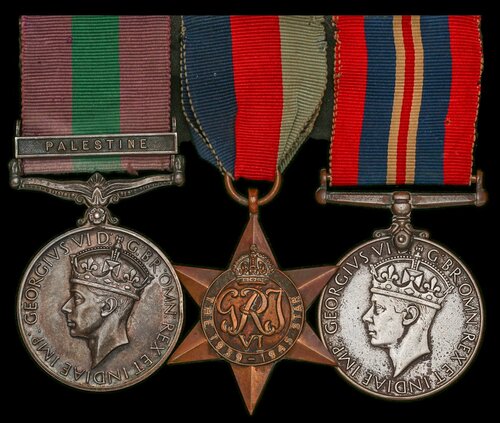
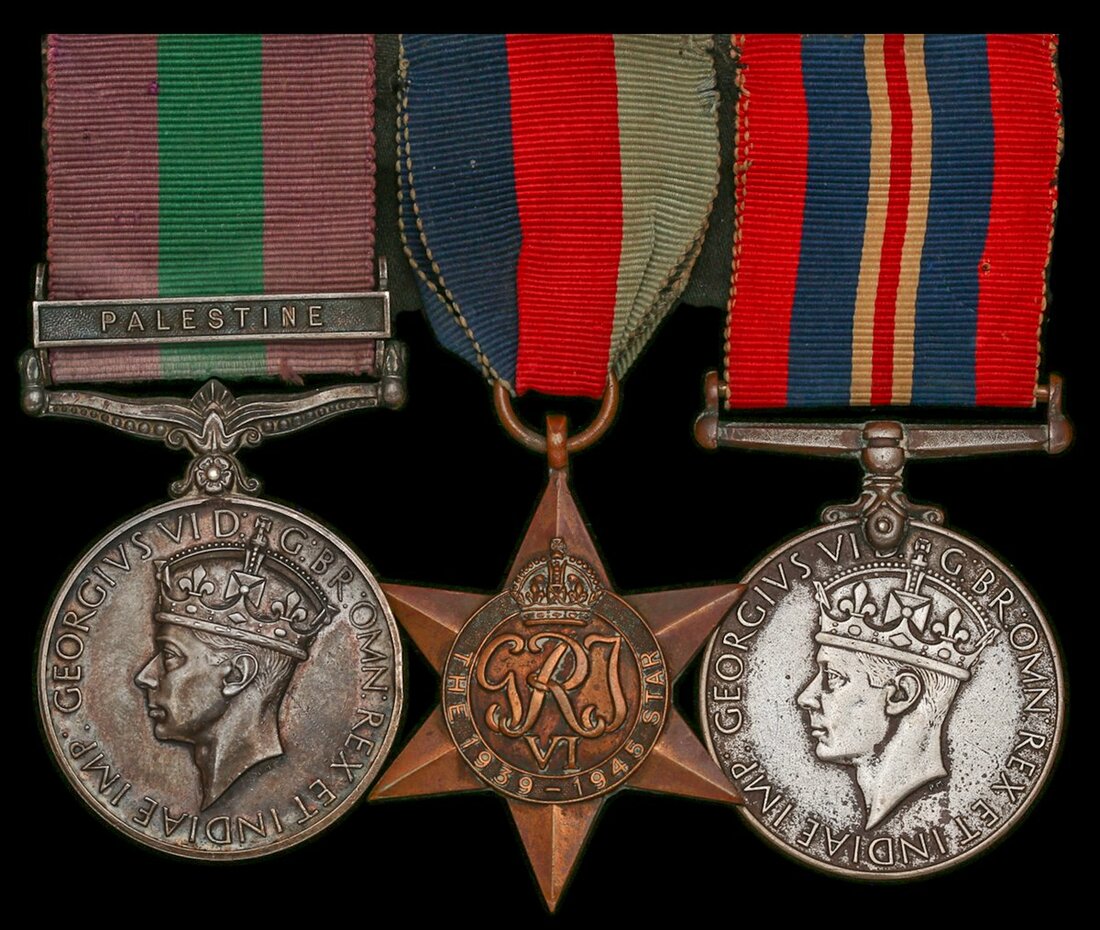
A Second World War casualty group of three to Major R. V. De. S. Walters, York and Lancaster Regiment who was killed in action in Norway on 27 April 1940 during the Battle for Kvam, giving his life with four volunteers whilst attacking a machine gun post
General Service 1918-62, 1 clasp, Palestine (Capt. R. V. De. S. Walters. Y. &. L. R.); 1939-45 Star; War Medal 1939-45, mounted for wear very fine (3)
Robert Vincent De Sausmarez Walters was born at Eastbourne on 19 July 1901 and was the son of Lieutenant Colonel Hubert De Lancy Walters, Royal Artillery, and Gwendolen Walters, of Guernsey. He was living at 1 Sloane Court, London in the 1911 census. He went to Sandhurst, joined the York and Lancaster Regiment, and later married Claire Dorothy Naunton Studdert on 26 July 1926. He was originally reported as missing on 23 April 1940 but was confirmed as killed in action on 27 April 1940 and is commemorated on the Kvam Churchyard, Norway. He is additionally commemorated on the St. Peter Port War Memorial, Guernsey.
The Battle for Kvam
The Battle for Kvam took place on 25-26 April 1940, in the Gudbrandsdal Valley in the village of Kvam in Nord-Fron Municipality in Oppland county, Norway. The battle was between British, Norwegian, and German troops. The Germans were moving rapidly north up the river valley to conquer central Norway. In the battle, soldiers from 1st Battalion, York and Lancaster Regiment and the 1st Battalion, King's Own Yorkshire Light Infantry, together with their Norwegian counterparts, held a rapidly advancing German army at bay for two days. It was one of the hardest-fought battles of the Norwegian Campaign.
On the night of 24 April 1940, the first elements of 15th Brigade landed, the battle for Central Norway had already been lost and the British were retreating in the face of the German advance up the Gudbrandsdal Valley. Major General Ruge had already informed the British commanders that his troops were completely exhausted and any lines of defense in the Gudbrandsdal Valley were near collapse.
Lt. Col. E.E.E. Cass was in command of the 1st Battalion of the K.O.Y.L.I., which made its way quickly by rail towards Kvam. They arrived at Kvam in the early morning hours of the 25th April. When they reached Kvam, they encountered Norwegian and British soldiers in full retreat from the German advance at Ringebu to the south.
In order to slow the German movement up the Gudbrandsdal valley, the retreating British and Norwegians first tried to blow up a very narrow portion of the road south of Kvam called the Kvamsporten [the gates of Kvam]. This narrow portion of the road was lined with steep rock cliffs. The demolition did little to slow the advancing Germans.
A few British aeroplanes from the airfield on the nearby lake appeared in the sky, offering encouragement of air support in the early hours of the 25 April; however, the Germans quickly destroyed the airfield, any surviving planes retreated north to safety, and British airpower was non-existent during the battle.
Upon his arrival, Brig. Gen. Smyth set up his headquarters in front of the Kvam Church. The British soldiers of 1st K.O.Y.L.I. arrived around 4:15 a.m. They quickly shed their heavy arctic clothing and, carrying only their weapons, ammunition and webbing kit, began to set up defensive positions. Lt. Col. Cass put "A" and "C" companies on the island in the Lågen river west of the road and "B" company east of the road up on the steep slopes. The British soldiers were armed with rifles and bayonets, Bren light machine guns, and two Ordnance ML 3 inch mortars. In addition to their light weapons, the British soldiers had five 25 mm Hotchkiss anti-tank guns set up at the forefront, and three in support further behind.
General Jacob Hvinden Haug had informed the British that Norwegian soldiers under his command, who had dug in south of Kvam, could hold until the evening of the 25th. Unfortunately at 7:30 a.m. on the 25th, the Norwegian soldiers moved into Kvam, carrying their wounded through the British lines. There was now nothing between the British and the advancing German army.
The advanced elements of the German forces came up the road at 11:50 am. As the Germans approached, the first up the road was a Panzer II tank, followed by a light tank and an armored car. The K.O.Y.L.I. held their fire until the Germans were within 150 yards, when they opened fire disabling the tanks and causing immediate casualties on the German infantry, who were accompanying the tanks. The Germans immediately responded with their artillery and mortars. The heavy artillery and mortar barrage caused heavy casualties for the British soldiers near the front line positions. At noon, Brigadier General Smyth was badly wounded by shrapnel from the artillery and was forced to relinquish command to Lt. Col A.L. Kent-Lemon, battalion commander of the York and Lancaster Regiment.
After a brief pause, the Germans infantry moved up the slope on the east side of the road to attack "B" company, but they were repulsed. The Germans then moved across the frozen river to attack the "A" company position on the island. "A" company had already suffered heavy losses from the artillery barrage, and was unable to stop the German offensive. By mid-afternoon, "A" company ceased to exist as an independent company, having lost 4 officers and 85 other ranks. "C" company moved forward to reinforce the line.
At 5:30 p.m., the first reinforcements arrived from the 1st York and Lancaster Regiment, which reinforced the left flank. By nightfall, company "B" on the east slope had held its position against the Germans, but its position was precarious. It decided to withdraw toward the village center of Kvam. Company "B" was reportedly in high spirits, having fought off several German attacks. In their withdrawal, the company had to abandon two of its Hotchkiss anti-tank guns.
At the end of the first day of fighting, the British had 89 casualties killed or wounded, while the Germans had 4 soldiers killed.
At 5:30 a.m. on the 26th April, the Germans commenced an intense artillery and machine gun barrage on the K.O.Y.L.I.. The Germans then commenced a series of infantry attacks against the left flank held by "C" company of the York and Lancaster Regiment. These attacks were all beaten off.
At 9:00 a.m., the Germans continued to attack the left flank of the British. This time they moved further up the steep hillside to the farmstead called Hillingen seter. Here they were met by three brave Norwegian soldiers, who though outnumbered, fought them off, losing their lives in the process. At 11:00 a.m., the Germans renewed their attack, and now had air support, as well as increased artillery, to bomb the village of Kvam. They began to have some success infiltrating the British lines. Around 1:00 p.m., the Germans brought tanks down the road toward "B" and "C" companies of the K.O.Y.L.I. in front of the village. The British had three of their 25mm Hotchkiss anti-tank guns positioned to defend the road; however, a light road block had been created across the road using tree branches. These tree branches prevented any of the anti-tanks guns from finding their targets. According to Plevy, Captain A. F. McRiggs crossed the road twice, fully exposed to machine gun fire from the German positions, to remove the debris from the road. Just as he finished, a bullet hit him in the shoulder, but one anti-tank gun could now see the tank.
Corporal Stokes of the York and Lancaster Regiment was in command of the third Hotchkiss gun beside the road at the back of the village. He could now see the tank and with his first shot he stopped the tank. His second shot set it on fire and left it at the side of the road. Moments later a second tank came up the road. Stokes waited until it was immediately beside the first tank, and he destroyed it with two shots in exactly the same way he stopped the first. Then the Germans sent an armored car rapidly down the road, and when it came between the two tanks, Corporal Stokes knocked it out with one shot. The three disabled vehicles now blocked the road. Corporal Stokes realized that his Hotchkiss gun was about to become a prime target, so he pulled his crew away from the position just before the Germans destroyed it. Stokes and his crew now became infantrymen.
Around 4:00 p.m., the British were in danger of being flanked on the left, but a company from the York and Lancaster battalion managed to hold them off. Then a company of 40 Norwegian skiers came down from high on the slopes above the battle. These Norwegian ski troops under the command of Paul Jørgenvåg opened fire on the Germans from a long distance up on the valley side. Although the fire had little effect from that distance, the Germans were forced to retreat because of their exposed position. Unfortunately the situation was deteriorating and at 5:00 p.m., General Paget issued orders for Kvam to be abandoned at 11:00 p.m. and the companies were to retreat behind new positions at Kjørem approximately 4–5 km further north, where companies from the York and Lancaster Regiment and the Green Howards had set up a new defensive position. At 6:00 p.m., the Germans gained full control of the island in the Lågen. German artillery began to fire phosphorus shells into the forests where several British companies were in position, and the resulting forest fires forced the British to escape. Still the British held until ordered to retreat by General Paget. The battle in Kvam on 25 and 26 April 1940 was the hardest in southern and central Norway. 1st Battalion K.O.Y.L.I. and 1st Battalion York and Lancaster had 54 soldiers killed. In addition, three Norwegian soldiers and three Norwegian civilians were killed in Kvam. The retreating British fought another delaying action at Kjørem on 27 April, and another at Otta on 28 April. After this action, fought mainly by the 1st Green Howards, the British were able to break contact with the Germans. "Sickleforce" was evacuated from Aandalsnes by 31 April.
Subject to 20% VAT on Buyer’s Premium. For more information please view Terms and Conditions for Buyers.
Estimate
£500 to £700
Starting price
£400

Watch, listen and bid as if you were in the room. Now available for auctions worldwide.
Click here to bid live
An exclusive and confidential service for the discerning collector or vendor.
View the Gallery
Download every Spink catalogue on your iPad, iPod or iPhone using free Spink app.
Download From iTunes© 2026 Spink & Son. All rights reserved.