
Auction: 26002 - Orders, Decorations and Medals
Lot: 131
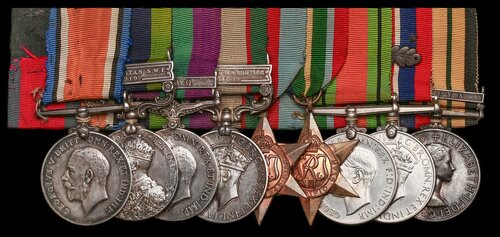
The outstanding campaign group of nine awarded to Lieutenant-Colonel J. H. D. Parkin, Indian Army, who was awarded a D.S.O. for his action at Barrier Ridge in Waziristan on 29 October 1939 and who was awarded a Bar to the D.S.O. for his actions north of Kluang, Malaya, on 25 January 1942, before being captured at the fall of Singapore on 15 February 1942
British War Medal 1914-20 (Lieut. J. H. D. Parkin.); India General Service 1908-35, 1 clasp, Afghanistan N.W.F. 1919 (Lt. J. H. D. Parkin, 1/12/Pionrs.); General Service 1918-62, 1 clasp, Iraq (Lieut. J. H. D. Parkin.); India General Service 1936-39, 1 clasp, North West Frontier 1937-39 (Maj. J. H. D. Parkin, 5-11 Sikh R); 1939-45 Star; Pacific Star; Defence and War Medals with M.I.D. oak leaf; Africa General Service 1902-56, 1 clasp, Kenya (J. H. D. Parkin. D.S.O.), court mounted as worn, very fine overall (9)
[D.S.O.] London Gazette 12 January 1940.
'Major J. H. D. PARKIN was in command of two Companies which occupied BARRIER RIDGE by 0600 hrs on the 29th October 1939. The enemy were engaged at about 0630 hrs and by 0820 hrs three piquets on the South end of the Barrier were very heavily engaged by parties of enemy that had crept up close to them under cover of some very thick bushes near them. Major PARKIN continually visited these piquets. By doing so he was able to co-ordinate supporting fire and organise an attack on a party of enemy which was threatening one of the piquets. This restored an ugly situation. His strong and determined leadership was entirely responsible for inflicting heavy casualties on the enemy, restoring the situation, avoiding delay, and thus enabling the two companies to be withdrawn without being followed up and suffering further loss. Major PARKIN was wounded in the withdrawal and remained with his command until it was all behind the RED FLAG. His devotion to duty, gallantry, leadership and complete disregard for his own safety throughout the action were most conspicuous.'
[Bar to the D.S.O.] London Gazette 13 December 1945.
'Throughout the campaign, Lt. Col. PARKIN has displayed magnificent qualities as a commander. His enthusiasm and dauntless spirit infused his Bn with the fine offensive spirit. It was his sound tactical sense, courageous determination, and skilful leadership which was responsible for the highly successful action north of KLUANG on the 25th January 42. On this occasion, his Bn with a Field Battery under command, whilst carrying out a wide outflanking movement of ten miles to regain possession of an approach to the KLUANG Aerodrome, became surrounded by superior enemy forces. Lt. Col. PARKIN so organised an attack that he inflicted very severe casualties on the enemy (150 enemy dead were counted on the ground) and forced the enemy to withdraw in disorder. Later, during the withdrawal of the 22nd Indian Infantry Brigade of the south of RENGAN he displayed similar initiative and on two occasions his troops attacked successfully, though his men had no food for over 48 hours and but little or no rest.'
M.I.D. London Gazette 25 October 1940.
John Henry Devereux Parkin was born at Kendal, Westmorland on 22 April 1898. He was educated at Wellington Cadet College (India) from 1 January 1917 and became a Second Lieutenant on the Unattached List on 18 June 1917. He joined the Indian Army on 24 June, serving with the 1/12th Pioneers, he was promoted to Lieutenant on 18 June 1918. He served on the campaign in Afghanistan between 5 May 1919 and September 1919 as Quartermaster and then went on to serve as a Company Commander during the Mesopotamia Insurrection, seeing action at Hillah, Museyib and Khan Nachta. He was promoted to Captain on 18 June 1921 and completed his time with this unit on 22 May 1922 when he transferred to the 2nd Bombay Pioneers on 23 May 1922. Parkin was awarded a single British War Medal for his Great War service.
He transferred to the 5/11th Sikh Regiment on 1 March 1929, becoming Company Commander on 1 April 1931, and then served as an Instructor (Class B) at the Indian Military Academy between 9 August 1934 and 3 August 1937; during that time was promoted to Major on 18 June 1935. He returned to the 5/11th Sikh Regiment on 4 August 1937 and became Company Commander once again. He then served in Waziristan from 8 April 1939 on the Razcol (Razmak Moveable Column) operations.
His was a strong, all-arms brigade-level force used by the British Indian Army to patrol the North-West Frontier. In October 1939, it was actively engaged in operations against Pashtun tribesmen led by the Faqir of Ipi. He was awarded his first D.S.O. for his action on the 29 October 1939, his papers note he was wounded in the right thigh while on the column with the Razcol on the same day and was taken to the Combined Indian Military Hospital at Ramzak. Parkin completed his time on these operations on 6 October 1940.
With the possibility of conflict in the Far East Parkin left Secunderabad on 7 April 1941, embarked at Madras on 9 April 1941 and disembarked at Malaya on 16 April 1941. He was promoted Acting Lieutenant Colonel on 9 May 1941 and exactly three months later to Temporary Lieutenant Colonel on 9 August. Parkin was involved in the major action at Kluang which was a strategic town in Johor, Malaya and was a critical point during the Japanese invasion. Serving as an important base with its own aerodrome, the area endured frequent Japanese bombing and strafing raids before Japanese forces seized control and General Tomoyuki Yamashita established his headquarters there at the end of the month. Among the Indian units that fought in Malaya, the 5/11th Sikh Regiment was engaged on the eastern coast of the peninsula, at Kuantan, and later on the right flank of the Australian 8th Division. They fought with considerable effectiveness in places: at Kluang, in Johore, according to the testimony of Subedar Gulzara Singh of the regiment, the Sikhs killed 300 Japanese soldiers and blew up their heavy guns. Nonetheless, they were outflanked, and strategic necessity compelled repeated. Parkin was one of those who was taken prisoner of war at Singapore on 15 February 1942 and during his time was made Substantive Lieutenant Colonel on 18 June 1943.
His papers note he was 'Recovered from Jap hands' on 15 August 1945 and was struck off from duty from the 11th Sikhs on 8 May 1946 and retired from the Indian Army on 9 May 1947 and moved out to Kenya where he served as part of the Kenya Police and Reserve during the Mau Mau uprising. Parkin subsequently moved to South Africa and became a farmer, he died at East London, South Africa on 15 June 1966.
Sold with photocopied service papers and minor research.
Subject to 20% VAT on Buyer’s Premium. For more information please view Terms and Conditions for Buyers.
Estimate
£1,800 to £2,200
Starting price
£1400

Watch, listen and bid as if you were in the room. Now available for auctions worldwide.
Click here to bid live
An exclusive and confidential service for the discerning collector or vendor.
View the Gallery
Download every Spink catalogue on your iPad, iPod or iPhone using free Spink app.
Download From iTunes© 2026 Spink & Son. All rights reserved.