Auction: 26002 - Orders, Decorations and Medals
Lot: 113
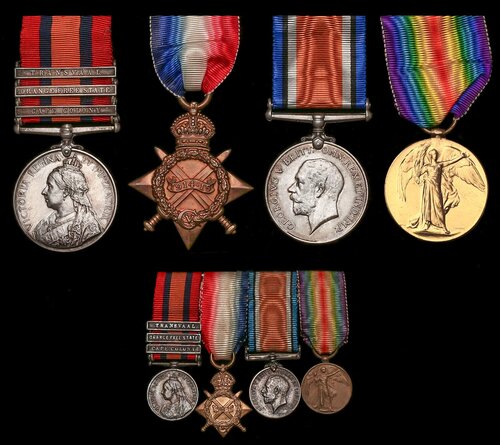
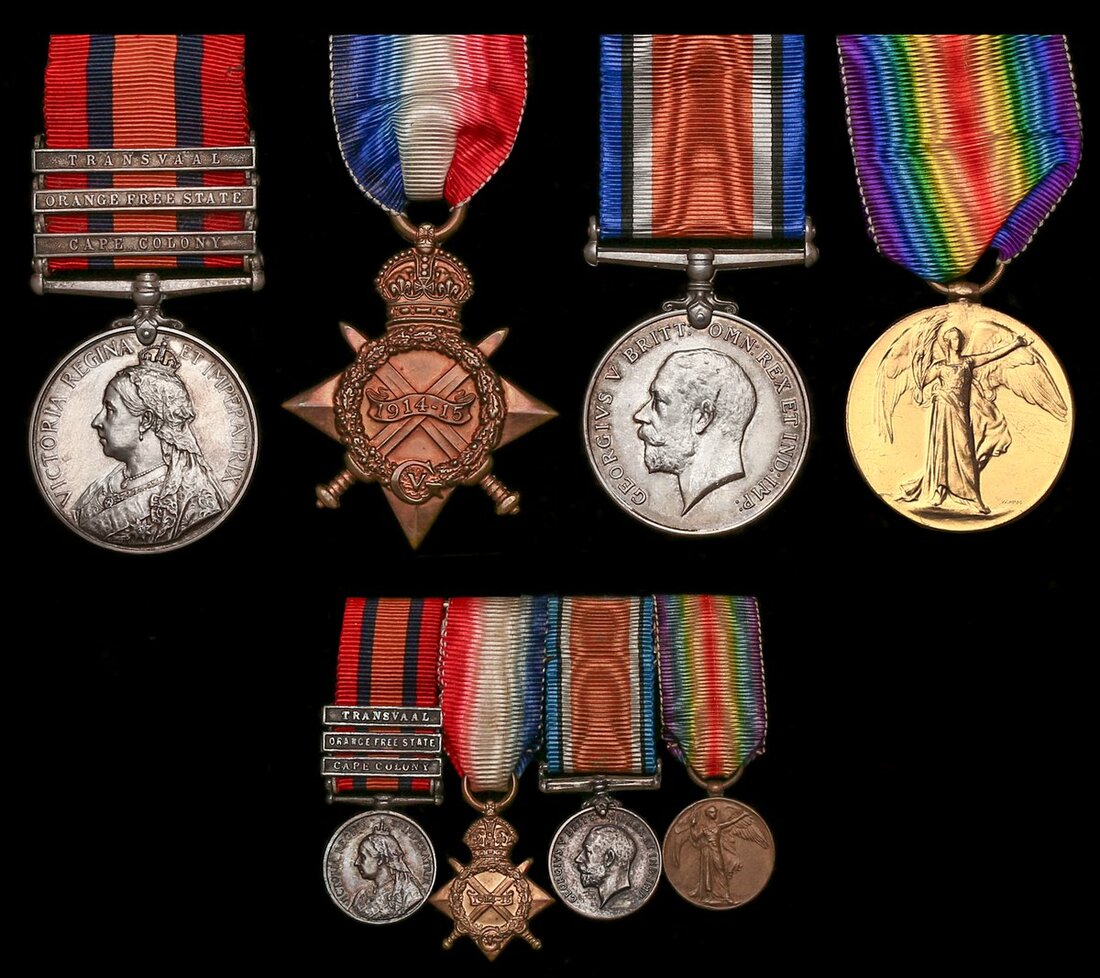
Four: Captain E. Emrys-Roberts, Royal Army Medical Corps, late Welsh Hospital, who before and after the Great War was the first Professor of Pathology and Bacteriology at the University of Wales
Queen's South Africa 1899-1902, 3 clasps, Cape Colony, Orange Free State, Transvaal (Drsr: E. Roberts. Welsh Hospital); 1914-15 Star (Capt. E. Emrys-Roberts R.A.M.C.); British War and Victory Medals (Capt. E. Emrys-Roberts), the first mounted as worn, good very fine (4)
Edward Emrys-Roberts was the son of E. S. Roberts and Mary Emrys Evans and was born on 14 May 1878. He was educated at Liverpool College and entered University College, Liverpool as a medical student. However his studies were interrupted and he joined the Welsh Hospital serving with the South African Field Force in 1900 as a Dresser. The hospital arrived at Cape Town on 3 May 1900 and was set up at Springfontein on 31 May 1900, it moved to Bloemfontein and then on to Pretoria in July 1900, most of the staff returned to Wales in October 1900.
Upon returning home Emrys-Roberts completed his studies and took the diplomas of M.B., B.Ch.Vict (1902). He held a research scholarship in gynaecological pathology in the University of Liverpool between 1903-06. He graduated M.B., B.Ch. Liverpool in 1904 and M.D. in 1908. He held for a time the appointment of sub-curator of the Pathological Museum, Liverpool, and in 1906 was appointed demonstrator of pathology in the University of Bristol and pathologist to the Bristol General Hospital. In Bristol he rapidly showed that he was one of the coming pathologists in this county, and it soon became obvious that his promotion to a professional chair was certain. In 1910 he was appointed first professor of pathology in the University of Wales, and held this post until his death.
With the outbreak of the Great War he was appointed to be officer in command of the Welsh Mobile Pathological Laboratory. Sir William Leishman was asked to organise and send to France a mobile bacteriological laboratory. He found that Professor C. J. Martin, Director of the Lister Institute, and his colleague Mr Sydney Rowland, were preparing a mobile laboratory for plague work - this was immediately diverted to France where it arrived on October 12th, and went forward to St.Omer; it was the original of the mobile laboratories which subsequently became recognized as field units. The idea of providing the Welsh Army Corps with such a laboratory originated towards the end of 1914. The sanction of the War Office was obtained, and in early January it was announced that Lady Lynn-Thomas would defray the cost, estimated at between £1200 and £1500. The laboratory was handed over to the Welsh Corps on 17 March 1915. It had been fitted up by Professor Emrys-Roberts, who went with it as officer in command (His M.I.C. notes that he entered the war in France on 2 December 1915).
The equipment of these laboratories was so designed as to make them completely independent; autoclaves, steam sterilisers, incubators, centrifuges, and all customary apparatus were provided. Sir William Leishman, who as pathological adviser to the Expeditionary Force had the best opportunities of judging, has said that they answered their purpose admirably, as was abundantly proved by the character and volume of work performed in them. Altogether during the war twenty five mobile bacteriological laboratories were supplied to armies overseas, eighteen in France and three in Egypt, all motor laboratories, and four "pack" laboratories (three in Salonica and one in East Africa).
The laboratory directed by Emrys-Roberts served chiefly with the First Army in France and continued its work until the end of the war in 1918. During the German advance in that year there were some exciting experiences; the mobile laboratories attached to the armies involved got away in a few hours and Sir William Leishman quoted 'without the loss of a test tube, and, indeed, in some cases were able to salve some portions of the equipment of casualty clearing stations which had been abandoned.... Not only did they get away promtly when the orders came, but in a very few hours after reaching the place to which they had been directed, they were open again and doing useful and important work. Again, on the final advance the mobile laboratories were able to keep well in touch with the advanced medical units, and give all the help in the treatment of wounded and the diagnosis of infectious disease which they had been accustomed to furnish during the period of trench warfare.'
Emrys-Roberts wrote various papers including articles to the Journal of Pathology and Bacteriology and to the Journal of the Royal Army Medical Corps. He died on 18 January 1924 and is buried in Penarth Cemetery, South Wales; sold together with his corresponding miniature dress medals, these mounted as worn, and with assorted photocopied research.
Subject to 20% VAT on Buyer’s Premium. For more information please view Terms and Conditions for Buyers.
Estimate
£400 to £500
Starting price
£400
Watch, listen and bid as if you were in the room. Now available for auctions worldwide.
Click here to bid live
An exclusive and confidential service for the discerning collector or vendor.
View the Gallery
Download every Spink catalogue on your iPad, iPod or iPhone using free Spink app.
Download From iTunes© 2026 Spink & Son. All rights reserved.