Auction: 26002 - Orders, Decorations and Medals
Lot: 111
Sold by Order of a Direct Descendant
'It seems months instead of only a few days since our charge, which I still can hardly realise. How we four squadron leaders got through, and the CO, will always seem to me an extraordinary feat of good luck, or I should say a kind of providence…
We had gone out on the left near the river, and had several small encounters with their infantry. We were keen to make some mark in history in this our first campaign, and when we got the, to us, memorable message - 'Annoy them and if possible cut off their retreat from Omdurman. SIRDAR' - off we went in the direction of what we thought were a few of their infantry.
We wheeled into line to the right and galloped, when I at once saw lumps of them concealed in a nullah within 100 yards of us, and by that time bullets flew by in hundreds. I turned round to my squadron and said, 'Now, men, get your lances down', and off I galloped as hard as I could split, and strange to say I got through them with nothing worse than a blow on the head, which only crushed my helmet, and a sword cut, slight, on my horse's quarters.
Not so my poor squadron, which suffered more than any of the others. I had 11 killed and 13 wounded out of the total casualties. When I got through I saw Nesham being run away with, and smothered in blood, and so weak he could hardly sit on his horse. I gave my sword to my trumpeter and went after him, but he fell off from exhaustion and loss of blood before I could catch him, his left hand nearly severed and a bad gash on his leg. I sent him to the rear as soon as I could, and then rushed back to my squadron. I then met a man whom I could not recognise, as his nose was cut off and his face covered with blood. He was one of my sergeants, and having rallied his troop as far as he was able, rode up to me sitting at attention and asked if he might fall out and get his nose put on. After the rally we again attacked the enemy with dismounted fire, and finally drove them on to their own main body, where they were nicely caught by our infantry advancing.
We then collected all the dead and laid them in a row, and proceeding in the direction of Omdurman, kept heading off the retreating army from the river and Omdurman. So we carried out to the letter the Sirdar's orders'.
Captain Frank Eadon writes to his father shortly after that famous charge against the Dervish warriors in the aftermath of the Battle of Omdurman
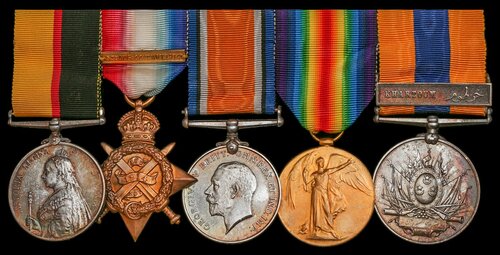
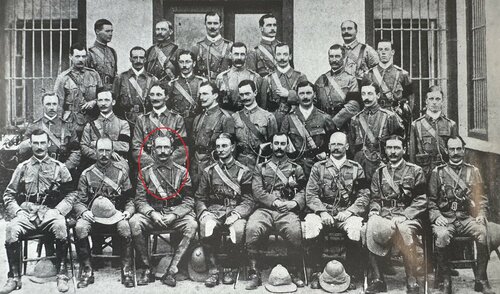
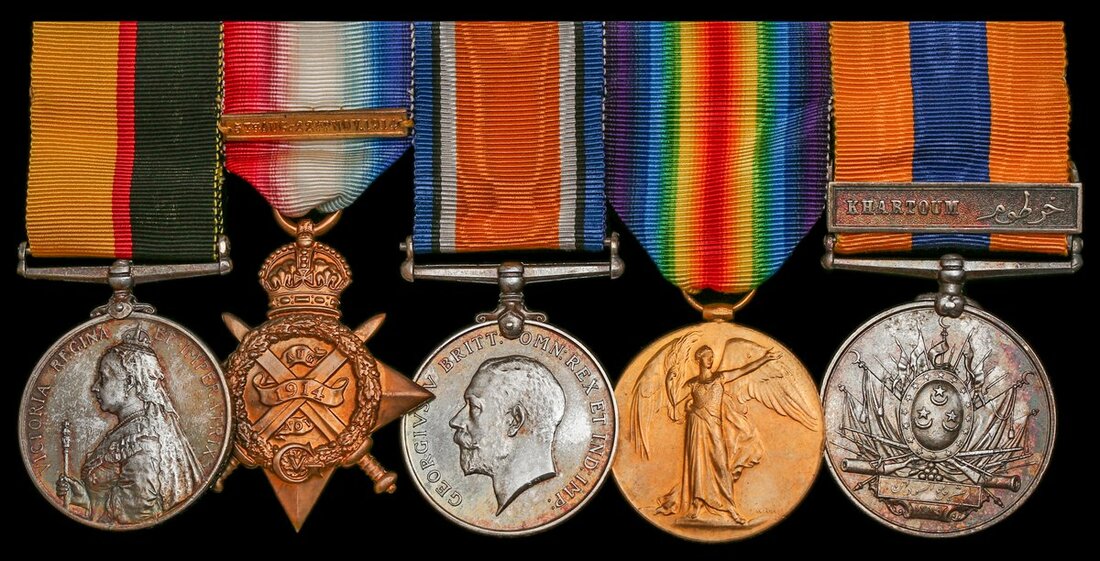
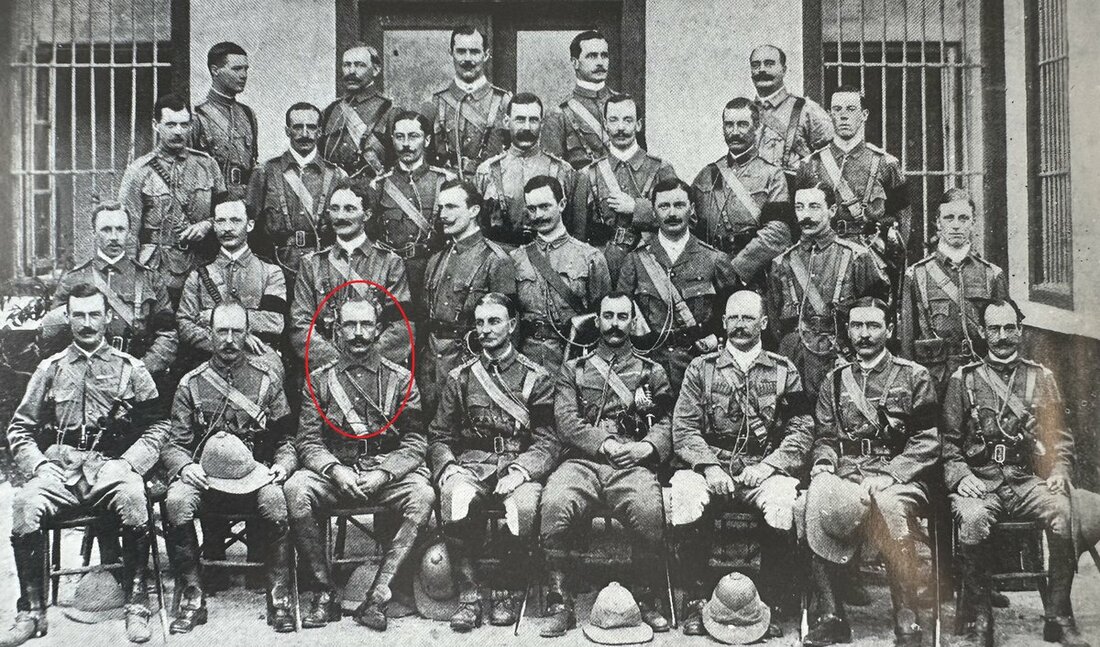
The rare and historically important Sudan and Great War campaign group of five awarded to Lieutenant-Colonel F. H. Eadon, 21st (Empress of India's) Lancers who commanded 'D' Squadron during the campaign in which they carved their name into history for performing a full cavalry charge against overwhelming odds; as Eadon notes above, 'D' Squadron suffered the heaviest casualties from those which threw themselves into the attack. Lucky to survive the ordeal, another officer who participated in the charge that day was none other than Lieutenant Winston Spencer Churchill
Queen's Sudan 1896-98 (Capt: F. H. Eadon. 21/Lancers.); 1914 Star, clasp (Major F. H. Eadon); British War and Victory Medals (Major F. H. Eadon); Khedive's Sudan 1896-1908, 1 clasp, Khartoum, unnamed as issued, mounted as worn by Spink & Son Ltd., 5 King St. S.W.1, minor contact marks to obverse field on first, otherwise good very fine (5)
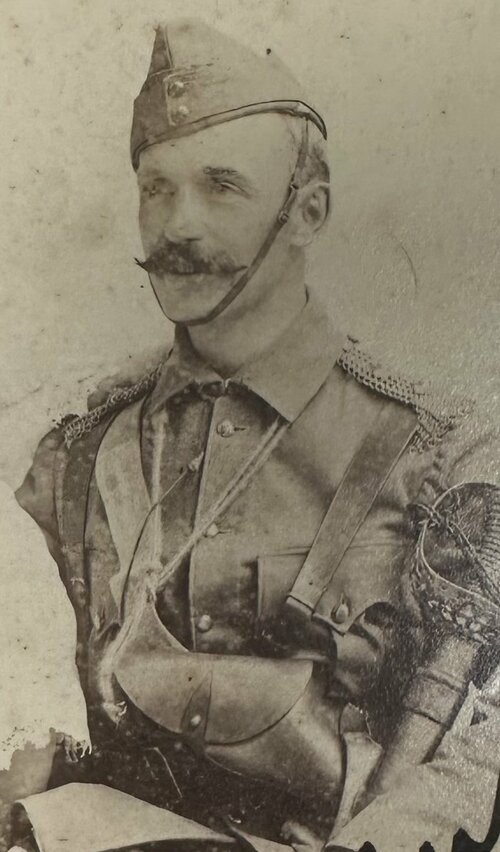
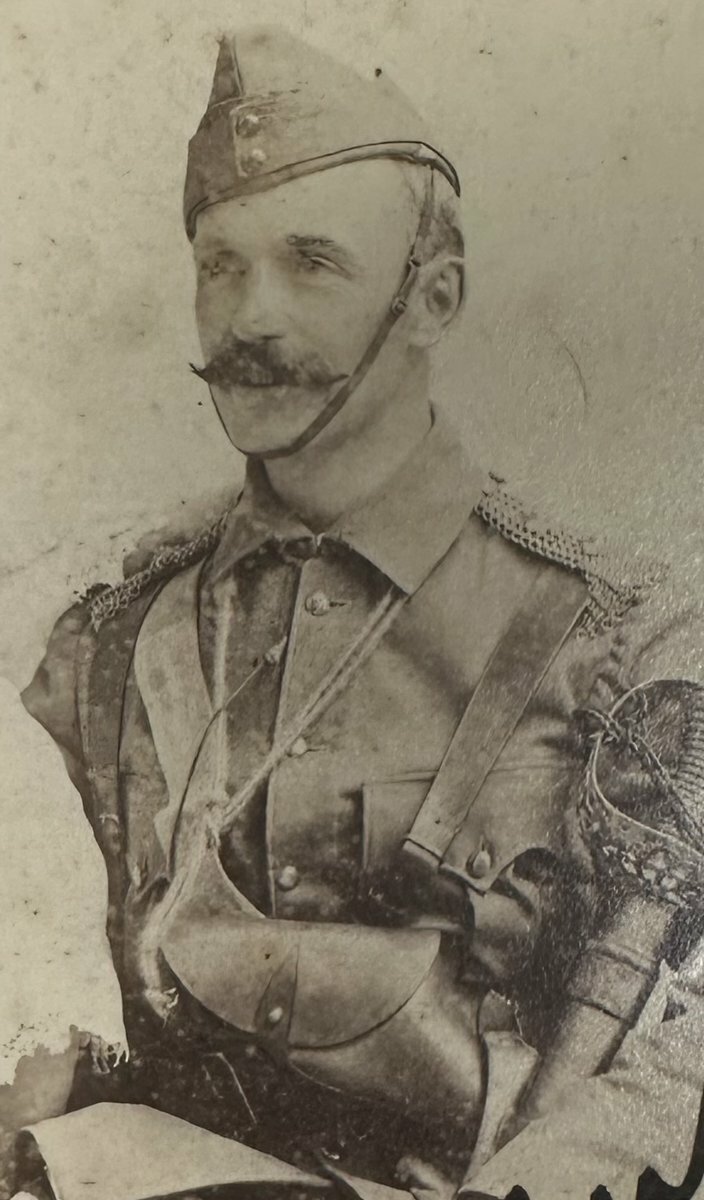
Frank Henry Eadon was born in 1861 at Snaith, Yorkshire. Initially commissioned into his father's old regiment (then the 3rd Battalion, York & Lancaster Regiment), in 1884 young Lieutenant Eadon transferred into the cavalry, joining what was then the 21st Hussars. (London Gazette, 29 January 1884, p. 432 refers).
Despite their lack of combat experience the Commanding Officer, Colonel Martin, trained his men hard for the perils of desert warfare which included manoeuvring squadrons at speed, training over 300 Arab horses, turning out "on alarm" with campaign equipment and desert rations in less than one hour, and route marches through the desert; the 21st also received notification that eight new officers were to be attached to them for the upcoming campaign and one of that number, who was already gaining an initially chequered reputation - was a Lieutenant Winston Spencer Churchill of the 4th Hussars.
The only British cavalry regiment in Kitchener's force, the regiment rode with the Sirdar's army in the direction of Omdurman, on the banks of the river Nile, where they initially undertook the traditional light cavalry role of scouting ahead of the main force; at the battle of Omdurman, on the morning of 2 September, Kitchener's infantry and artillery cut the attacking Dervishes to pieces - in 30 minutes the Khalifa's army lost 2,000 dead and 4,000 wounded for less than 60 British and Egyptian casualties. The 21st Lancers had been mere spectators, but their moment of glory was soon to come.
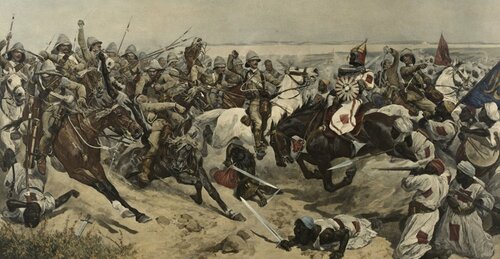
At 7.30am, the regiment were sent out on reconnaissance towards Omdurman itself, to check the route Kitchener intended to take with his army; small patrols were sent out and that under the command of Lieutenant Pirie encountered a Dervish force, estimated at 1,000 strong, blocking the main road. Reporting back to Colonel Martin, the Commanding Officer decided now was the time to strike and ordered the regiment into the trot: Captain Doyne and 'C' Squadron were at the head of the column, followed by Eadon's 'D', with Major Fowle's 'B' and Major Finn's 'A' riding behind them in that order. Coming under fire as they passed the Mahdist line, the 21st they swung from column of Troops into line, and prepared to charge. There are multiple accounts of what happened next:
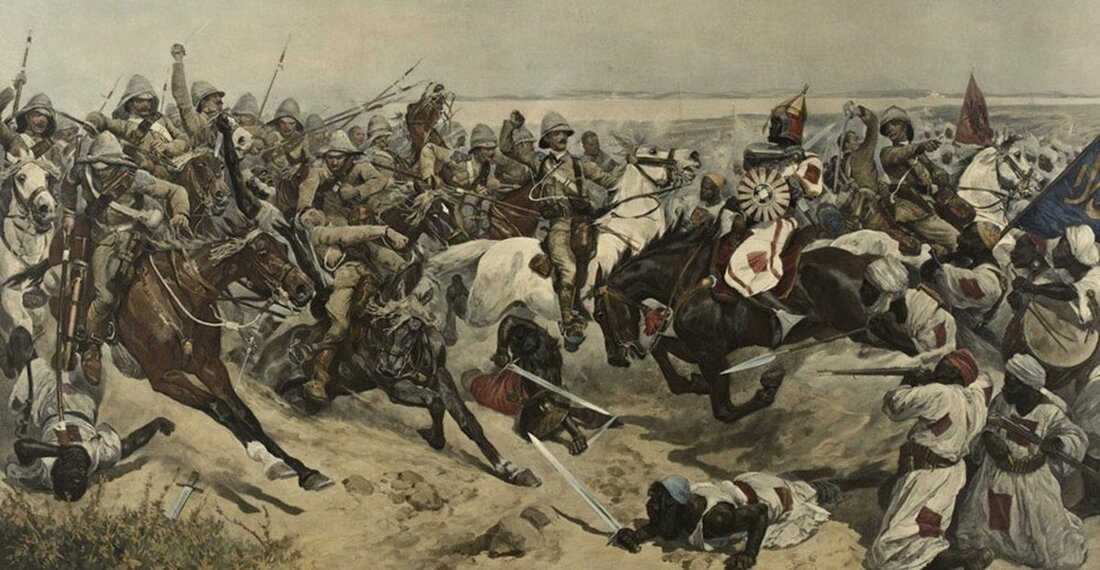
'The whole regiment - all sixteen troops - turned neatly to face the knot of Beja on the ridge three hundred yards away. Martin spurred his horse on and led his men from the centre, thirty yards in front. Looking back, he saw his massed ranks of horsemen, helmets cocked across their eyes, lance-tips and sabres gleaming, leap forward at the gallop, into what would be the last regimental cavalry charge in British military history'. (Khartoum: The Ultimate Imperial Adventure, Michael Asher, refers).
It was at this point as the line connected with the tribesmen that the full dire nature of their position became clear. A much larger force of Dervish infantry, some 2,000 spearmen, were positioned in a hidden watercourse behind the thinly populated skirmish line:
'The pace was fast and the distance short. Yet, before it was half covered, the whole aspect of the affair changed. A deep crease in the ground - a dry watercourse, a khor - appeared where all had seemed smooth, level plain; and from it there sprang, with the suddenness of a pantomime effect and a high pitched yell, a dense white mass of men nearly as long as our front and about twelve deep. A score of horsemen and a dozen bright flags rose as if by magic from the earth. Eager warriors sprang forward to anticipate the shock. The rest stood firm to meet it. The Lancers acknowledged the apparition only by an increase of pace. Each man wanted sufficient momentum to drive through such a solid line. The flank troops, seeing that they overlapped, curved inwards like the horns of the moon. But the whole event was a matter of seconds.' (The River War, Winston Churchill, refers)
The sudden appearance of the enemy did not cause the lancers to withdraw and instead they pressed on into the enemy ranks. Eadon himself later wrote in his diary of that day:
'...Meanwhile we were advancing on the left along river and constantly in collision with small parties of enemy infantry who were well hidden in rocks and annoying us a good deal. We held them for some time and then got order from Sirdar to annoy enemy as much as possible, drive them from the river and prevent them retiring on to Omdurman. We immediately advanced in column of troops from left and saw some 20 enemy infantry on our then right flank with more of them in a depression closer still. We wheeled into line to the right and then discovered about 1500 enemy infantry and spearmen hidden in this depression or Khor 100 yards in front of us. We were committed to the attack and had to go. I with 4th Squadron was No 2, C Squadron left, A right, B No 3. Bullets in meantime thick over our heads, bad shooting. We galloped through as fast as the bad ground would allow. My Squadron got the brunt of it and we simply galloped through, a thick mass of spearmen and rifle men who did terrible work as the ground was so impossible that we could not advance in any formation nor sufficient pace to get our lances well home. When I got through, which was an extraordinary feat of luck, I saw Nesham my right troop leader about 100 yards in front of me covered with blood and being run away with and reeling in his saddle. I gave my sword to my Trumpeter and chased him, but he fell from his horse before I could reach him and I was very glad to see him get up on his hind legs. I saw he had been badly cut about and I handed him over to some men and sent him to the rear. All this time I was busy trying to collect my Squadron which seemed to have scattered in all directions. We eventually reformed the regiment and went towards the river, dismounted half the regiment and used our carbines on the enemy which had rallied in the nullah. They were continually firing at us but no result. We eventually drove them out of the Khor on to their retreating main body where they had a hot reception from our infantry and guns. Halted some time to pick up dead. Grenfell killed. Nesham, Pirie, Brinton, Molyneaux wounded. Total casualties between 69 and 70 of whom 21 killed. In my Squadron alone were 11 killed and 24 wounded. An enormous percentage.' Eadon's bravery and leadership - along with that of nine further officers and three other-ranks of the 21st - was officially recognised in Lord Kitchener's Despatch of 5 September 1898 (London Gazette, 30 September 1898, p. 5729 refers). As further reward he was advanced Brevet Major, which again was noted in the London Gazette of 15 November the same year; he was promoted Major a year later, still in the 21st Lancers, upon the promotion of another Major to Lieutenant-Colonel (London Gazette, 19 December 1899, p. 8467, refers).
In addition to multiple books concerning Kitchener's campaign and the part the 21st Lancers played in the aftermath of Omdurman (not to mention numerous paintings) the charge has also been superbly depicted on the 'big screen', featuring in Richard Attenborough's 1972 star-studded major motion picture 'Young Winston'.
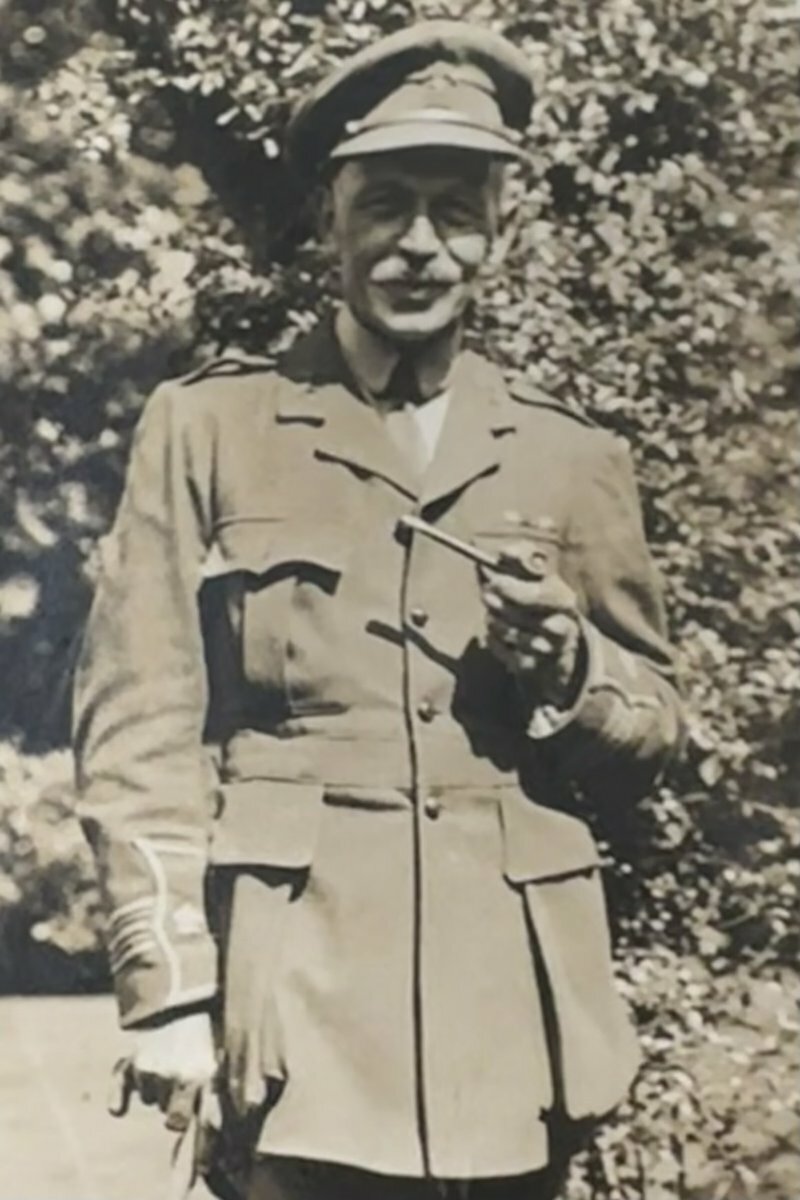
Recalled to the Colours for service during the Great War, Eadon's significant military experience and excellent knowledge of horses and horsemanship saw him swiftly deployed to France with the British Expeditionary Force. Landing on 29 September 1914, whilst nominally still with his old regiment the 21st Lancers spent the entirety of the conflict in India - Eadon was therefore seconded to the Remount Service (as noted on his M.I.C.), firstly as a Major before being advanced Brevet Lieutenant-Colonel.
The good Lieutenant-Colonel died in 1935 at Ashford, Kent.
Sold together with the following original archive, comprising:
(i)
The recipient's Great War miniatures and original tunic ribands for the Queen's Sudan, Khedive's Sudan, and 1914 Star, together with a 21st Lancers officer's Collar Badge.
(ii)
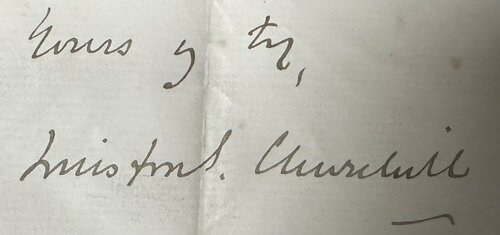
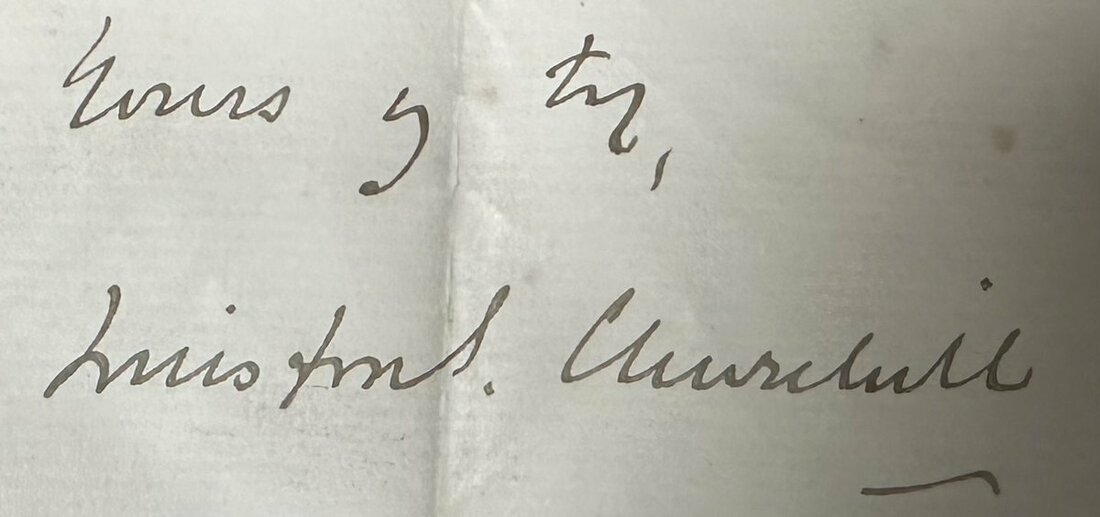
A piece of torn-off notepaper, bearing a handwritten note in ink stating: Yours vy. try., Winston S. Churchill, the outer envelope inscribed: 'Churchill's autograph as a subaltern'.
(iii)
A full two-page handwritten letter, in ink, dated 25 July 1904 and addressed from Horse Guards, Whitehall, from Robert Baden-Powell to 'Major F. H. Eadon, 21st Lancers', regarding the training of Instructors for cavalry regiments and the care of horses.
(iv)
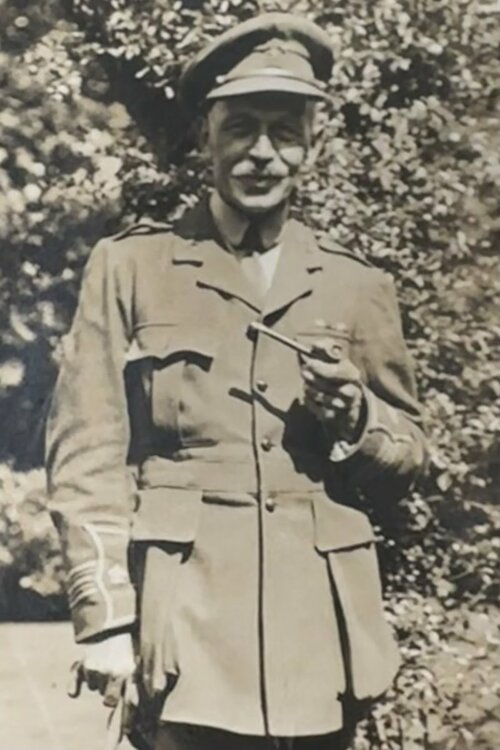
Three black-and-white photographs of the recipient, all in uniform: one contemporary to the time of the famous cavalry charge, two circa 1914-18, one of these contained in a silver case alongside a photograph of his wife, engraved to the front: F. H. E. / 10 - 3 - 1892 / 10 - 3 - 1917 / C. F. E.
(v)
A menu card for a Regimental Dinner of the 17th - 21st Lancers, dated 2 June 1927 and held at the Savoy Hotel; together with a full transcription of the recipient's Sudan-period diary (an extract of which is quoted above), which was donated by his family to the Queen's Royal Lancers Regimental Museum in 1997. It is worthy of note that the National Army Museum, Chelsea, holds both papers and photographs associated with Eadon; these also almost certainly donated by his family.
Subject to 20% VAT on Buyer’s Premium. For more information please view Terms and Conditions for Buyers.
Estimate
£10,000 to £15,000
Starting price
£8000
Watch, listen and bid as if you were in the room. Now available for auctions worldwide.
Click here to bid live
An exclusive and confidential service for the discerning collector or vendor.
View the Gallery
Download every Spink catalogue on your iPad, iPod or iPhone using free Spink app.
Download From iTunes© 2026 Spink & Son. All rights reserved.