
Auction: 25113 - Orders, Decorations and Medals - e-Auction
Lot: 300
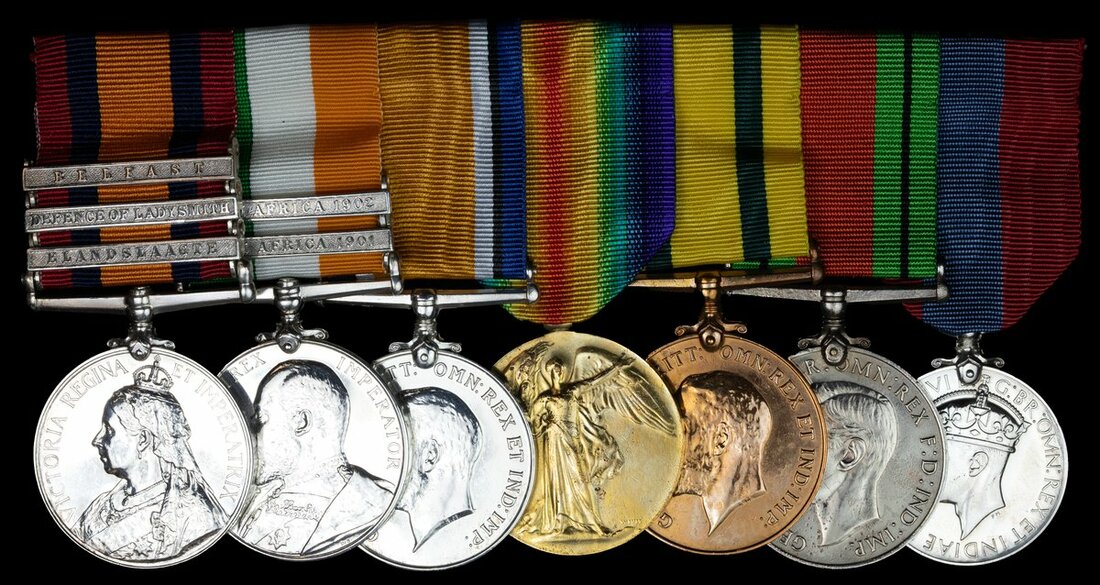
Seven: Serjeant W. E. Tidball, Devonshire Regiment
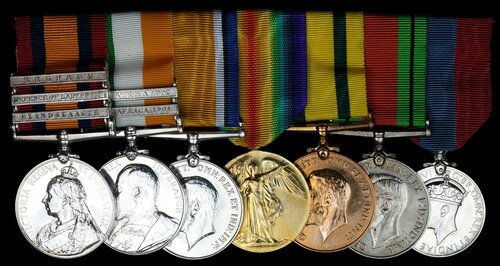
Queen's South Africa 1899-1902, 3 clasps, Elandslaagte, Defence of Ladysmith, Belfast (3640 Pte. W. Tidball, Devon: Regt,); South Africa 1901-1902, 2 clasps, South Africa 1901, South Africa 1902 (3640 Pte. W. E. Tidball. Devon: Regt.); British War Medal 1914-20 (2348 C.Sjt. W. E. Tidball. Devon. R.); Victory Medal 1914-1919 (200691 C.Sgt. (O.R.S.) W. E. Tidball. 4/Devon. R.), unofficially re-engraved naming; Territorial Force War Medal (2348 Sjt. W. E. Tidball. Devon. R.); Defence Medal 1939-45; Imperial Service Medal, G.VI.R. (William Edward Tidball), minor contact wear, very fine (7)
William Edward Tidball was born at Farringdon, Devon in 1876, the son of John and Jane Tidball of Cullumpton, Devon. Attesting on 31 December 1892 he was posted to the 1st Battalion in India on 26 September 1894, arriving with them on 19 October. He was still with this unit when they were posted to South Africa on 21 September 1899 joining Sir George White's Army in Ladysmith.
They took part in the Battle of Elandslaagte, where the Regiment stormed the Boer positions to the front in open order. They reached the Boer front and a number of the Burgher's surrendered only for General Kock to lead a counter-attack, leading to accusations of treachery. The result was a furious hand to hand fight in which the bayonets and rifle butts of the Devons proved crucial alongside the Gordons and the Manchesters.
Falling back before the larger Boer forces the Regiment was part of the force besieged at Ladysmith where they took part in the defence against the Boer attack in January. The Devons launched a bayonet charge which finally drove the Boer's from the crest of Waggon Hill Tidball was later also present for the Battle of Belfast, the last of the three major engagements the Regiment was heavily involved with.
Returning to India on 19 January 1902 he was to serve there for several years before he began to suffer from pain in his legs. This proved to be an infection of his Lymph Glands which saw him returned to Britain on 19 January 1905 and discharged on 24 September 1905. Tidball listed his intended place of residence as Cullompton, Devon and settled there, working as a postman and joining the 4th Battalion, Devonshire Regiment (Territorial Force) and rising to the rank of Sergeant.
He was mobilised for service, entering the war in France at some stage after 1916 and rising to the rank of Colour-Sergeant. Re-numbered at the end of his career he was additionally appointed Orderly Room Sergeant at some stage Tidball was once again discharged and settled back in Devon where he lived until 20 November 1954 when he died at Tiverton, sold together with copied research.
Subject to 20% VAT on Buyer’s Premium. For more information please view Terms and Conditions for Buyers.
Estimate
Starting price
£420
Watch, listen and bid as if you were in the room. Now available for auctions worldwide.
Click here to bid live
An exclusive and confidential service for the discerning collector or vendor.
View the Gallery
Download every Spink catalogue on your iPad, iPod or iPhone using free Spink app.
Download From iTunes© 2026 Spink & Son. All rights reserved.