Auction: 24113 - Orders, Decorations and Medals - e-Auction
Lot: 638
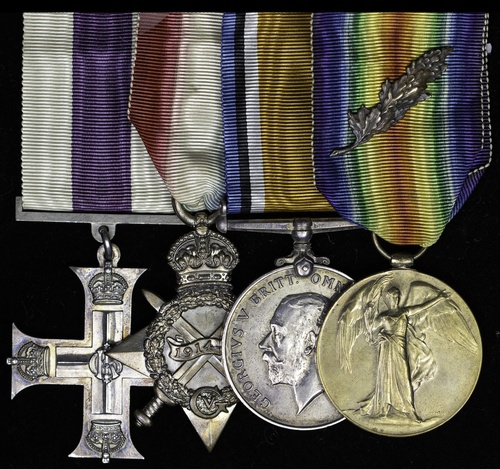
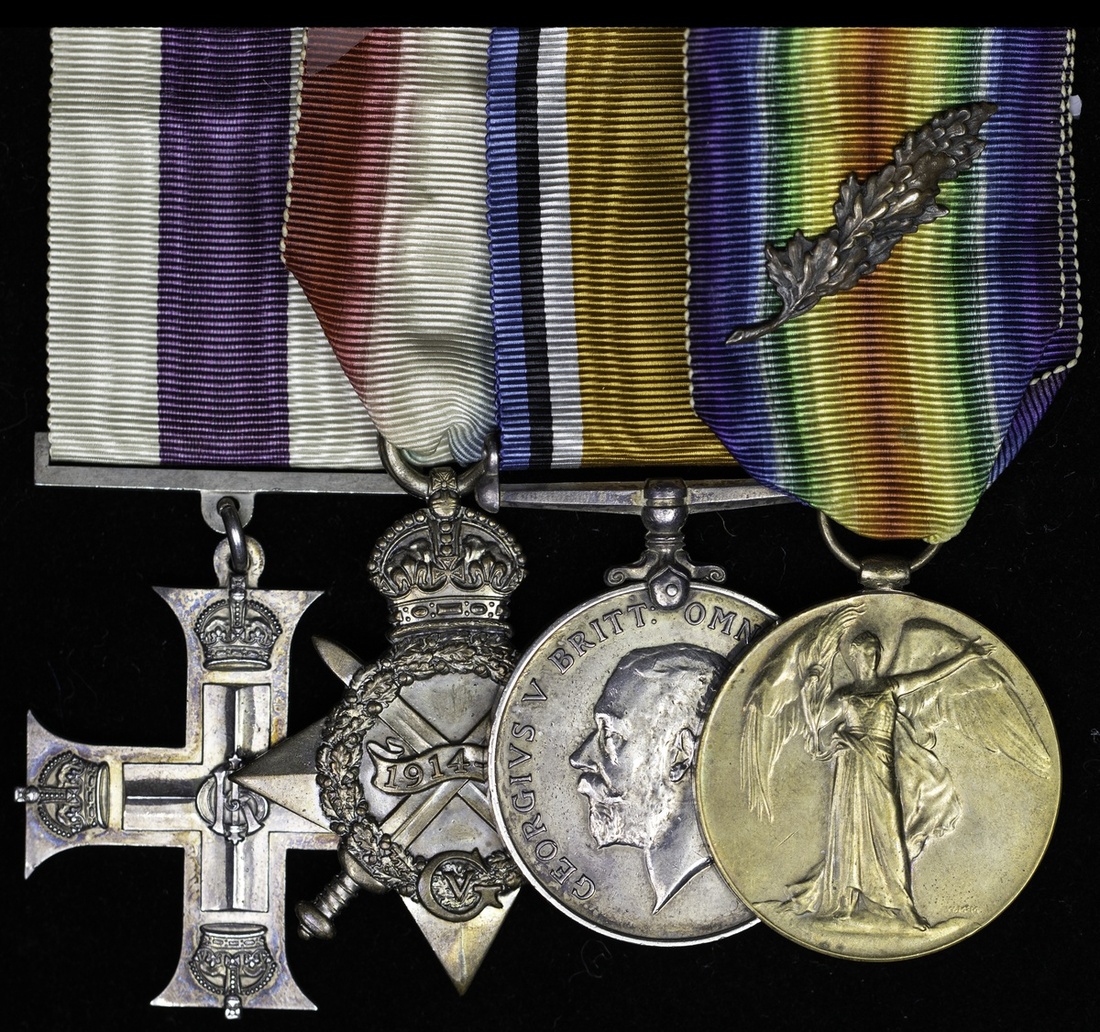
A rare Great War German East Africa M.C. group of four awarded to Major A. C. Robinson, South Lancashire Regiment, attached 3rd Nigeria Regiment
The recipient of a 'mention' for his services in the Northern Cameroons in 1914-16, he was decorated for his gallantry at Ngwembe in January 1917 and severely wounded at Nyengedi in September 1917: it appears the latter occasion led to his unit having approved him a Second Award Bar to his M.C., but in the event he received as second 'mention'
Military Cross, G.V.R., unnamed as issued; 1914-15 Star (Lieut. A. C. Robinson, S. Lan. R.); British War and Victory Medals, M.I.D. oak leaf (Major A. C. Robinson), very fine and better (4)
Provenance:
Purchased Spink, November 1959 (original Bill of Sale accompanies the Lot).
M.C. London Gazette 4 June 1917:
'For distinguished service in the Field.'
Regimental records state:
'Handled his company with the greatest judgment and coolness at Ngwembe on 24 January 1917. His action kept the enemy in check at a most critical period until reinforced, thus enabling the main body and guns to get clear.'
Alfred Conrad Robinson was born at Ladywood Villa, Roundhay, Yorkshire on 14 September 1889 and was commissioned in the South Lancashire Regiment in March 1910, when he was posted to the 2nd Battalion at Tidworth.
Northern Cameroons 1914-16 - 'mention'
Advanced to Lieutenant in September 1912, he was seconded for service under the Colonial Government in April 1913, when he joined the 3rd Battalion, Nigeria Regiment, Royal West Africa Frontier Force. And it was in this capacity that he arrived in the Cameroons on 20 September 1914. He subsequently participated in the severe fighting that led to the final German surrender at Mora in February 1916, fighting in which 'the Nigerians' gained the admiration of a wide audience, not least Brigadier-General F. J. Cunliffe, commanding Allied forces in the Northern Cameroons:
'This report would be incomplete were I to conclude it without a word of praise to the native rank and file of the Nigeria Regiment, who have borne the brunt of the fighting … Their rations have been scanty, their barefoot marches long and trying, and their fights at times extremely arduous, yet they have not been found wanting either in discipline, devotion to their officers, or personal courage, as the list of recommendations which I am proud to enclose, amply testifies.'
Robinson was among those mentioned in despatches (London Gazette 31 May 1916, refers).
Action at Ngwembe, January 1917 - M.C.
In respect of future operations in German East Africa, the replenished ranks of the Nigeria Regiment returned to the fray in December 1916, in which month they landed at Dar es Salaam. Robinson, who had been advanced to Captain in October 1915, was given command No. 10 Company in the 3rd Battalion, and first saw action at Mgeta River in the first half of January 1917.
But it was for his gallantry at Ngwembe on the 24th, when he handled his company with great judgement and skill, that he was awarded the M.C. As related in The History of the Royal West Africa Frontier Force, by Hayward & Clarke, his company was left 'in the air' on the firing line for 30 minutes, as the main body and artillery withdrew around them. But for timely arrival of another reinforcement company, Robinson's outlook looked grim.
Nyengedi, September 1917 - severe wounds - 'mention'
Having undoubtedly seen further action in the intervening period, he and No. 10 Company were heavily engaged at the enemy's stand at Nyengedi River on 30 September 1917, and action best summarised by Hayward & Clarke:
'The enemy next made a determined stand at the Nyengedi River, to which he held all the approaches. The country consisted of open patches of farmland interspersed throughout with thick bush. The 3rd/2nd King's African Rifles of No. 3 (O'Grady's) Column was to follow the southern track along the trolley line, while the 3rd Battalion (Nigerians) was to advance by a track on their right. The only map was - as so often happened - a map made by missionaries, of very doubtful accuracy. Partly owing to this, and partly to delay caused by a guide, touch between the two battalions was lost and the King's African Rifles came into action before the Nigerians could co-operate.
The 3rd Battalion was working on a compass bearing through the bush until it struck the road. No. 10 Company (Robinson) was the advance guard, Nos. 12 and 9 Companies (Ambrose and Southby respectively) were main body, while No. 11 Company was divided between the duties of camp guard and occupying Chirumaka Hill to protect the right flank.
At 1000 hours the advance guard made contact with the enemy's patrols and deployed, but open order formation was difficult to maintain owing to the nature of the country. About a mile and a half farther on resistance stiffened and a hasty line of entrenchments was dug, to which half of No. 12 Company was sent as reinforcement. In the meantime the main body dug a strong defensive line in the rear. The firing now became very heavy and the advance guard suffered severely. Robinson was reporting the situation by telephone to the C.O. when he was hit. Owing to shortage of ammunition, and the enemy's shelling, combined with a threat to Robinson's right flank, he ordered a retirement.
This retirement had to be carried out in a single file because of the denseness of the bush. In spite of casualties from sniping occurring all the time, it was executed with praiseworthy steadiness, the last to retire being Robinson, sitting on the back of his orderly, Private Afolabi Ibadan, while the Company Bugler and Sergeant-Major were in the rear. The latter was hit when shielding his Captain's body, and the bugler stayed to assist him. Afolabi was decorated with the Military Medal and Sergeant-Major Sumanu received a mention in despatches. The men themselves were full of fight, and of the Europeans all but one were casualties.
The remnants of No. 10 Company were now rallied at the trenches occupied by the main body and supplied what ammunition could be spared. The enemy, after making two determined efforts to turn the right flank of this position, broke off the action at dusk, but not before one officer had been killed and two others, including Captain Collins, the Adjutant, wounded. On checking the ammunition it was found there was left only an average of 15 rounds per man, with two belts per machine-gun and four drums per Lewis gun.
This action had been remarkable for several cases of individual initiative as well as conspicuous gallantry … '
As it happens, the Regimental History credits Robinson with having been awarded a Bar to his M.C. for this action, but instead ended up gaining another 'mention', as per the despatch of Major-General A. R. Hoskins, C-in-C., East Africa Force (London Gazette 5 March 1918, refers).
Advanced to Major in June 1918, Robinson appears to have remained in the employ of the Colonial Government until July 1922; sold with copied research.
Subject to 20% VAT on Buyer’s Premium. For more information please view Terms and Conditions for Buyers.
Sold for
£3,500
Starting price
£1200
Watch, listen and bid as if you were in the room. Now available for auctions worldwide.
Click here to bid live
An exclusive and confidential service for the discerning collector or vendor.
View the Gallery
Download every Spink catalogue on your iPad, iPod or iPhone using free Spink app.
Download From iTunes© 2026 Spink & Son. All rights reserved.