
Auction: 24113 - Orders, Decorations and Medals - e-Auction
Lot: 272
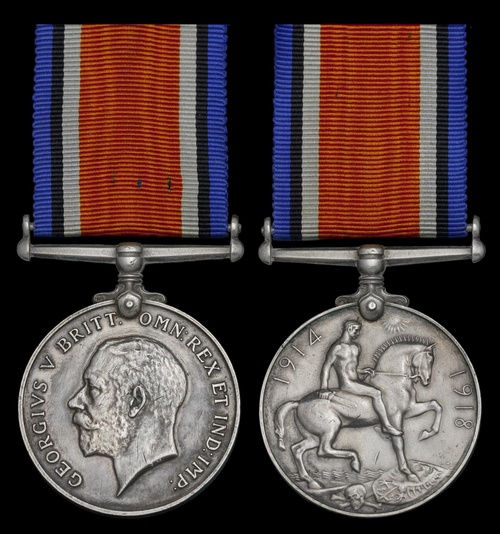
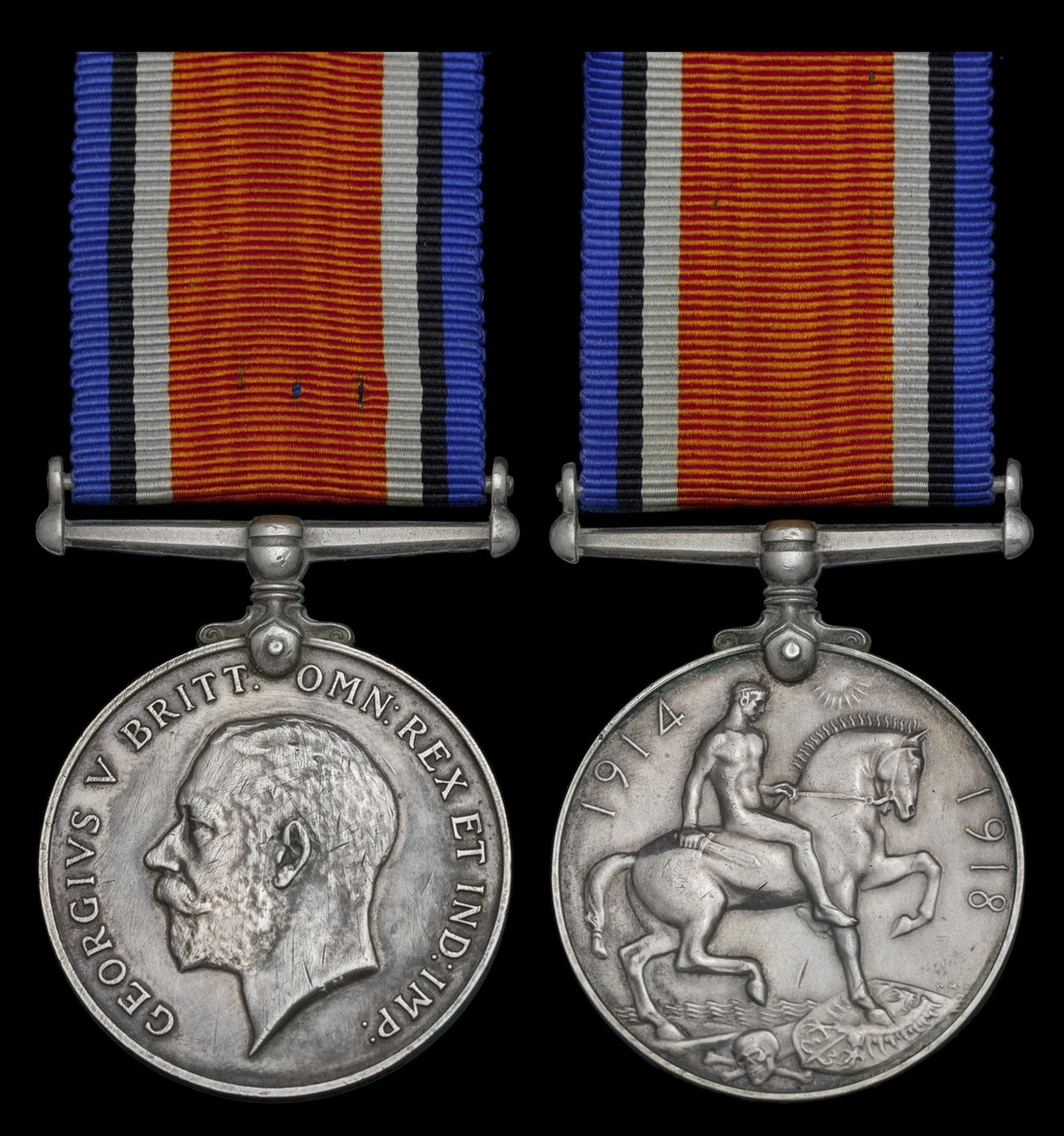
The British War Medal awarded to Captain R. C. R. Kane who was awarded a M.C. and Bar for bravery serving with the Royal Irish Rifles, late Prince Alfred’s Volunteer Guard and Royal Dublin Fusiliers, a long term colonial official, later Resident Commissioner of the Solomon Islands Protectorate at the time of the Malaita massacre
British War Medal 1914-20 (Capt. R. C. R. Kane.), some scratching, otherwise very fine
[M.C.] Edinburgh Gazette 14 November 1916, the original citation states:
'For conspicuous gallantry during a successful raid. He commanded the left flank party, killed one of the enemy with his revolver, bombed three enemy dug-outs, and held up an enemy counter-attack till ordered to withdraw.'
Bar to the M.C. Edinburgh Gazette 18 September 1917, the original citation states:
'For conspicuous gallantry and devotion to duty. During an advance he organised and rallied under his command stragglers from other units, and captured a large number of prisoners from hostile strong points and dug-outs. He also displayed the utmost skill and judgment in consolidating his objective under heavy shell fire, and established communication to flanks and rear within five minutes of reaching his objective.'
Richard Cecil Rutledge Kane was born at Belfast on 21 September 1877, the son of Church of Ireland Minister and Orange Order Grand Master Richard Rutledge Kane. He reputedly served in the Prince Alfred’s Volunteer Guard during the Bechuanaland Campaign, although his name does not appear on the latest published transcript of the medal roll. Prior to the Great War he was also a District Commissioner in the Fiji Islands, and served in the Colony’s Legislative Council.
Returning to the U.K. following the outbreak of the Great War, Kane was commissioned Second Lieutenant in the Royal Dublin Fusiliers on 16 November 1915. He transferred to the Royal Irish Rifles in July 1916 and served with them on the Western Front, being awarded the Military Cross in 1916, and a Second Award Bar the following year. He finished the war with the rank of Captain.
Kane applied for his war medals on 21 February 1925, with his address being the Office of the Resident Commissioner, British Solomon Islands, Tulagi.
Appointed the United Kingdom's fourth Resident Commissioner of the Solomon Islands Protectorate, he served in that role from 1921-1929. He had previously worked in Fiji as District Commissioner for Rewa, as well as serving in the colony's Legislative Council. As Resident Commissioner in Samoa, he made a speech on Malaita about the benefits of the new tax per head. The speech caused considerable resentment, as in truth, there was little to show for the tax collection. The District Commissioner of Malaita, William R. Bell, then pushed the authorities to provide a Medical Officer and other return for the tax money. The resentment did not decrease, however, and Bell was murdered by Kwaio in October 1927 as part of the Malaita massacre. Kane was on tour at the time of the killing, and his deputy Captain N.S.B. Kidson sought immediate help. By the time Kane returned, a punitive expedition was nearly fully planned.
In November Kane began planning for a resettlement of the Kwaio on another island. He was later encouraged by the High Commissioner in Fiji to issue a 'King's Regulation to Authorise the Detention of Certain Natives Formerly Living on the Island of Malaita,' declaring as lawful the detention of the 200 Kwaio that were brought to Tulagi during the expedition. However, the scheme was quashed by Lieutenant-Colonel H.C. Moorhouse, sent by the Secretary of State for the Colonies to investigate, who pushed for rapid repatriation of the detainees. They were returned in August 1928. Retiring to New South Wales, Australia, Kane died at Manly on 2 November 1958.
Subject to 20% VAT on Buyer’s Premium. For more information please view Terms and Conditions for Buyers.
Sold for
£150
Starting price
£100

Watch, listen and bid as if you were in the room. Now available for auctions worldwide.
Click here to bid live
An exclusive and confidential service for the discerning collector or vendor.
View the Gallery
Download every Spink catalogue on your iPad, iPod or iPhone using free Spink app.
Download From iTunes© 2026 Spink & Son. All rights reserved.