
Auction: 24112 - Orders, Decorations and Medals - e-Auction
Lot: 461
A Great War casualty group of three awarded to Private A. Chadd, Worcestershire Yeomanry, who was severely wounded on 28 August 1915 at Gallipoli and died in 1921 as a result of those same wounds
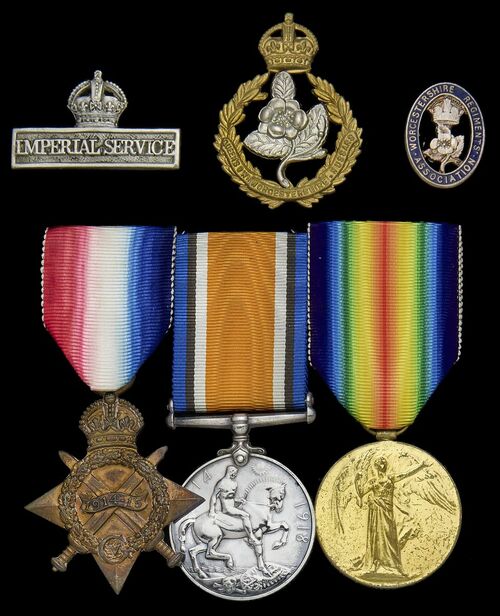
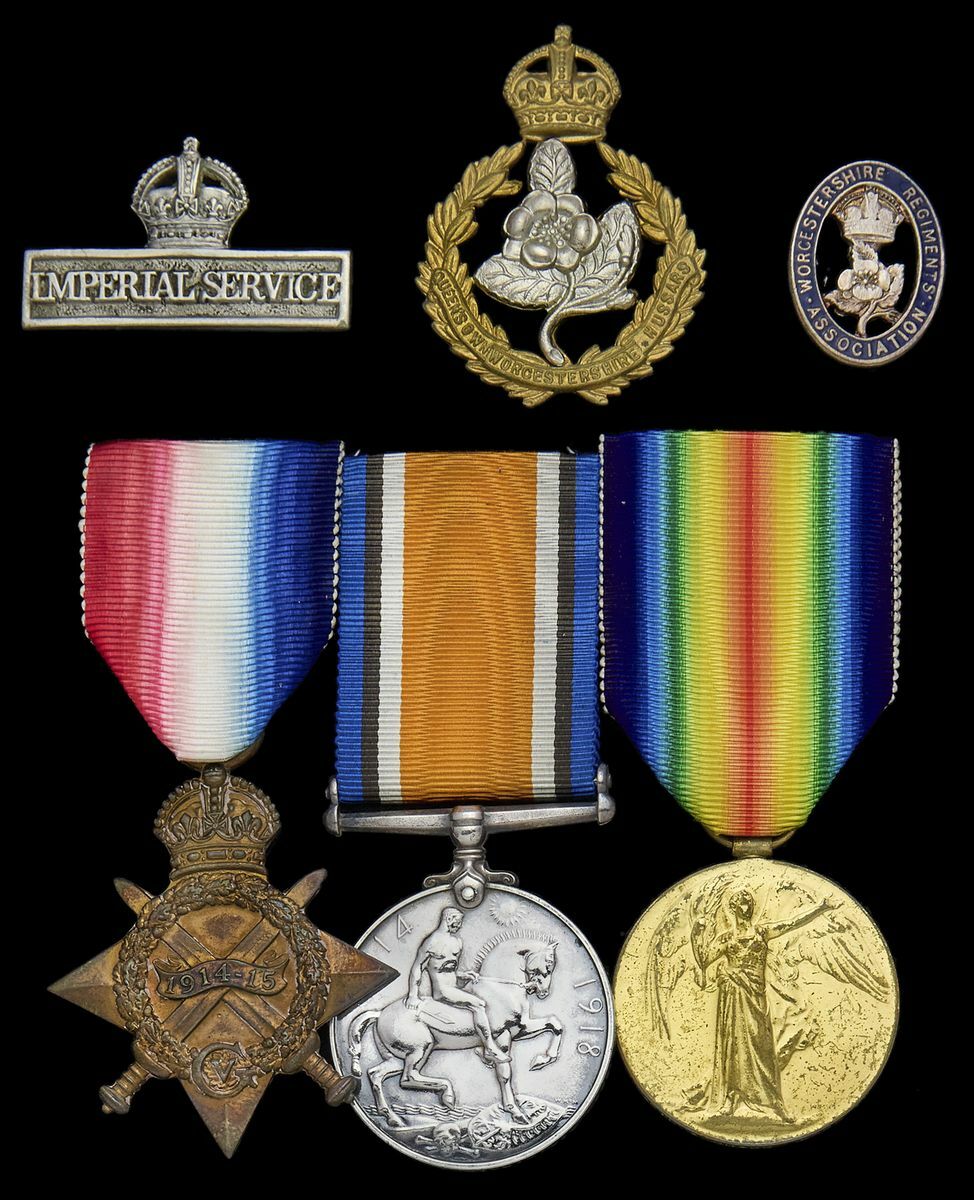
1914-15 Star (2770. Pte. A. Chadd. Worc. Yeo.); British War and Victory Medals (2770Pte. A. Chadd. Worc. Yeo.), good very fine or better (3)
Archibald Chadd was born either in November 1895 (shown in one document within his discharge papers) or 1897 (shown in his Pensioner's Record Card).
Chadd enlisted into the Queen's Own Worcestershire Hussars (Yeomanry) on October 1914. If born in 1895, he would have been 18 years 11 months old, but if 1897 is his birth year, he would have only been was 17, and thus too young to enlist without lying about his age.
Following the fall of Antwerp in October, the Regiment was one of many put under orders to be able to move at a moments notice. Training was essential for many of the new recruits and on 17 November 1914, the troops detrained at Sheringham, Norfolk in pouring rain and marched inland and, by 19 November were concentrated around Barningham Hall. While in Norfolk the troops were often billeted in rat-infested leaky barns, with no lighting whatsoever, where the floors became a sea of liquid mud. Washing was conducted in the cattle troughs and their blankets soon became sodden and remained so.
After much protestation by commanders, the Regiment finally moved to Kings Lynn on 10 December, where four months of training was completed to bring the troops up to standard. Finally, in April 1915, news was received that the Regiment was soon to embark overseas and on 8 April the Regiment entrained at Kings Lynn for Avonmouth, with speculation abounding so as to its destination.
Between 9-11 April, the Regiment left Avonmouth on three ships: the Wayfarer, Eloby, and Saturnia. However, the Eloby met with a torpedo attack within 48 hours and limped into Queenstown, thankfully with no casualties.
Between 22-24 April, the troops arrived at Alexandria and made their way with their horses to Chatby Camp, two miles outside Alexandria. Here they stayed until August, during which time they continued training and assisted in transferring the many wounded men of the Gallipoli landings from the hospital ships to the casualty stations. They did this until asked to join the landings at Suvla Bay with the rest of the 1st South Midland Brigade of the 2nd Mounted (Yeomanry) Division.
The Regiment left Alexandria on 13-14 August 1915 and arrived in Suvla Bay at daybreak on the 18 August and no time was lost in getting ashore owing to Turkish shellfire; digging-in began immediately. The Turks continued to shell the beaches and the transport ships ferrying supplies, while fighting continued to the south between the Anzacs and Turks at Sari Bair.
The unit received orders to move at dusk on 20 August as another plan to attack the Turkish centre position at Suvla was being finalised. If this attack proved successful it would push the Turks off the heights surrounding Suvla and prevent constant shelling. Additionally, it would capture the heights of Sari Bair by a different route - the ground that proved unattainable to the Anzacs weeks before. Medical Officers were, however, warned to expect casualties in the order of 40%; the attack would not be easy.
The troops made their way silently and slowly to the position required for the commencement for battle the following day. At midnight, they reached the western slopes of the Lala Baba, a small hill only 130 feet high which overlooked the area of the Salt Lake and Chocolate Hill, that was to be attacked later that day. They dug in and waited.
The morning of 21 August brought a veil of mist to the hills, but at 2.30 pm the British Artillery opened fire, and for half an hour pounded the Turkish lines. The firing abruptly stopped at 3 pm and it was to be the infantry's turn.
The 2nd Mounted Division was to follow behind the leading attacking troops and consolidate the ground taken on the ridge of high ground ahead of them. The 1st South Midland Brigade were the third wave in their Division. They watched as the two lines of men ahead of them were ripped to pieces by two Turkish batteries using high explosive shells as they crossed the Salt Lake on the approach to Chocolate Hill. This was a distance of over 1500 yards of barren terrain which afforded no cover at all. Just as the Regiment set off to suffer the same fate, their Commanding Officer ordered the two Squadrons to separate and leave 100 yards between each other - this very order saved many casualties, as they were spread out more thinly as they charged at the double across the open expanse of land.
16 men were lost while crossing the lake (many other regiments lost in excess of 50), but the Regiment had made the base of Chocolate Hill. There, the medical teams attended the wounded and the Regiment waited for twenty minutes. News was received that the 2nd Mounted Division were to support a renewed attack against the enemy positions and, with the London Brigade, were to attack Hill 112 from the south of Chocolate Hill. Using their shovels over their heads as protection against bullets and shrapnel, they advanced over Chocolate Hill along the crest to Green Hill and into the valley at the southern end of Scimitar Hill. Despite the heavy fire laid down by the Turks, casualties were light.
Troops dug in as night fell and the firing died down, believing that the attack would be renewed that next day. Orders were received, however, that the 2nd Mounted Division were to withdraw under cover of darkness back to their camp at Lala Baba. The Regiment had begun the attack 284 strong with eight officers and had received 43 casualties - and for what gain? The troops then settled down to a period of trench warfare, with no more significant attacks.
The Regiment were ordered back up Chocolate Hill on 22 August, this time under cover of darkness. 'D' Squadron had to continue and take up the front line trenches on Green Hill. After a day spent uneventfully, the Squadron re-joined the Regiment on Chocolate Hill and the time was then spent digging further accommodation.
During the night of 27 August, the enemy brought up a battery of field guns that they used the next morning to shell the western slopes of Chocolate Hill. The Regiment took the full force of the bombardment, with many of the men above ground getting their breakfast. In particular, 'C' Squadron men attached to 'D' Squadron together with 'D' Squadron's Worcester troop under Lieutenant L. Haynes Rudge suffered the most, with nearly 30 men killed or wounded.
It was in this incident that Chadd was dangerously wounded. A shell splinter had entered his head at a point on the right jaw and exited below his left eye; he had been in action for only 10 days. Chadd was evacuated to Mudros the following day and embarked for the U.K. on 1 September, being admitted to the 2nd Southern General Hospital in Bristol on 10 September 1915.
Chadd miraculously survived, but the war was over for him and he was medically discharged from service on 23 February 1916 at 16 Silver Street, Worcester (one of the Territorial Halls). He had served for 1 year and 127 days and his conduct was described at exemplary.
Unfortunately, Chadd's survival of his wounds was not the end to his suffering. The extent of his facial wound was that he would continually suffer pain, discomfort, partial loss of use of his left arm among other ailments. His visits to the medical board for pension entitlements show some of the details:
Gloucester, 2.2.16 - Left antrium and head injury. Injury to right motor cortex Causing ……….of left arm. Pulsating scar over right parietal bone. Antrium discharging. P…….. left arm and tricep - 50% disabled.
Newport, 23.6.16 - Has improved - 50% disabled.
Worcester, 9.7.17 - Still some discharge from Antrium - 30% disabled.
Cheltenham, 2.4.18 - Wound healed but subject to headaches. Harsh breathing both upper lobes…… on right side - 80% disabled.
Gloster, 17.9.18 - Pulsating scar right parietal size 2/- scar over left molar also one under right jaw. Left Antrium still discharging. P………… of left arm improved. Loss of sensation on outer surface of upper left arm - 40% disabled.
Gloster, 25.7.19 - Pulsating scar right Parietal. Discharging sinus leading into M ………antrium. Satisfactory dental plate provided - 60% disabled.
Gloster, 5.10.20 - Complains of headaches. .....in which if he is in the…… he has to stand still and hold onto something. Scar 3" long right parietal region with…… pulsating gap…….no tenderness …….working of left arm …….with ring and little finger when touched. Grip of hand as a whole good and loss of power in limb. Has now lost 10 teeth from upper jaw …….. and two teeth from lower jaw.
23.10.20 - Gun Shot Wound Head and pulmonary tuberculosis.
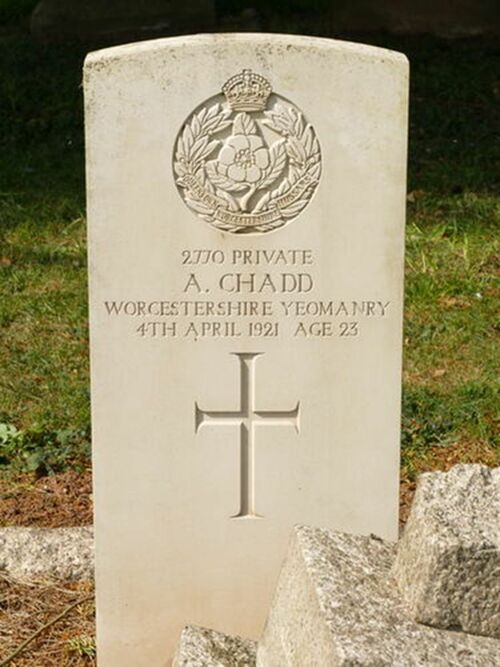
4.4.21 - DIED from Pulmonary Tuberculosis and Dilatation of Head.
Archibald Chadd was buried in Ledbury Cemetery, Ross Road, Ledbury, aged just 23 years old, the much loved son of Thomas and Harriet Elizabeth Chadd.
Sold together with the following badges:
(i)
Q.O. Worcestershire Hussars other Ranks cap badge.
(ii)
Imperial Service badge.
(iii)
Worcester Regiments Association badge.
Subject to 20% VAT on Buyer’s Premium. For more information please view Terms and Conditions for Buyers.
Sold for
£290
Starting price
£210


Watch, listen and bid as if you were in the room. Now available for auctions worldwide.
Click here to bid live
An exclusive and confidential service for the discerning collector or vendor.
View the Gallery
Download every Spink catalogue on your iPad, iPod or iPhone using free Spink app.
Download From iTunes© 2026 Spink & Son. All rights reserved.