

Auction: 24112 - Orders, Decorations and Medals - e-Auction
Lot: 428
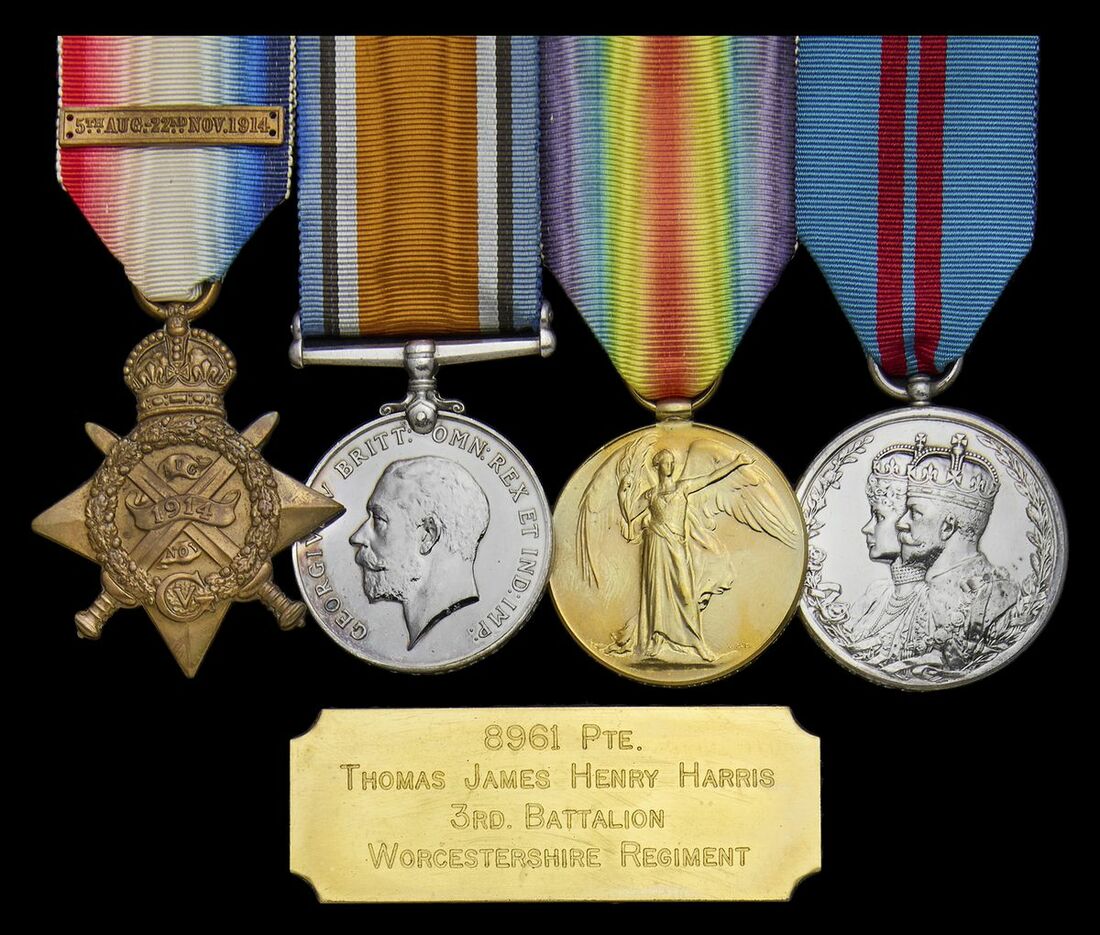
A Great War group of four awarded to Private T. J. H. Harris, Worcestershire Regiment, who was badly wounded on 3 November 1914
1914 Star, clasp (8961 Pte T. J. H. Harris. 3/Worc: R.); British War and Victory Medals (8961 Pte. T. J. H. Harris. Worc. R.); Delhi Durbar 1911, silver (Pte. T. J. H. Harris. Worc. Regt), engraved naming, very fine (4)
Thomas James Henry Harris was born circa August 1886 in Leamington, Warwickshire and enlisted into the Worcestershire Regiment at Birmingham on 2 December 1904. A labourer at the time of enlistment, his next of kin were his older brother Charles, younger brother John, and his Father William Harris of 8 Queens Road, Aston, Birmingham.
Harris joined his Regimental Depot on 7 December 1904 and was posted to the 1st Battalion on 20 December 1904 at Templemore, County Tipperary, Ireland, where he served until 21 November 1905. He was transferred to the 4th Battalion on 22 November and soon after embarked on the Soudan for Malta, where he arrived on 1 December. Harris spent three days in hospital with dental issues on 19 February 1906.
Travelling on the Dilwara on 8 May 1906, Harris arrived in Egypt on 11 May, later returning to Malta on the Dufferin on 12 June. He was granted his first Good Conduct badge on 2 December 1906 and gained his 3rd Class Education Certificate on 12 August 1907.
Posted to India, Harris arrived on 25 November 1908 after travelling on the Rohilla. On 12 July 1909, he was admitted to hospital for 14 days with malaria and was again hospitalised for 19 days on 5 March 1910 with a sprained right ankle, sustained whilst off duty. He gained his 2nd Class Education Certificate on 16th July, 1910.
Harris, with his Regiment, took part in the Delhi Durbar on 12 December 1911 and is confirmed on the roll for the Delhi Durbar Medal.
Harris spent a total of 3 years and 113 days in India, finally returning on 6 March 1912 and on 9 March was transferred to the Army Reserve. He found work afterwards as a tram conductor.
On 4 August 1914 Britain declared war on Germany and on that day hundreds of Army Reservists were called up - Harris being amongst them. All Army Reservists were sent an Army Form D463a, instructing the soldier named thereon to report to his local regimental depot the following day (5th August). The original notification to Harris is sold with this group, an extremely rare and poignant item.
Both the 2nd and 3rd Battalions of the Worcestershire Regiment were immediately mobilised for overseas service, with Harris posted to the 3rd Battalion. The Battalion moved to Tidworth and then to Southampton at 7am on 13 August, but it was not until the following day that the 3rd Battalion left for France on the Bosnian, arriving first at Le Havre, then moving to Rouen and finally disembarking on 16 August. Early the next day, they marched through the streets and entrained for the Front. Finally on 23 August, having been billeted at Ciphy, they marched towards Mons whilst German shells 'shrieked overhead and burst behind them', (Stacke's History of the Regiment, page 3, refers).
The Regiment was hotly engaged from this point onwards. They saw action during the retreat from Mons, the Battle of Le Cateau, the fight at Caudry, the Battles of the Marne and Aisne, and the Battle of La Bassee.
As the war entered into November 1914, the 3rd Battalion were in the region of the Ploegsteert Wood and they moved forward into the front line trenches on the eastern edge of the Wood to relieve the 1st Hampshire Regiment. They were in water filled trenches and under constant fire, being overlooked by Messines Ridge to their left. It was here, on 3 November, that Harris was badly wounded by a gunshot wound to his left buttock.
Harris arrived home on 20 November and was treated in the Military Hospital at Devonport. He continued to experience 'Weakness and instability of left leg, resulting from shrapnel wound in left buttock'. His medical report concluded in September 1915: 'Patient's wound healed in 3 weeks, at the end of that time he tried to walk, but was unable to an account of pain and weakness in left leg and there has been no improvement in his condition since that time. Patient has spent altogether 9 months in hospital as a result of his present condition. Damage to sciatic nerve due to the shrapnel caused by active service'. Harris was discharged from the Army on 31 October 1915 as a consequence of his wounds and being unfit for further active service. He received a Disability Pension.
(Note: Harris may have lied about his age in order to enlist, as a Thomas James H Harris is recorded as being born on 29 April 1887, when he died in Stourbridge between July-September 1971, aged 84).
The lot is sold together with a rare Army Reserve Mobilization notice issued to Harris on 4 August 1914, recalling him to service on the outbreak of the Great War.
Subject to 20% VAT on Buyer’s Premium. For more information please view Terms and Conditions for Buyers.
Sold for
£260
Starting price
£200

Watch, listen and bid as if you were in the room. Now available for auctions worldwide.
Click here to bid live
An exclusive and confidential service for the discerning collector or vendor.
View the Gallery
Download every Spink catalogue on your iPad, iPod or iPhone using free Spink app.
Download From iTunes© 2026 Spink & Son. All rights reserved.