
Auction: 24112 - Orders, Decorations and Medals - e-Auction
Lot: 427
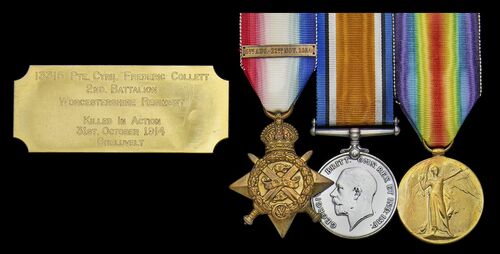
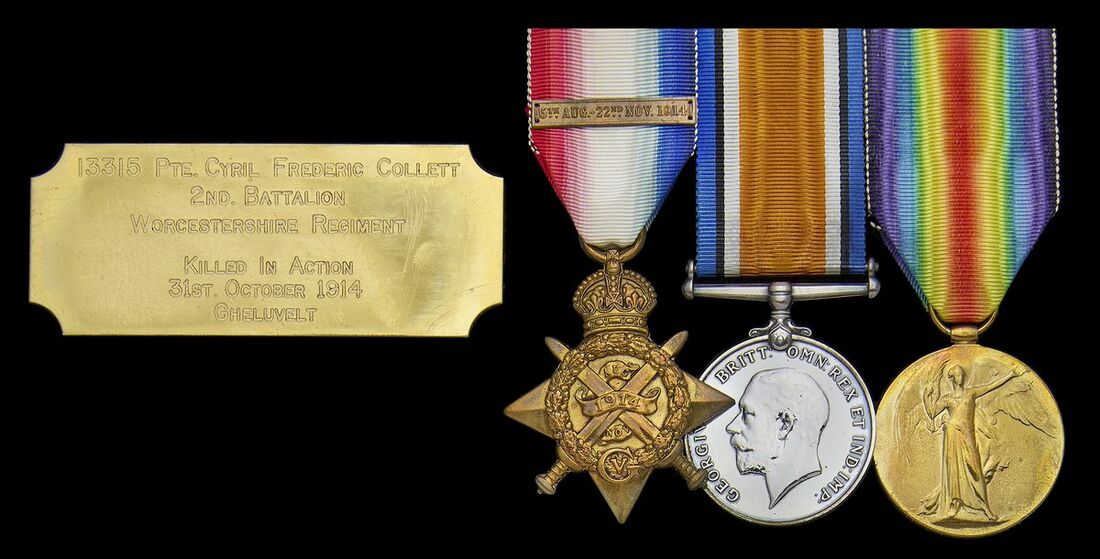
A Great War 'Casualty' group of three awarded to Private C. F. Collett, Worcestershire Regiment, who was killed in action on 31 October 1914
1914 Star, clasp (13315 Pte C. F. Collett. 2/Worc: R.); British War and Victory Medals (13315 Pte. C. F. Collett. Worc. R.), light contact marks, very fine (3)
Cyril Frederick Collett was one of four children born to Frederick John and Ada Collett. At the time of the 1901 census, Cyril was living with his mother and widowed grandmother in Solihull High Street. His grandmother Mary was the widow of Richard Lea, who had died in 1883. After her husband's death, Mary carried on his business as a grocer and shopkeeper in Solihull High Street. Cyril's father is not listed with the rest of the family on the 1901 census, although Cyril's mother is there and listed as married, not widowed. It seems that Ada petitioned for a divorce in 1900, which was presumably granted as she was still living with her mother in Solihull High Street at the time of the 1911 census, but her marital status had changed to divorced. She subsequently remarried William de Jongh in London in 1921. Ada is listed as next-of-kin in her son's Commonwealth War Graves register entry as Mrs. Ada de Jongh (formerly Collett) of 79 Leith Mansions, Maida Hill, London.
In April 1910, Collett enlisted into the Royal Navy and served as a Boy 2nd Class on the H.M.S. Ganges. This was a shore training establishment in Shotley, Suffolk for boy entrants to the Royal Navy. The boys would have been aged 15-17 when they joined and received training in seamanship and gunnery as preparation for future service with the Royal Navy. Most boys signed up for 9 years of service (excluding any time before their 18th birthday).
Collett subsequently served during 1911 as a Boy 1st Class on H.M.S. Essex, then Prince George, then Berwick (he was serving aboard this ship in the East Indies at the time of the 1911 census, although his entry is scored through, suggesting he was absent from the ship on census night), and finally Pembroke, before being discharged in July, 1911. What happened next is unclear, as the service record suggests he enlisted in the Royal Navy on 30 April 1912 (his 18th birthday) for a period of 12 years. However, the only entries on the service record relate to Collett's service as a boy sailor during 1910-11. During this time, his character is consistently recorded as Very Good.
How Collett came to leave the Navy after enlistment in 1912 is not known, nor when he enlisted in the Army, as his Army service record appears not to have survived. His medal index card gives the date of his entry into a Theatre of War with the Worcestershire Regiment as 12 August 1914, exactly one week after war was declared.
On 13 August 1914, Collett was present with the 2nd Battalion, Worcestershire Regiment when they left Southampton on the transport ships Lake Michigan and Herschel and landed at Boulogne in the afternoon of 14 August, as part of the British Expeditionary Force sent to stem the tide of the German assault on France and the low countries.
For the first few days, the Battalion took time in moving to the front and on 23 August, the Battalion began preparing trenches on a slight rise that overlooked Mons. No sooner had they dug in, expecting to be attacked at any moment, they were given orders to move during the night to Frameries and were successfully entrenched by dawn on 24 August. Here, they came under heavy shell fire and experienced their first casualties. The Battalion were then engaged in the retreat from Mons in the face of a stiffening German assault: the battle of the Marne and the advance to the Aisne.
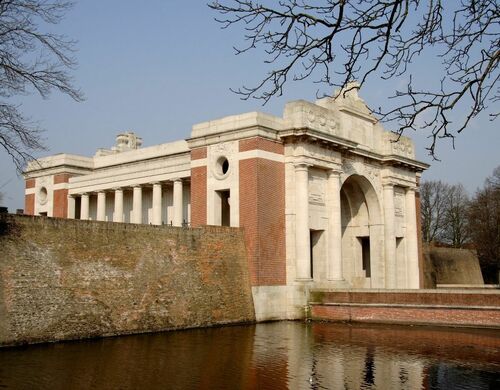
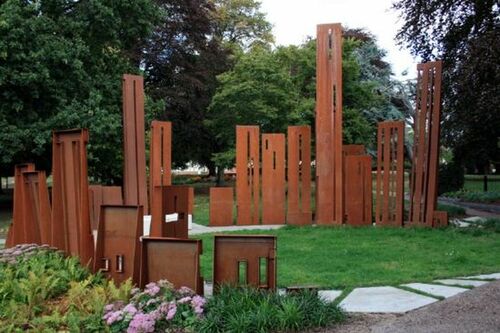
ln mid October, the Battalion were moved to positions north west of Ypres, near Langemarck ,and were hotly engaged in the battles that surrounded this area and also that of Polygon Wood, where they closed with the enemy in a vicious hand to hand bayonet fight amongst the trees. Soon after this was to be the battle that would catapult the Worcestershire Regiment - in particular the 2nd Battalion, into military stardom - the famous bayonet charge over the shell and bullet strewn flat ground to Gheluvelt chateau an 31 October.
The Battalion suffered heavily, losing about a third of their already depleted strength (the 187 casualties, included 31 killed), but succeeded in plugging a gap in the British line that would have undoubtedly given the Germans access to the channel ports and would have probably secured total victory for the enemy and changed the boundaries of Europe forever.
Subject to 20% VAT on Buyer’s Premium. For more information please view Terms and Conditions for Buyers.
Sold for
£2,100
Starting price
£350

Watch, listen and bid as if you were in the room. Now available for auctions worldwide.
Click here to bid live
An exclusive and confidential service for the discerning collector or vendor.
View the Gallery
Download every Spink catalogue on your iPad, iPod or iPhone using free Spink app.
Download From iTunes© 2026 Spink & Son. All rights reserved.