
Auction: 8023 - Orders, Decorations, Medals & Militaria
Lot: 40
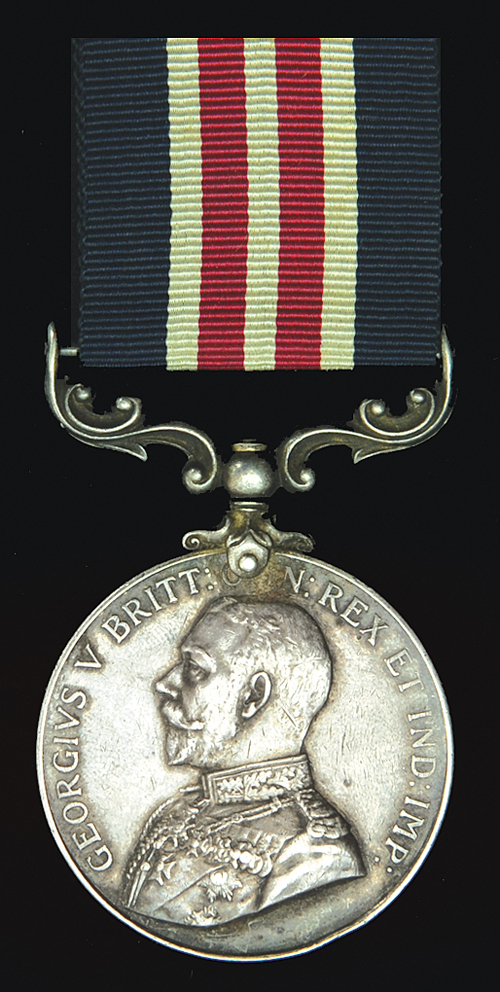
A Scarce Great War 1916 ´French Theatre´ M.M. to Sergeant W. Gill, 178th Tunnelling Company, Royal Engineers Military Medal, G.V.R. (147518 Sjt: W. Gill. 178/T´lg: Coy R.E.), edge bruises therefore very fine Estimate £ 200-250 M.M. London Gazette 14.12.1916 14758 Sjt. W. Gill, R.E. 14758 Sergeant William Gill, M.M. served during the Great War on the Western Front with 178 Tunnelling Company, Royal Engineers from 2.5.1915; on formation the 178th Tunnelling Company moved to the Fricourt sector of the Somme, and on the 1st Day of the Battle of the Somme, ´´At 6.25am the intensive bombardment of the enemy´´s front system was begun, and between 7.15 and 7.25am in order to mislead the enemy, what remained of the gas was released from the centre of the corps front from which no assault was at first to be delivered. At 7.22am a hurricane bombardment by Stokes mortars on the whole front of attack took place. At 7.26am smoke discharges were launched by the 4th Mortar Company of No 5 Battalion, Special Brigade R.E., in order to create barrages to screen the inner flanks of the attacking wings of the 7th and 21st Divisions, also to form a cloud on the German support line opposite the 7th Division, to mask the direct assault. At 7.28am three mines of 25,000lbs., 15,000lbs. and 9,000lbs., placed by the 178th Tunnelling Company R.E., were fired under the German line opposite the salient known as "The Tambour", facing Fricourt, against which no assault was to be made. The purpose of the mines was to distract the enemy´´s attention and form craters which block enfilade fire against the 21st Division from the northern face of "The German Tambour" (just south of Tambour). Bulgar Point, a heavily wired strongpoint jutting out into No Man´´s Land (south of the south-east corner of Mametz) was completely destroyed by a 2,000lbs. mine, and a sap west of it by one of 200lbs. Four small mines of 500lbs. each were also exploded under the German line south of Hidden Wood, where much mining had already taken place.´´ (Official History of the War, Military Operations, France and Belgium, The Imperial War Museum, refers). As the advance progressed in July 1916, the 178th Tunnelling Company moved up to try to mine enemy positions in the High Wood area, in particular on the 3rd of September, ´´The 1/Black Watch attacking the German Front line in High Wood, had the help of blazing oil drums, "pipe-pushers", and flame throwers, the objective being too close for artillery bombardment; in addition, a mine was exploded (The 178th Tunnelling Company R.E. used a charge of 3,000lbs. of ammonal) under the German strongpoint at the eastern corner of High Wood 30 seconds before zero hour. The mine crater was seized by the right company of the Black Watch, consolidation began with the assistance of a section of the 23rd Field Company R.E., and bombers worked some distance westward along the German front trench. Unfortunately the "pipe-pushers" in the wood had blown back, and a Stokes mortar, firing short, had ignited the oil drums prematurely, so that considerable confusion prevailed when the other companies of the Black Watch began to advance.´´ (Ibid). In March 1918 the company was spread in Fins, Gouzeaucourt and Heudicourt when enemy bombardment struck; they were also engaged in the demolition of Tortille Bridge.
Sold for
£400


Watch, listen and bid as if you were in the room. Now available for auctions worldwide.
Click here to bid live
An exclusive and confidential service for the discerning collector or vendor.
View the Gallery
Download every Spink catalogue on your iPad, iPod or iPhone using free Spink app.
Download From iTunes© 2026 Spink & Son. All rights reserved.