
Auction: 5012 - Orders, Decorations, Campaign Medals & Militaria
Lot: 338
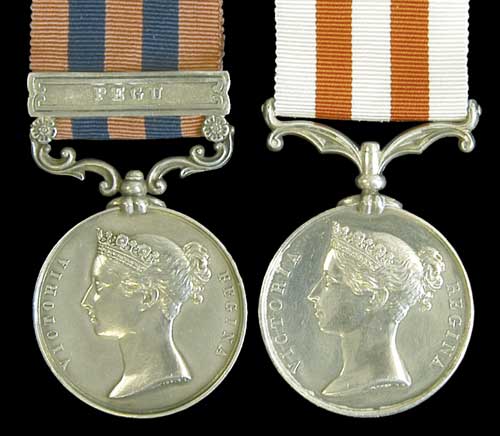
An Important Indian Mutiny Pair to Major S.G.C. Renaud, 1st Madras Fusiliers, Commander of the Advance Relief Column for Cawnpore, Instigator of Strict Punitive Measures, and Mortally Wounded Leading His Men into Action India General Service 1854-95, one clasp, Pegu (Capt. & Bt. Majr. Sydenham Geo. Chas. Renaud. 1st Madras Fusrs.); Indian Mutiny 1857-58, no clasp (Major, S,G,C, Renaud, 1st Madras, Fusrs.), minor edge bruising, nearly extremely fine (2) Estimate £ 2,000-2,500Attempted Relief of Cawnpore At Cawnpore on the 26th June 1857 the British garrison under Major General Sir Hugh Wheeler surrendered to the mutineers under Nana Sahib. Wheeler´s force had held out for three weeks, until ultimately disheartened by their commander receiving what turned out to be a mortal wound. The Governor-General was made aware of the problems that were befalling Cawnpore, but was ignorant of the surrender and on the 30th June a column consisting of 400 European troops, 300 Sikhs, 120 Irregular Cavalry and two nine pounders was sent out from Allahabad under Major Renaud with the purpose of rushing to Wheeler´s aid. "Major Renaud, Madras Fusiliers, will command. I will have the utmost confidence in him. They are well Europeaned, and must get on well" (Telegram from Colonel Neill (Commanding at Allahabad) to Colonel Birch, C.B. (Secretary to the Government of India, in the Military Department and Deputy Adjutant General of the Army, dated 28.6.1857 refers). However, in the meantime, "the Nana allowed them [what was left of Wheeler´s garrison] to get into boats with all they had.....after getting them in boats, fire was opened on them from the bank, and all destroyed. One boat got away 10 miles down the river, was pursued, brought back, and all in her taken back into barracks and shot" (Telegram from Colonel Neill to Governor General of India in Council, dated 5.7.1857 refers). Brigadier General Havelock, marched from Allahabad with a 1000 Europeans to combine with Renaud´s force and make haste for Cawnpore. The latter had halted his progress, and was proceeding to take punitive measures, "In the course of a conversation to-day, an officer, who was attached to Renaud´s column when it moved out in advance of Havelock´s force, told me that the executions of Natives were indiscriminate to the last degree.....In two days forty-two men were hanged on the roadside, and a batch of twelve men were (sic) executed because their faces were ´turned the wrong way´ when they were met on the march. All the villages in his front were burned when he halted" (History of the Indian Mutiny, Kaye and Malleson Vol II refers). These measures were undertaken in ignorance of the attrocities at Cawnpore, perhaps, however, they were done in mind of the actions taken by the mutineers at Murath and Delhi. On 12.7.1857 Havelock, having joined Renaud´s column by two forced marches, engaged with the insurgents (3,500 in number) at Futtehpore and defeated the force, capturing 11 guns, and mentioning Renaud in his Despatch for the action as follows, "Major Renaud......has everywhere pacificated the country by punishing the ringleaders in mutiny and rebellion wherever they have fallen into his hands, and earned, as I venture to think, the best thanks of His Excellency..........I might say that in ten minutes the action was decided, for in that short space of time the enemy was utterly subdued. The rifle fire reaching them at an unexpected distance filled them with dismay, and when Captain Maude was able to push his guns through flanking swamps to point blank range, his surprisingly accurate fire demolished their little remaining confidence. In a moment three guns were abandoned to us on the Chaussee, and the force advanced steadily driving the enemy before it at every point......Major Renaud won a hillock on the right in good style and struggled on through the innundation..........I must endeavour in this hasty despatch to do justice to those who led the troops to this easy victory. First on the list I must place Major Renaud, whose exertions at the head of the advanced column I cannot sufficiently praise. His coolness and conduct in the action are equally entitled to my highest commendation." Havelock´s force pushed on for Cawnpore, however enroute he received intelligence that the village of Aong was strongly entrenched by enemy forces. A detachment under Lieutenant Colonel Tytler undertook the task of dispersing the enemy forces on the 15th July, "These affairs cost me 25 killed and wounded......amongst the latter I regret to have to particularize Major Renaud, 1st Madras Fusiliers, to whose gallantry and intelligence I have been under great obligations. His left thigh was broken by a musket ball in the skirmish at Aong, but I hope from the fortitude with which he endures all suffering a favourable result" (Telegram from Brigadier General Havelock, C.B., to the Deputy Adjutant General of the Army, dated 15.7.1857 refers). Sadly, the wound which Major Renaud received whilst charging at the head of the Madras Fusiliers (his beloved "Lambs"), was to prove mortal and he died later that day. Major Sydenham George Charles Renaud; Lieutenant 1st Madras Fusiliers 1832; Adjutant to the Regiment 1843; Captain 1845; promoted Major, Deputy Judge Advocate General (Mysore Divison) 1851.
Sold for
£3,600


Watch, listen and bid as if you were in the room. Now available for auctions worldwide.
Click here to bid live
An exclusive and confidential service for the discerning collector or vendor.
View the Gallery
Download every Spink catalogue on your iPad, iPod or iPhone using free Spink app.
Download From iTunes© 2026 Spink & Son. All rights reserved.