
Auction: 26002 - Orders, Decorations and Medals
Lot: 269
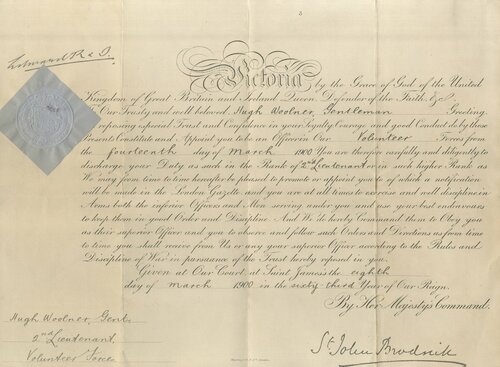
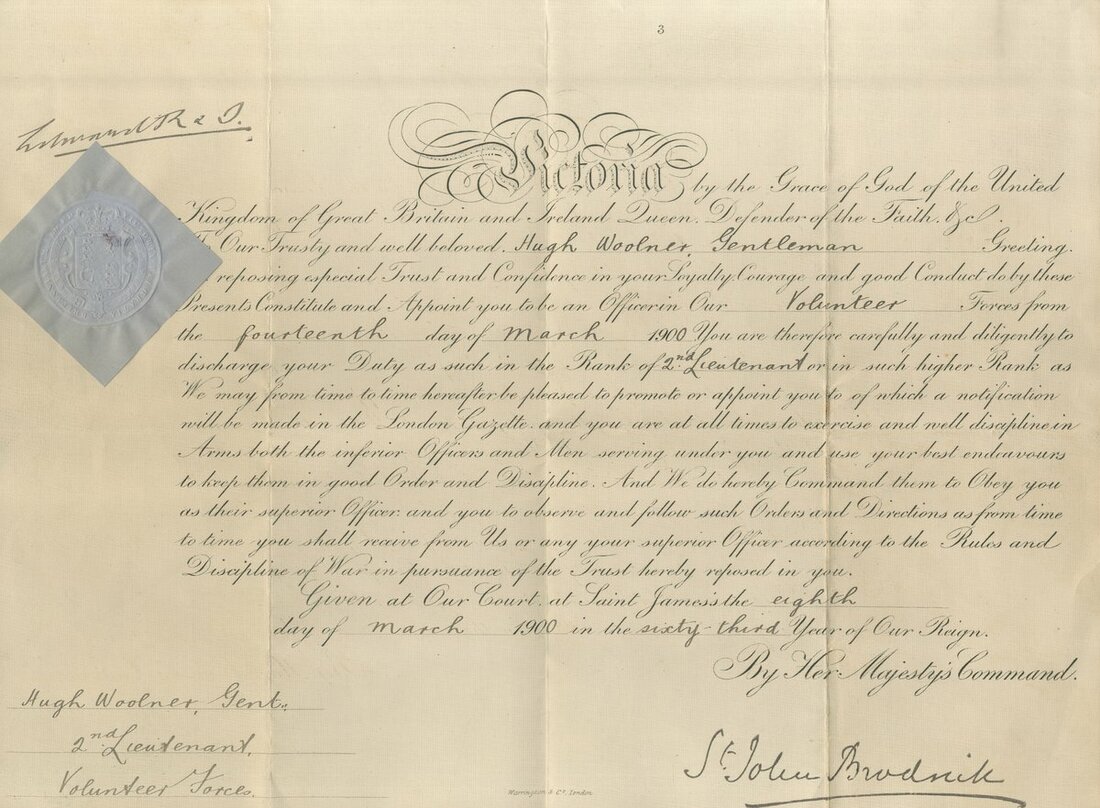
(x) The document of Commission addressed to 2nd Lieutenant H. Woolner, Volunteer Force, a notable survivor of the Titanic disaster who testified before Congress and left his own written account of the sinking
Document of commission named to 'Hugh Woolner, Gentleman' and dated 8 March 1900, very minor discolouration and wear, overall good very fine
Hugh Woolner was born at Welbeck Street, Marylebone on 28 September 1866, the son of Thomas and Alice Woolner; his father a well-known sculptor and art-dealer. He attended Marlborough College before matriculating to Cambridge, before going into business for himself with the London Stock Exchange, founding Woolner & Co. in 1894.
Still working in this role his business was hit by the effects of the Anglo-Boer War. Perhaps in response to this, Woolner was commissioned 2nd Lieutenant with the 3rd Battalion Middlesex Volunteer Force on 13 March 1903. In 1901 he appeared as the only Hugh Woolner on the census and at the time was living in Middlesex.
As his business continued to suffer Woolner's activities came under repeated scrutiny, and he soon found himself in trouble as his firm was dissolved in 1904, but continued trading until 1905. The death of his wife in 1906 and the failure of his business interests in Britain saw Woolner repeatedly cross the Atlantic for work. Having been briefly held personally bankrupt Woolner was in Liverpool when he learned of the death of his mother on 9 March 1912.
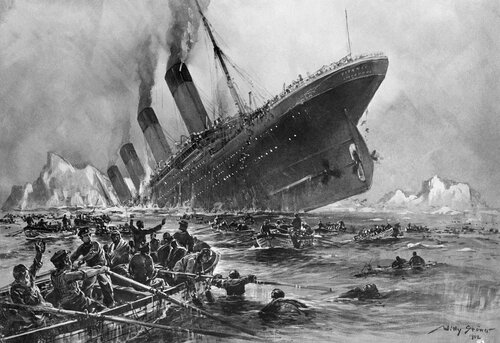
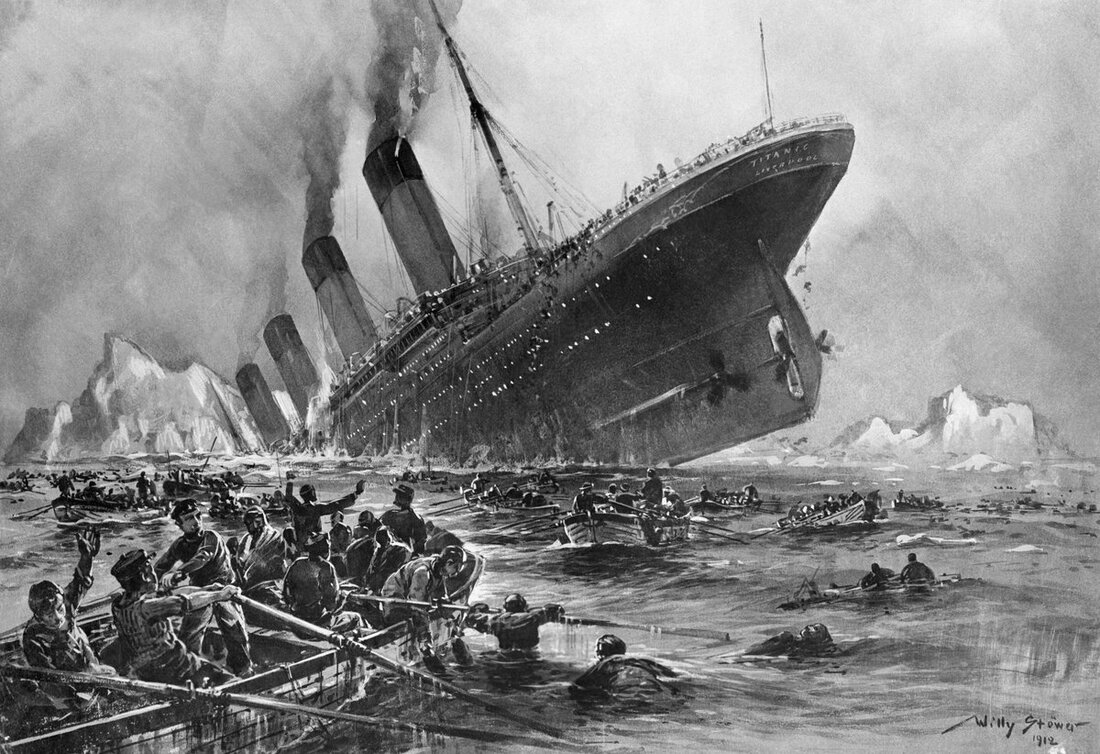
Forced to change his plans as a result, he booked onto the new White Star vessel Titanic with first class ticket No. 19947, placing him in cabin 52, B deck. Woolner left his own account of the sinking which went as follows:
'We were sitting, a party of about six, drinking hot whiskey and water. On Sunday night I noticed that everyone was drinking hot drinks. On the previous night, iced drinks had been the favourites, but on Sunday night, everyone seemed to be drinking grog. It had suddenly become deadly cold in the lounge and restaurant and the lady of our party had gone off to her room.
Then we men strolled up just above to the smoking room and had been seated only a few minutes when there came a heavy grinding sort of shock beginning far ahead of us in the bows and rapidly passing along the ship and away under our feet. Everyone sprang up and ran out through the swing doors astern. A man in front of me called out that he had seen an iceberg towering fifty feet above the deck, which was 100ft above the sea, and passing away astern. This was the explanation.
I went with a Swedish friend whose acquaintance I made on board, Biörnström Steffanson of the Swedish Embassy in Washington. We sought out the lady who had been recommended to my care, Mrs Churchill Candee, who was returning from Paris to see her only son who had met with a serious aeroplane accident in America. We found her and I took her up on to the A deck to see how things were going.
We found the engines stopped and the officers and crew making preparations to lower the boats. The officers were assuring everyone that there was no danger to life, but that the ladies were to be put into the boats as a precautionary measure. We continued our walk awhile, and then I saw passengers coming up with life belts on. I got Mrs Candee's tied on to her and then went off to my room and got on mine and brought away an extra one which I soon gave to some scared person who had none. Bjornstrom and I took Mrs Candee up to the upper A deck where the boats were hung and we put her safely with a rug into the first boat, which gradually was filled with women and children and a few of the crew were put in, three I think, and a youth with a broken arm.
We then went and helped with several more life boats, bundling in the women and children. Meanwhile several gentlemen were standing calmly by and looking on. Several men crept into these few boats, as it came out, and they give fatuous explanations how they came to do so. They were forced in by zealous friends against their own wish, and so on.
The calm courage of the passengers was most inspiring. Many women refused to leave without their husbands. Björnström and I look many of them at their husbands' desire and bodily chucked them into the boats. Eventually all the lifeboats on the port side were launched, and while the crew were putting a big Berthon collapsible boat on the davits he and I went down to the lower deck and around to look for stray women.
We found three ladies close together and then we rushed them into a boat on the starboard side by sheer bluff. We shouted our way through the press; 'Make way for ladies!' and then we hoisted them up, one of us on each side, and giving them a final heave in they had to go, head over heels. We then turned our attention to a boat ready on the starboard side, where there was shouting going on.
We saw the first officer twice fire a pistol in the air ordering a crowd of the crew out of the boat. We ran in and helped bundle the men out onto the deck and then we got a lot, about ten, Italian and other foreign women into that boat and when we saw it was being safely lowered we went away and made a final search on the deck below. The electric lights were beginning to turn red and not a soul was to be seen on the whole deck of 160 yards. The thick glass windows were all closed and Björnström said to me: 'I think we may now make a try for ourselves. I replied: 'All right.'
We walked along through an open door beyond the glass windows, where there was an open gunwale. Looking out we saw the sea pouring over the bows and through the captain's bridge. Just opposite us was the collapsible boat which we had seen being hooked onto the last davits on the port side. She was being lowered into the sea and hung about nine feet away from us. I said: 'Let's make a jump for it! There is plenty of room in her bows! Björnström replied 'Right you are!
We skipped on the gunwale, balanced ourselves for a moment and leaped into the air. He landed fair and square into the boat. I landed on my chest and caught hold with my hands on the gunwale and slipped off backward. I hauled myself up with my arms and got my right foot over the gunwale. Björnström said, 'All right, I've got you, and levered me up by my right foot. But that time my left leg was in the sea, so it was a near thing. man took the fourth. the water at least eighty feet, went out and the roaring went on for about a minute. seven hundred men in the dark, going down amid that ghastly turmoil! I can never forget it.
We continued our course, for it would have been sheer madness to have returned and tried to pick up any more. It would have meant all of us perishing. The sea was as smooth as a pond or none of us would be alive. The Titanic struck at 11.45 p.m. on a starry, clear night. She sank finally at 2.22 a.m. I believe seventeen boats got away. I was in the seventeenth clothes. The only thing I saved was my money. I worked all through the excitement with Björnström at my side. We spoke with strong authority and people simply stood aside and made way for us when we came up with women in tow. It was remarkable! There were scenes of magnificent unselfishness and devotion: women who absolutely refused to go without their husbands; dozens of husbands who simply obeyed orders and remained silent and quiet on deck while their wives were put into safety. In particular a very handsome old gentleman. Mr Isidor Straus. and his wife were there and declined to be separated and when we suggested that so old a man was justified in going into the boat that was waiting, Mr Straus said: "Not before the other men." His wife tightened her grasp on his arm and patted it and smiled up at him and then smiled at us.
In our boat we floated around for a long time in the dark, the cries getting fainter and fewer in the distance. Then a boat with an officer came along and he gave us orders for us to form a string by making fast our painter's head and tail. so as to make a more conspicuous mark on the ocean for a passing ship to see. This we did and it gave us something to do.
After a while orders were given to lighten the officer's boat, so that he could go and help some poor wretches on an upturned boat, which by now was faintly visible in the distance. We got seven more into our already pretty full boat, but we could stand them upright. Other boats got others, and the officer went away with his sail up and got in about twenty shivering men who had been balancing themselves for over three hours up to their ankles on an upturned collapsible boat. Think of it! Faint streaks of light began in the east by this time and I saw a breeze coming towards us, which was a serious matter in our heavily loaded condition. I advised throwing off the painter and keeping her head into the sea. This was done. The wind continued to freshen.
Looking around, I saw about twenty icebergs that looked like photographs of the Antarctic expedition. The whole horizon was snow the edge of a floe, which turned out to be at least forty miles long and yet our lookout on the Titanic had seen nothing and we had been going full speed ahead all through the night. Then I saw a rocket and a little later the lights of a steamer coming our way. This cheered us mightily, as you may imagine. Very slowly she seemed to come on, picking her way through the ice. Eventually she slowed down and then stopped and we saw boats about her sides and I understood that our first boatloads were being taken aboard.
The officer in the sailboat bore down on us and seeing we were being rather roughly knocked about by the sea, gave us a tow, but started away from the steamer and we then saw he was making for another set of unfortunates, who were standing up, apparently in the water. They were a party of fourteen or so, among them a black haired woman and two corpses.
The living having been taken aboard, we wore around and made for the ship, the breeze freshening all the while. It seemed a very long time, but eventually we came alongside the Carpathia on her way with a crowd of tourists on their way to Gibraltar. Getting under the lee side, we made fast and soon had the women hoisted in a sling, and then we men clambered stiffly up the rope ladders.
Stewards steered us to the dining saloon, where hot brandy and water and biscuits awaited us. Seven hundred, about, were saved out of, I believe, 2,500. Everything possible has been done on board to make us comfortable, and nothing could exceed the kindness the passengers on the Carpathia showed to the shivering people who came up out of the sea. I was given a sofa in the first officer's cabin. We had fogs nearly all the time since we were rescued and our speed was therefore moderate.
This general description will serve to show that the behaviour of the American and English passengers and of the whole crew was admirable, with very few exceptions.'
Testifying before the Titanic inquiry in Washington D.C. he returned to Britain and remarried Mary Dowson, the daughter of another London based stockbroker. Unfortunately he was soon implicated in another financial scandal, an accusation of undue influence in drawing up the will of an elderly woman whose family contested the document claiming that she was not of sound mind.
Perhaps to escape the attention which this fresh scandal brough him Woolner and his new wife divided their time between London and Budapest, taking a home in the latter city from a relative of his mother. He died there, still relatively young, of respiratory failure on 21 February 1921; sold together with copied research.
Subject to 5% tax on Hammer Price in addition to 20% VAT on Buyer’s Premium.
Estimate
£300 to £500
Starting price
£240
Watch, listen and bid as if you were in the room. Now available for auctions worldwide.
Click here to bid live
An exclusive and confidential service for the discerning collector or vendor.
View the Gallery
Download every Spink catalogue on your iPad, iPod or iPhone using free Spink app.
Download From iTunes© 2026 Spink & Son. All rights reserved.