
Auction: 26002 - Orders, Decorations and Medals
Lot: 233
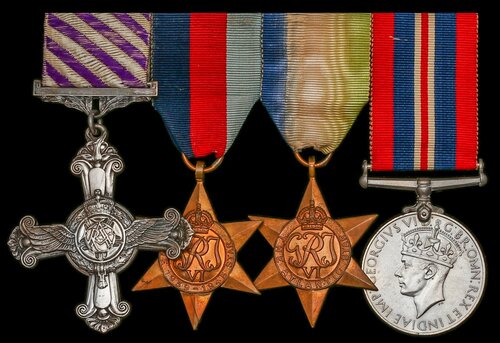
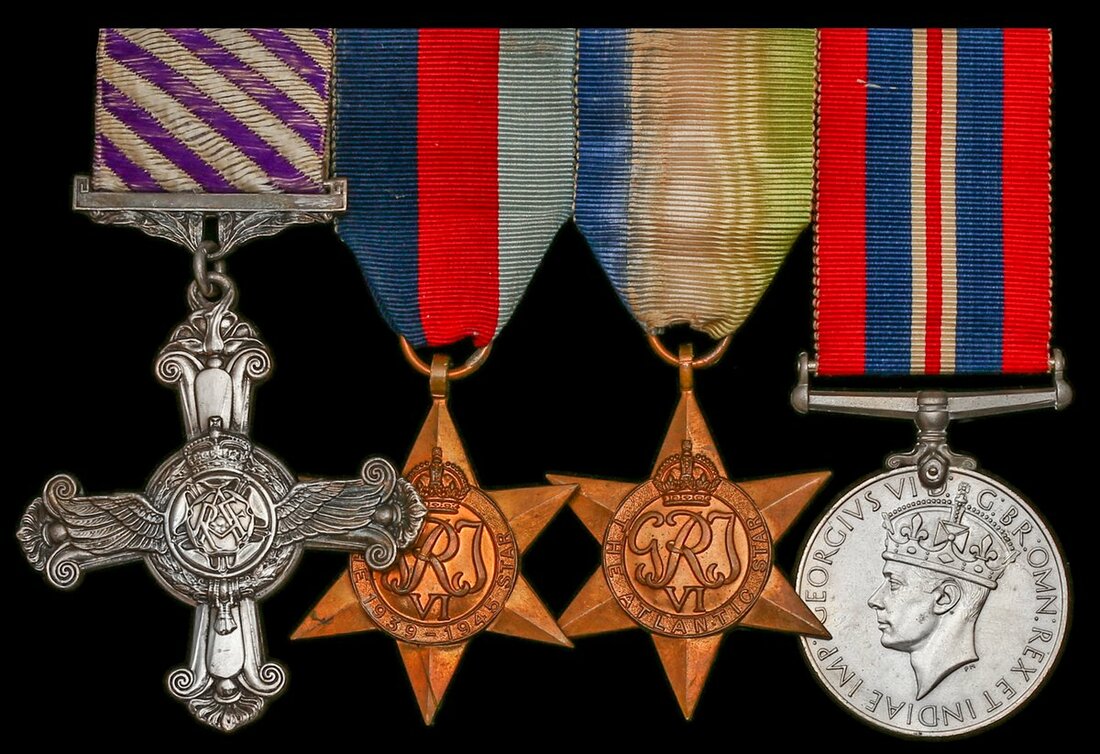
A Second World War D.F.C. group of four attributed to Flight Lieutenant E. H. Jeffreys, Royal Air Force, who was shot down and killed on 10 June 1944
Distinguished Flying Cross, G.VI.R., reverse officially dated '1943'; 1939-1945 Star; Atlantic Star; War Medal 1939-45, mounted for display, very fine (3)
D.F.C. London Gazette 16 February 1943.
Joint Citation with FO 119447 R. A. Irving. Awarded the D.F.C.
In January, 1943, Flying Officers Jeffreys and Irving were pilot and navigator respectively of an aircraft engaged on a shipping reconnaissance over enemy waters. In spite of adverse weather, success was achieved and valuable information obtained. Throughout the flight both these officers displayed great skill and determination. On a further 2 sorties later in the month they displayed great fortitude and devotion to duty.
Edmund Henry Jeffreys was born in South London on the 22 December 1921, the younger son of Captain R. E. Jeffreys, D.S.C., R.N. and M. E. Jeffreys (née Hobbs). He was educated at St Michael’s School, Uckfield from 1931 to July 1935 and at Radley College from September 1935 to December 1938. On leaving school he studied for entrance to the Royal Navy and was bitterly disappointed when he was unsuccessful. Instead, he went to work for the British Power Boat Company. He entered the Royal Air Force Volunteer Reserve in 1941 and rose to the rank of Leading Aircraftsman before being commissioned as a Pilot Officer on 24 January 1942. On completion of his training he was posted to 236 Squadron operating Beaufighter aircraft in September 1942 based at RAF Wick in Scotland. He was promoted to Flying Officer on 1 October 1942. In January 1943 Jeffreys and his navigator Flying Officer R. A. Irving set off from Wick in search of the German battleship Scharnhorst. The ship had been reported as having slipped out of Kiel and to be heading north. In appalling weather conditions, they spotted the vessel which, when discovered, turned back to head for home waters.
In the spring of 1943 Edmund Jeffries was transferred to 248 Squadron, who by D-Day were operating “Tsetse” Mosquitos. These were aircraft which fired armour piercing cannon and provided an escort on anti-shipping patrols in the Bay of Biscay. They were based at RAF Talbenny in Pembrokeshire. He was promoted to Flight Lieutenant on 25 January 1944.
On 10 March 1944 he and three other aircraft from the squadron, took off from RAF Portreath in a Mosquito Mk IV for a special patrol. Visibility was 8-10 miles below the cloud base. At noon, they spotted an enemy formation of eight to ten Ju88s which were protecting an enemy naval force at an altitude of 2,000 feet. Two of the enemy aircraft were night fighters as they were painted black. The Mosquitos engaged the Ju88s during which Edmund Jeffreys fired around 200 rounds of 20mm ammunition and damaged an enemy aircraft. On his return to base he filed the following combat report:-
'At 09.24, aircraft U/248 with R, Y and Z in formation as AA escort, and E/L of 248 Squadron (Special Detachment) sighted six Ju88s in line astern at 2,000 ft., circling enemy convoy. “U” then climbed up to base of broken cloud at 2,500 ft. with R, Y and Z and became detached from formation. ”U” formated on E/L 248 (Special Detachment and circled with “E” and “L” which made two attacks on target, while “U” climbed to 3,000 ft. Pilot then saw one Ju88 burning on the sea, and the starboard D.R of the last two turned round in an effort to pick up survivors, but regained former position as Ju88 burnt itself out on the water. Sighted one Ju88 ahead emerging from cloud. “U” made head on attack closing to 30 ft. The E/A pulled over and passed “U” to port, and was seen to emitting smoke. No return fire was experienced, and pilot was unable to avoid entering cloud and so lost visual contact. “U” then turned sharply to port, and on breaking cloud was attacked from very close range astern by another Ju88, using tracer which went to starboard, and later by a further 88 from a greater range also using tracer. ”U” took immediate evasive action and entered cloud, and attempted to regain contact with formation by V.H.F. Thick cloud prevented “U” from regaining proximity of convoy, and though contact was ultimately achieved no Mosquitos were seen. The Liberators however were sighted 3 miles distant and south of the convoy, and “U” weaved in behind them, then diving down ahead of them alongside the convoy at 3,000 ft. to 0 ft. at 360 m.p.h. Attempts were made to take photograph but camera jammed, and “U” turned away as Flak which was “hosepiped” and short, was being experienced from D.R.s. At this moment both Liberators followed “U” in to attack, the D.R.s opened fire with heavy and light flak. Pilot then s/o for base.'
On D-Day, 6 June 1944, 248 Squadron flew five anti-shipping sorties off Normandy, Brittany and off the coast of the Bay of Biscay. On 10 June 1944 he was to fly his last sorties. He took off from RAF Portreath in Mosquito FB Mk VI HR117 for an anti-shipping sortie off the French coast. They and three other aircraft from their squadron attacked the U-boat U-821 near Ushant. The attack was so ferocious that the crew abandoned ship and the abandoned submarine was sunk by a Liberator of 206 Squadron. That afternoon the squadron was called upon to undertake a follow up mission during which Jeffreys and his navigator F/O D. A. Burden were shot down by a motor launch which was carrying the survivors of U-821. Their aircraft crashed at Ushant. The motor launch was promptly sunk by other members of his squadron, with the loss of 50 lives. He is commemorated on the Runnymede Memorial.
For the medals awarded to his father, please see Lot 171.
Subject to 20% VAT on Buyer’s Premium. For more information please view Terms and Conditions for Buyers.
Estimate
£800 to £1,200
Starting price
£600

Watch, listen and bid as if you were in the room. Now available for auctions worldwide.
Click here to bid live
An exclusive and confidential service for the discerning collector or vendor.
View the Gallery
Download every Spink catalogue on your iPad, iPod or iPhone using free Spink app.
Download From iTunes© 2026 Spink & Son. All rights reserved.