
Auction: 26002 - Orders, Decorations and Medals
Lot: 231
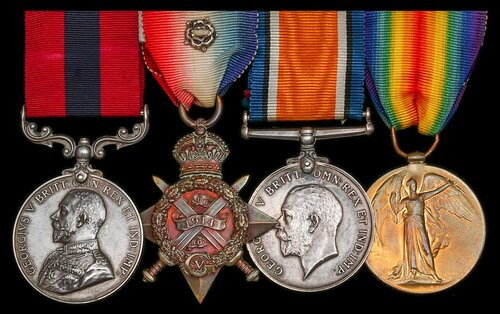
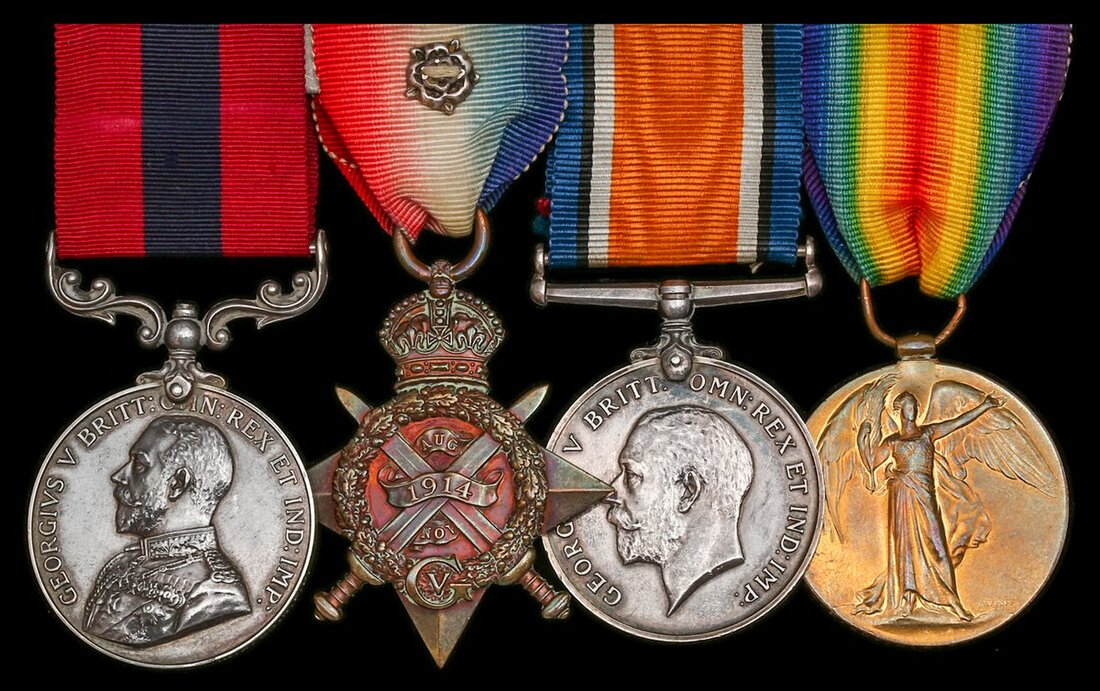
A Great War D.C.M. group of four to Flight Sergeant D. R. Baxter, Royal Flying Corps, who flew on numerous Artillery Patrols, accurately bombing enemy gun positions as well as attacking enemy infantry and vehicles with his Lewis gun at impressive heights
Distinguished Conduct Medal, G.V.R. (1336 Sjt: D. R. Baxter. No. 3/Sq: R.F.C.); 1914 Star (1336 Cpl. D. R. Baxter. R.F.C.); British War and Victory Medals (1336. F.Sgt. D. R. Baxter. R.F.C.), mounted as worn, very fine (4)
Provenance:
Spink, September 2001.
D.C.M. London Gazette 1 January 1917.
Citation for the D.C.M. Edinburgh Gazette 14 February 1917:
'For gallantry and meritorious work between July 1st and September 30th, 1916. Sergt. Baxter is a very good artillery observer, he has done well in many combats in the air, and on three occasions he has come very low to attack infantry on the ground. He has done excellently in the repair work of damaged machines.'
David Robert Baxter was born at Portsmouth, Hampshire, on 5 November 1893. He enlisted into the British Army as a Boy on 2 July 1908 and received a 3rd Class Certificate of Education on 21 July 1908, followed by a 2nd Class on 13 November 1908. He began his service as a Man on 2 December 1911 and served with 30 Company, Royal Engineers (35487). Baxter transferred to the Royal Flying Corps on 29 April 1914 and entered the war in France on 13 August 1914, serving as a 2 A.M. with No. 3 Squadron.
His early service is not confirmed however he went into Artillery Patrolling and also became an expert gunner. On 21 July 1916 he had an Artillery Patrol with Vavasour and this is followed on 24 July with one, the first of many, with Miller where they spot various flashes on two separate patrols. He is noted as engaging a battery on 31 July 1916 and in the same patrol he and his pilot Miller were attacked by 5 LVG's over Le Transloy. On 2 August 1916, this time with Vavasour as pilot, they engaged targets and large explosions were noted. This was repeated the following day with four direct hits on artillery pits on separate locations.
On 4 August they had two direct hits which started explosions of ammunition which appeared to be stacked along a side road, and this was followed an hour later with them silencing an active battery. On 7 August his pilot was Colonel Ludlow-Hewitt and they were attacked by five L.V.Gs. over Le Sars, one got close and four drums of ammunition were fired at the aircraft but without effect. On 8 August he was back with Vavasour and they engaged various targets resulting in exploding ammunition. The following day his pilot was Miller and they engaged and silenced an active battery resulting in them silencing it; this was followed by an attack on another but without success. He flies with Miller again on 17 August and their reporting resulted in 26th Heavy Battery engaging and silencing targets. He was up again with Miller on 29 August for Artillery Registration of which one point was registered and 3 balloons were additionally noted between Grevillers and Le Transloy.
Baxter's next patrol, again with Miller, resulted in five direct hits on two targets and a further successful target. On 3 September they enabled 26th Heavy Battery to successfully engage their target, in addition two enemy machines downed. 15 September saw him on an Artillery patrol, this time with Lynch, and they first silenceed an active battery, spotted various enemy tanks and then spotted a small body of enemy going south of Le Transloy of which they engaged and dispersed with Lewis gun fire from 1500 feet. Fifteen minutes later they spotted 2 motor cars entering Le Transloy and engaged with the machine gun at 1000 feet.
On 25 September, Lynch and Baxter spotted four two-horse wagons and three motor cars in Le Transloy which they engaged with the machine gun. The following day, this time with Green, they fired on a small party of troops running through LIGNY, scattering them. Baxter is back with Lynch on 27 September however they end their patrol early as a result of engine trouble and a storm.
A combat report dating 31 October 1916 notes his shooting at a German machine with ten or twelve tracers hit, however it was confirmed it was not actually brought down, despite firing one drum of tracer. Baxter qualified as an Observer on 17 November 1916.
He was gazetted for a Distinguished Conduct Medal on 1 January 1917 based on an original recommendation for an award by Captain A. M. Miller who was the O.C. 'B' Flight, No. 3 Squadron, Royal Flying Corps.
'No.1336 Sergt. Baxter D. Together with F/Sgt. Graham & 1/A.M. Young, this N.C.O. on several occasions worked all night on damaged machines in order that they could be ready for the following day's work. In excess of this he has shown great keenness in aerial observation, so much so that he is now able to carry out Artillery shoots as successfully as the best trained observer. On four occasions whilst flying with various pilots he has engaged with success hostile aircraft, and on 3 occasions has descended to 1000' and below, and engaged advancing enemy infantry with good results.'
Baxter survived a serious landing on 12 March 1917 flown by Lieutenant Carter. The aircraft ran into the road resulting in the undercarriage being wrenched off, the airscrew smashed and much other damage with the report asking for a replacement machine, Carter and Baxter somehow were unharmed. He was promoted to Flight Sergeant (N.C.O. Observer) on 1 May 1917 and was sent to No. 5 School of Aeronautics on 11 October 1917. However he was found unfit as a pilot on 14 January 1918.
Baxter was promoted Chief Mechanic (Observer) in April 1918 and was eventually discharged at Blandford as unfit from a combination of asthma and bronchitis on 8 February 1919 and lived at Swaythling, Southampton. He is further entitled to a Silver War Badge (4319). Baxter departed for South Africa on 5 March 1925 on S.S. Ballaratbut returned on 2 July 1934 on the Warwick Castle. However he returned to South Africa and died at Johannesburg, South Africa in 1955; sold together with a quantity of photocopied research, combat reports, precis of reports received, etc.
Subject to 20% VAT on Buyer’s Premium. For more information please view Terms and Conditions for Buyers.
Estimate
£6,000 to £8,000
Starting price
£5500

Watch, listen and bid as if you were in the room. Now available for auctions worldwide.
Click here to bid live
An exclusive and confidential service for the discerning collector or vendor.
View the Gallery
Download every Spink catalogue on your iPad, iPod or iPhone using free Spink app.
Download From iTunes© 2026 Spink & Son. All rights reserved.