Auction: 26002 - Orders, Decorations and Medals
Lot: 104
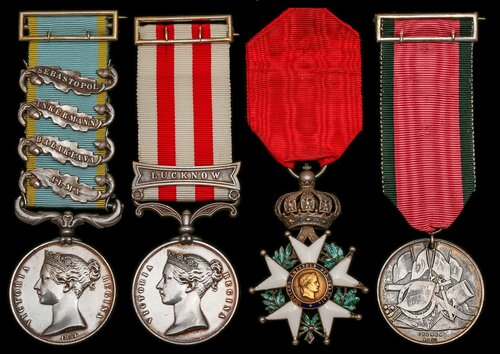
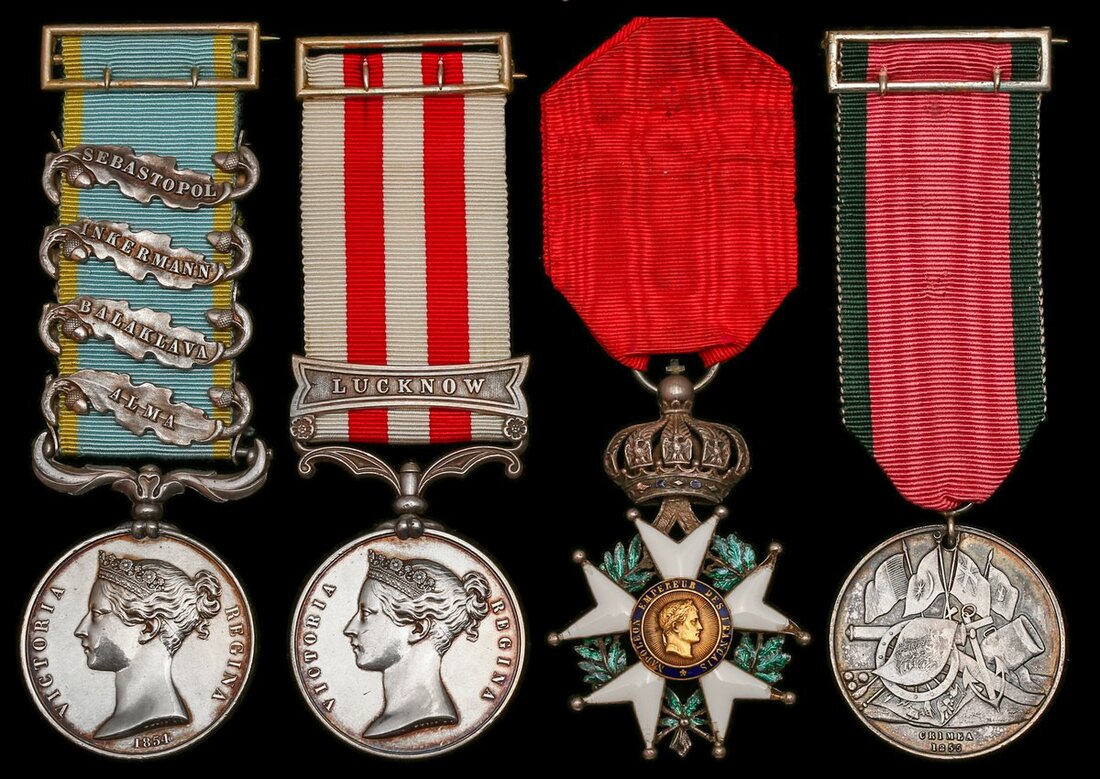
The campaign group of four awarded to Lieutenant S. J. M. Maxwell, 'E' Troop, Royal Horse Artillery, who was picked out for having 'galloped his Flanders wagons right into the trenches' with the aim of providing additional gunpowder during the bombardment of Sebastopol, and who was later wounded in action at Jugdeespore in June 1858 during the Indian Mutiny
Crimea 1854-56, 4 clasps, Alma, Balaklava, Inkermann, Sebastopol (Lieutt. S. J. M. Maxwell. Rl. Horse Arty); engraved ‘Hunt & Roskell’ style in smart upright capitals; Indian Mutiny 1857-58, 1 clasp, Lucknow (Lieut. S, J, M. Maxwell, Rl. H. Art.); France, Legion d’Honneur, Knight’s breast Badge, silver and enamels with a gold centre; Turkish Crimea, British issue, by Hunt & Roskell, unnamed as issued, first, second and fourth with silver-gilt claw-type top bars upon ribbons, the latter marked ‘Hunt & Roskell' to reverse, the Legion Badge with some damage to finial points and white enamels, therefore nearly very fine, otherwise good very fine (4)
Provenance
Glendining, 29 May 1980.
John Stuart Mildmay Maxwell was born on 8 March 1834 in the British Chaplaincy, Rome, the son of Captain George Berkeley Maxwell and Letitia Maxwell (née Clerk). Passing out from the Royal Military College in 1853, he enlisted for service with the Royal Artillery and received his first Commission as Second Lieutenant on 22 June 1853.
Promoted Lieutenant on 20 June 1854, he joined the Royal Horse Artillery and was present in the Crimean War with 'E' Troop/'H' Battery. He appears on the list of Royal Artillery Officers present at the Battle of the Alma. This was a famously uncoordinated action for the artillery with little communication between themselves and the infantry, instead they brought guns up the hill and into action as possible.
He was to see further action at Balaklava, the Russian Reconnaissance of 26 October 1854 (also called Little Inkermann), the Battle of Inkerman itself and during the Siege of Sebastopol. It was during the Great Bombardment of Sebastopol that he was selected for praise by his superiors for bringing a supply of powder to the guns, having 'galloped his Flanders wagon right into the trenches' during the bombardment (The History of the Royal Artillery (Crimea Period) by Jocelyn refers).
While it has not been possible as of yet to confirm the citation behind the award of his Legion d'Honneur from official sources, it seems very likely that this award - confirmed in British Battles & Medals - was made with this action in mind.
Maxwell later travelled with 'E' Troop to India to serve during the Mutiny, taking part in the skirmish at Pandora, there 'E' Troop joined Brigadier Campbell's force enroute to Allahabad. Joining Grant's force they advanced towards Lucknow, pausing to take part in the capture of Maingunge in February 1858. Arriving before Lucknow they took part in the eventual relief of the city.
After this, they were deployed for action around Azimgaur and at Jugdeespore under Brigadier Lugard. They were present in action in the Jugdeespore Jungles from 7-9 May, and they were still in the area the next month when Maxwell was wounded in action. The Battery saw further action in Oude under Grant, capturing Rampore Kussia in November 1858, Amithi and Shunkgepore.
They were withdrawn from the line and sent to Fyzabad in mid-November that same year before and Maxwell died just two years later in 1860 at the age of 26, cutting short a promising life and career; sold together with copied research.
Subject to 20% VAT on Buyer’s Premium. For more information please view Terms and Conditions for Buyers.
Estimate
£800 to £1,200
Starting price
£750
Watch, listen and bid as if you were in the room. Now available for auctions worldwide.
Click here to bid live
An exclusive and confidential service for the discerning collector or vendor.
View the Gallery
Download every Spink catalogue on your iPad, iPod or iPhone using free Spink app.
Download From iTunes© 2026 Spink & Son. All rights reserved.