
Auction: 26002 - Orders, Decorations and Medals
Lot: 90
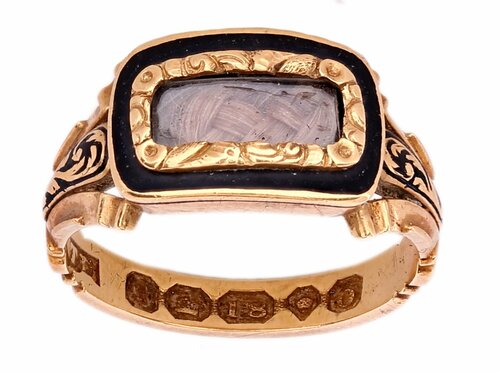
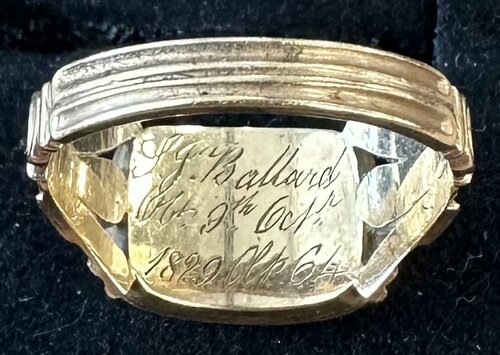
(x) Georgian gold and enamelled Mourning Ring in memory of Rear-Admiral of the Red Samuel James Ballard, whose long and illustrious career saw him participate in the Glorious First of June, the invasion of Guadeloupe and the siege of Porto Ferrajo, after beginning his career during the American Revolution where he was present at the Battles of Ushant, Cape St. Vincent, Fort Royal, Chesapeake Bay and St. Kitts
Gold band with black enamel detail, small portion of braided hair inset into the centre and protected behind glazed panel, interior engraved with the inscription 'S. J. Ballard, Ob. 9th Octr. 1829 AE. 64', with London hallmarks for 18 carat gold, date letter circa 1809-10, 'TD' maker's mark, 17mm diameter, varying thickness 1-3mm, varying width 3-8mm, weight 2.68g, some light rubbing and scratches to panel, otherwise very fine
Samuel James Ballard was born in March 1765 in Portsmouth, the son of Samuel Ballard, a local ship chandler who was formerly a junior naval officer, and his wife Lydia Flint. The younger Ballard first joined the Royal Navy in 1776 under the patronage of Captain the Honourable John Leverson-Gower, serving as a Boy aboard H.M.S Valiant from the tender age of 11. He was with Valiant under Leverson-Gower when she was a part of Admiral Keppel's Grand Fleet during the Battle of Ushant in July 1778, where she was in the centre of the fleet and pursued French frigates which had been shadowing the British. Ballard later left Valiant upon his transfer to the 74-gun H.M.S. Shrewsbury under Captain Mark Robinson in October 1779, and with her bore witness to Admiral Rodney's destruction of the Spanish fleet at the Battle of Cape St. Vincent just a few months later in January 1780.
Shrewsbury rejoined Admiral Rodney's fleet in the West Indies where she participated in the Battle of Fort Royal off Martinique in April 1781. She quickly saw action once more in September at the Battle of Chesapeake Bay. There, she took on a much more prominent role leading the vanguard. Sustaining significant damage under French fire, Shrewsbury lost her main and fore topsails and later fell out of the line after her fore and main topmasts were shot away, suffering a total of 14 killed and 52 wounded during the battle - a figure which included Captain Robinson who lost his leg. After the battle she returned to the West Indies under Admiral Hood and next saw action at the Battle of St. Kitts in January 1782, now under the command of Captain John Knight. There, the ship was in the centre division and afterwards proceeded to Jamaica for repairs.
In February 1783, the now 17-year-old Ballard was promoted Lieutenant by Rear-Admiral Joshua Rowley. Despite the ten years of peace which followed the end of the American Revolutionary War, Lieutenant Ballard managed to obtain a number of postings including aboard 32-gun fifth rate H.M.S. Astrea under Captain Peter Rainier, who he followed into service with 74-gun H.M.S. Monarch in 1790 during the Spanish armament. After a period aboard 74-gun H.M.S. Alfred, the outbreak of the French Revolutionary War in 1793 found Ballard serving with 98-gun second rate H.M.S. Queen, Rear Admiral Alan Gardner's flagship. He served as her First Lieutenant during the Glorious First of June 1794, where she was in the centre squadron and commanded by Captain John Hutt. Queen suffered heavy damage to her masts after engaging the French line, and together with H.M.S. Orion faced Northumberland and Jemmappes, forcing their surrender though Queen was in such a state of disrepair that she was unfortunately unable to secure Jemmappes. French Admiral Villaret found an opportunity to aim an attack at the mostly-disabled Queen, but Lord Howe managed to reform a squadron and successfully came to her rescue, driving off Villaret. Queen was heavily battered during the course of the battle and had the second-highest casualties of any British ship with 36 killed and 67 wounded. This number included her Captain, who died after the loss of his leg.
Ballard's services during the battle were such that he was made Commander on 5 July, in which capacity he had a number of short-term appointments including aboard small 14-gun H.M. Sloop Flirt, the Channel Fleet's fireship Megaera, and finally the more impressive 74-gun Tremendous for a few months in spring 1795. Ballard was advanced Post-Captain that August, and enjoyed temporary command of H.M.S. Irresistible in the autumn. In February 1796 he was finally granted a permanent command as Captain of the 32-gun frigate H.M.S. Pearl. The beginning of his appointment was spent convoying trade around Canada. This was patently not a successful venture, with several of the ships under her early Quebec convoy being captured by a French privateer in April 1796, with another convoy out of Quebec that October losing seven of its ships.
Once away from Canada, Ballard and Pearl enjoyed more success. After convoy and escort duty in the Baltic and English Channel, on 16 April 1797 alongside Flora she captured the 24-gun French privateer Incroyable, manned by 220 men, following a chase in the Bay of Biscay. In 1797 Ballard married his first cousin Maria Flint, who later passed away in 1821. Prior to her death the couple had 8 children together, of whom only three were living by the time of Ballard's own death.
Pearl sailed to West Africa with Commodore William Cornwallis in March 1798, where after several months of patrol she was posted to the Barbados station. There, Ballard captured the 10-gun privateer Scaevola and the 12-gun Independence. Pearl returned home in June 1799 and that October carried General Henry Fox to serve as Lieutenant-Governor of Minorca, with Pearl remaining in the area attached to the Mediterranean fleet and joining Lord Nelson's squadron at Palermo in December. That February, she drove ashore a 14-gun Genoese polacre and then enjoyed a period of great success cruising the Mediterranean, reportedly assisting in the capture or destruction of some 50 vessels, mostly privateers. She also participated in the Siege of Porto Ferrajo in 1801, where the British allied with Tuscan forces to prevent French forces from seizing the Elba town. In August 1801, off the coast of Elba, Pearl assisted in the capture of 40-gun French frigate Carriere alongside H.M.S. Pomone.
After a few years under Ballard's command, Pearl returned to England where she was paid off on 14 March 1802. Ballard's next role was notably less action-packed, spending the following seven years commanding the naval militia the Essex Sea Fencibles. He returned to action in October 1809 with his appointment to 74-gun third-rate H.M.S. Sceptre with whom he sailed to join Vice-Admiral Sir Alexander Cochrane's Leeward Islands squadron. There appointed Commodore, Ballard took command of his own squadron which captured two 40-gun French frigates, Loire and Seine, and destroyed the shore batteries at Anse-la-Barque, Guadeloupe. Ballard was active at the reduction of Guadeloupe in early 1810, during which he escorted an army division and commanded a naval brigade. Sceptre returned to England that September and spent the next two years on duty with the Channel Fleet and in the Bay of Biscay. This rather uneventful period was to prove the end of his service afloat, and he went ashore when Sceptre was paid off in January 1813.
Though his service at sea was ended, Ballard was advanced Rear-Admiral on 4 June 1814 and on 27 May 1825 was promoted Vice-Admiral. Following the death of his first wife Ballard was re-married to the widowed Catherine Crawley, nee Boevey, on 2 December 1822.
The illustrious Admiral Ballard died at his home at 29 Park Street, Bath, in October 1829 at 64 years of age. He was buried at St. Margaret and St. Andrew Churchyard in Exmouth, Devon and was survived by two daughters, a son, and his wife Catherine. This ring was likely worn by one of his female family members to commemorate his death.
Compiled with reference to https://morethannelson.com/officer/samuel-james-ballard-1765-1829/.
Subject to 5% tax on Hammer Price in addition to 20% VAT on Buyer’s Premium.
Estimate
£300 to £500
Starting price
£240

Watch, listen and bid as if you were in the room. Now available for auctions worldwide.
Click here to bid live
An exclusive and confidential service for the discerning collector or vendor.
View the Gallery
Download every Spink catalogue on your iPad, iPod or iPhone using free Spink app.
Download From iTunes© 2026 Spink & Son. All rights reserved.