
Auction: 26002 - Orders, Decorations and Medals
Lot: 52
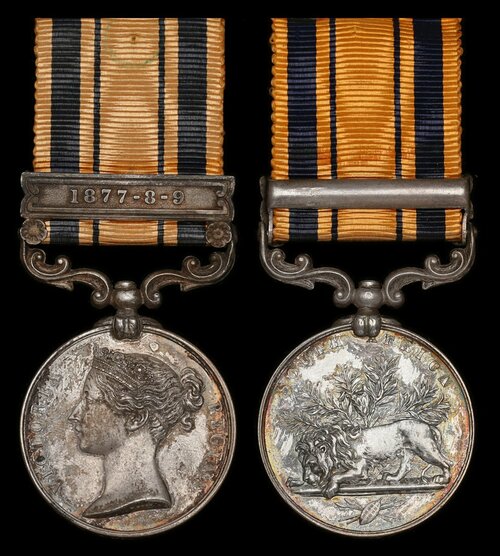
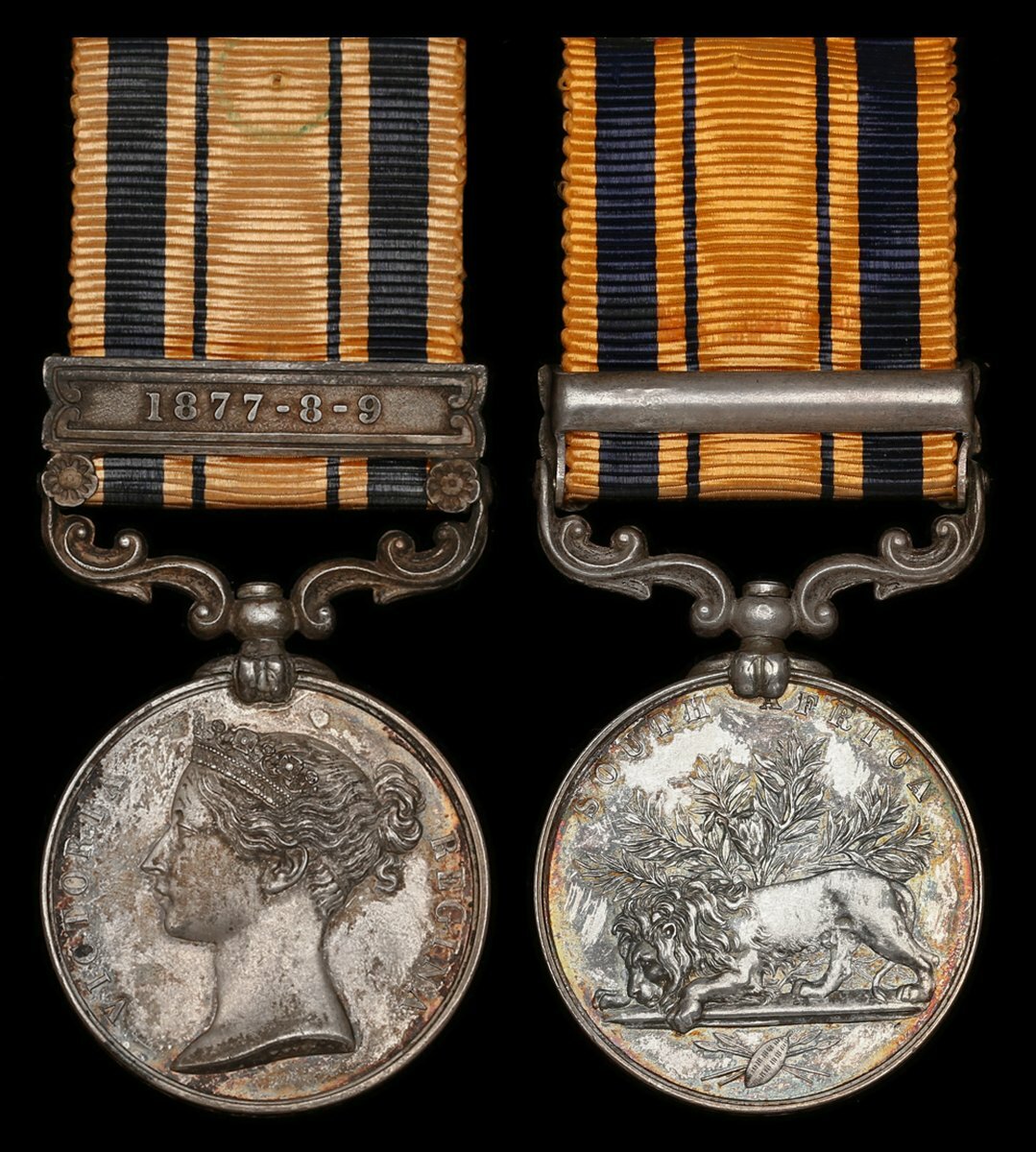
A rare Isandlwana casualty's South Africa Medal awarded to Gunner T. Harrison, 'N' Battery, 5th Brigade, Royal Artillery, one of the few Gunners on the field, who was killed in the legendary action on 22 January 1879, which saw his unit massacred whilst trying to save the guns
South Africa 1877-79, 1 clasp, 1877-8-9 (668. Gunr. T. Harrison. N/5. R.A.), somewhat toned, nearly extremely fine and rare
Of the 71 men of 'N' Battery in the camp, 62 became casualties of which 30 served as Gunners.
Thomas Harrison appears on the roll as a Gunner with the 'N' Battery, 5th Brigade, Royal Artillery.
Isandlwana - Opening Moves
Both battalions of the 24th participated in the campaign (each fielding six companies) with the 1st Battalion forming the principal element of Number Three Column, which was under the overall command of Colonel Richard Glyn of the 1st/24th: therefore Brevet Lieutenant-Colonel Henry Pulleine was appointed to command in his stead.
Upon crossing the Buffalo River on 11 January, the column (accompanied by the Commander-in-Chief, General the Lord Chelmsford) found itself pitching camp nine days' later at the base of a prominent feature - the hill at Isandlwana. Chelmsford, eager to bring the campaign to a swift conclusion, departed at dawn on 22 January with half the column's strength (some 2,800 men) leaving behind Pulleine with approximately 1,300 men: five companies of the 1st/24th, one company of the 2nd/24th, 700 men of the Natal Native Contingent, two 7-pounder artillery pieces and a rocket battery.
Battle and Defeat
Failing to take any defensive measures to secure the camp, Pulleine's force was subsequently surprised by a vast Zulu army totalling some 20,000 warriors which, by additionally using the terrain to their advantage, swept forward to the attack using their traditional 'Horns of the Buffalo' strategy of a central advance supported by encircling forces on both flanks. Pulleine deployed the 24th Foot some way in advance of the camp in an extended firing line, aiming to subdue the Zulus with superior firepower. For at least an hour, the British held the Zulu warriors at bay, inflicting significant casualties with their powerful Martini-Henry rifles and aided by support from the two 7-pounder guns from N/5 Battery Royal Artillery.
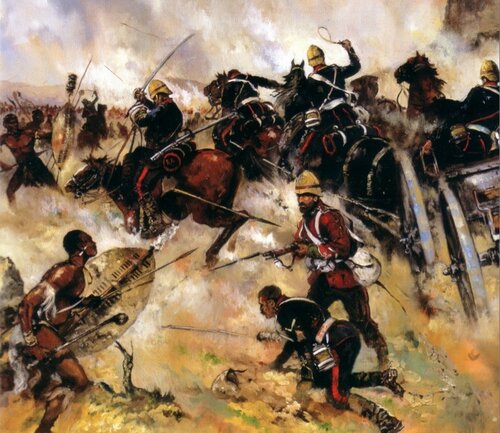
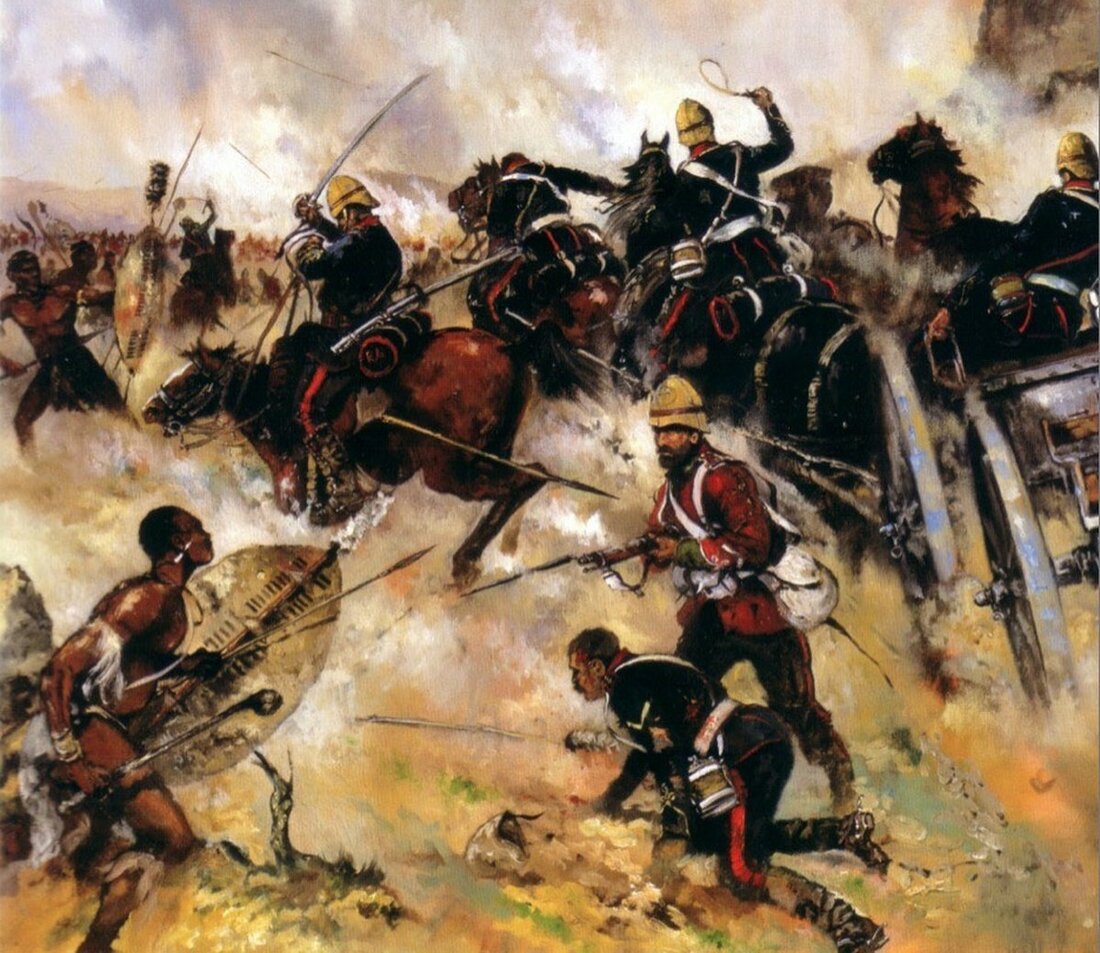
As the British found themselves overwhelmed and pushed back on the camp, Pulleine called out every man who could bear arms, doubtless including many men of 'N' Battery who were engaged in administrative duties. Eventually as the lines were overrun Major Smith gave the order to save the guns, and very few were to survive the headlong flight into Natal. That is not to say the entire Battery withdrew, many were not actively with the guns and these men would have died alongside the 24th Regiment in the last stands throughout the camp. The plight of those on the road was outlined well in The Road to Isandlwana by Philip Gon, which states:
'The gun detachments of N/5, with the limber gunners running behind, fought their way through the camp, losing fifty men in an attempt to save the guns. They paused on the Nek long enough to confer with Coghill about what hope there was of making a stand, and decided it was futile. Major Smith, who was wounded, felt that his first duty was to save the guns.
The rock-strewn slope behind the stony kopje was near impossible for any wheeled conveyance; and the spectacle of the big guns in flight acted as an incitement to the warriors behind Isandlwana. Slowed by the broken ground and by stragglers clinging to the traces, the teams were quickly overtaken. Drivers were pulled off their horses and gunners from their seats. The unattended horses, crazed by noise and stab wounds, broke into a wild, headlong gallop that took them to their destruction over the edge of a boulder-strewn ravine. The only survivors were the two independently mounted artillery officers. Gunners and stragglers were hacked to pieces.'
The scale of the loss to the Battery as a whole is neatly summed up in The South African Campaign of 1879 by MacKinnon and Shadbolt which states:
'The battery formed part of Glyn's Column of the army of invasion, and consisted, at the time of its entry into Zululand, of 130 of all ranks, with six guns, 73 horses, 36 mules, and six mule-carts, with transport waggons. In the disastrous encounter with the enemy at Isandhlwana, the battery lost Bt. Major Stuart Smith, 61 non-com. officers and men, two guns, 24 horses, 30 mules, and 534 rounds of ammunition, besides the whole of the camp equipment.'
Subject to 20% VAT on Buyer’s Premium. For more information please view Terms and Conditions for Buyers.
Estimate
£5,000 to £7,000
Starting price
£4800

Watch, listen and bid as if you were in the room. Now available for auctions worldwide.
Click here to bid live
An exclusive and confidential service for the discerning collector or vendor.
View the Gallery
Download every Spink catalogue on your iPad, iPod or iPhone using free Spink app.
Download From iTunes© 2026 Spink & Son. All rights reserved.