
Auction: 26002 - Orders, Decorations and Medals
Lot: 49
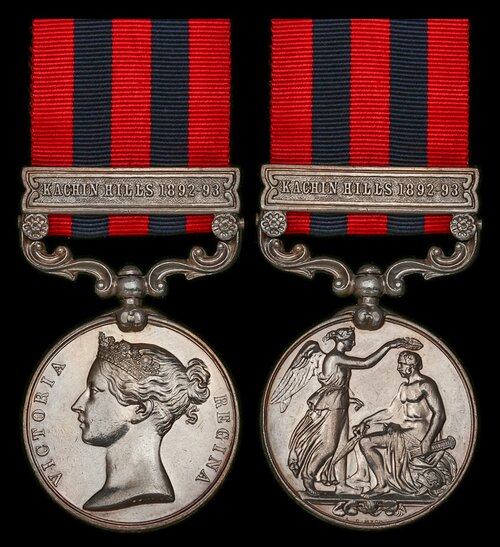
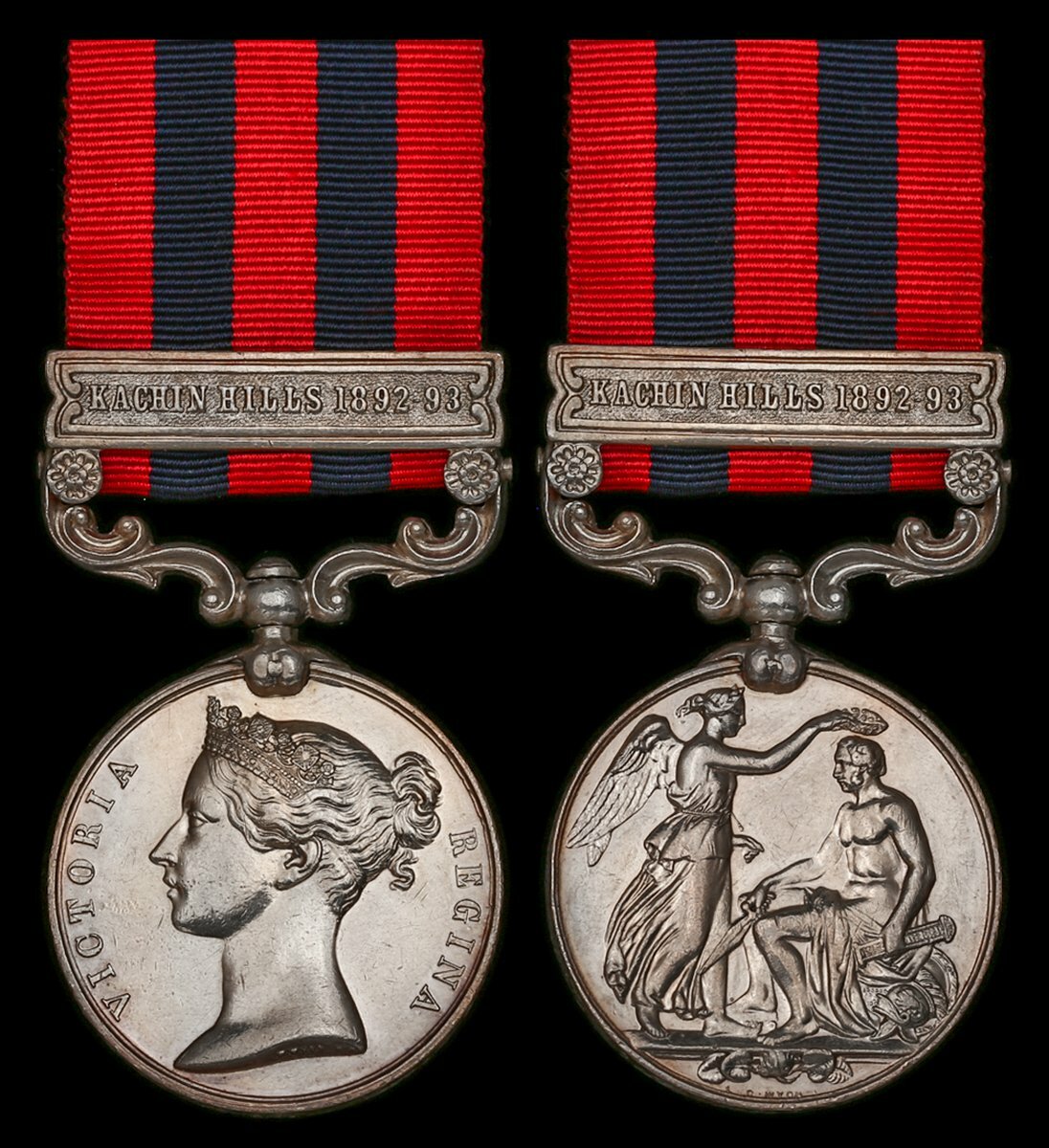
The India General Service Medal awarded to Lieutenant-Colonel J. L. W. Ffrench-Mullen, C.S.I., C.I.E., K.P.M., 13th Bengal Lancers and Burma Military Police
A long-served frontier hand, he was wounded in the Kachin Hills campaign, before serving with the Burma-China Boundary Commission 1898-1900, on the Piema Expedition of 1910 - for which he took his C.I.E. - before the Great War, serving once again in the Kachin Hills in 1915; and finally as Staff Officer for the Kuki Rebellion, taking a unique C.S.I. for that final campaign
India General Service 1854-95, 1 clasp, Kachin Hills 1892-93 (Lt. J. L. W. Ffrench-Mullen. 13th. Bl. Lcrs.), officially re-engraved naming as most often encountered, good very fine
Provenance:
Christie's, July 1987.
[C.S.I] London Gazette 5 June 1920 (Kuki Rebellion - Assam & Burma).
[C.I.E.] London Gazette 14 June 1912 (Northeast Frontier - Pienma Column).
[K.P.M.] London Gazette 1 January (Deputy Inspector-General, Burma Military Police).
Clasp 'Kachin Hills 1892-93' authorised on 9 January 1903 for the various small Columns and clashed which pushed into the Kachin Hills of Upper Burma to pacify the local resistance. The main engagements took place from December 1892-February 1893 with numerous attacks on British-held posts and stockades. The Field Force comprised just over 1,200 men and saw action around Bhamo, on the Chinese border near Muse and at Nkrang, Mytikina, Mali and Sima. Of the force, 3 Officers were killed or wounded whilst some 102 men were killed or wounded. Surgeon-Major Lloyd of the Army Medical Service won the Victoria Cross for his bravery when defending the Fort at Sima, in which Captain Morton was mortally wounded.
John Lawrence William Ffrench-Mullen was born on 24 March 1868, eldest son of Colonel T. Ffrench-Mullen of Tuam, County Galway. Educated at The Oratory, Edgbaston, young Ffrench-Mullen thence went to the Royal Military Academy Sandhurst and was commissioned 2nd Lieutenant into the 7th Dragoon Guards in September 1887. Transferred to the Indian Army, he joined the Indian Staff Corps as Lieutenant in January 1889 and joined the 2nd Cavalry in 1890. Made Assistant Commandant of the Upper Chindwin Battalion, Burma Military Police in June 1892, he was made a Squadron Officer with the 13th Bengal Lancers in May 1893 and served with them in the Kachin Hills Expedition, during which he was one of few Officers wounded.
Advanced Captain in September 1898, he was once again up to the frontier and commanded the Military Police Escort to the Burma-China Boundary Commission from 1898-1900. Squadron Commander for the 13th Lancers by November 1901, he was advanced Major in September 1905. Having been at the 1911 Durbar (Medal), with the outbreak of the Great War, Ffrench-Mullen served as Lieutenant-Colonel in the Kachin Hills during 1915 (1914-15 Star Trio). Latterly sharing the action against the Chins 1917-18 and thence as Chief Staff Officer during the Kuki Rebellion, for which he took his C.S.I. - which would be a unique award for that campaign. It further saw 6 C.I.E.'s, 2 D.S.O.'s, 2 C.B.E.'s, besides a good smattering of I.D.S.M.'s. The following extract has been taken from a definitive account of the rebellion; see kaiserscross.com/304501/525801.html
'The Kuki Rising was eventually put down by a combination of British military ruthlessness supported by modern weapons of war, assisted by Kuki pragmatism in submitting when morale was low and further resistance was seen to be futile. The Kuki Rising was not the most glorious of Britain's colonial actions and it was deliberately under-publicised at the time. However, the exertions and courage of the British sepoys in fighting serious and savage banditry over very hostile terrain deserve recognition.
Totalling the results of military operations between December 1917 and May 1919, 140 rebel villages were destroyed, 112 rebel villages submitted and 15 villages were found deserted. In Manipur 970 muskets were confiscated whilst in the south Chin Hills over 600 were handed in. Large amounts of grain and cattle were also confiscated. The estimated number of Kukis killed was 126 men, but doubtless others died of wounds away from the scenes of action, especially when the new British weapons came into use. The British lost 59 all-ranks killed, 135 wounded and 97 dead from other causes, principally disease.
The whole affair had been an embarrassment to the Government of India and the campaign was denied publicity. Participation in the campaign did not qualify for a clasp to the India General Service Medal; however, troops who served in the field for any period from the start of the Kuki rising until 31 October 1918 qualified for the award of the British Victory Medal. Two Distinguished Service Orders were awarded but the citations were not published.
The last word must go to the Kukis. They led the British on a merry dance for 18 months armed only with ancient muskets, they carried no packs and had no supply trains or medical support but they knew their own country well and how to live off it and fight effectively from it. They were a tough and fierce adversary who commanded the respect of all who went up against them.'
Finally retired in May 1920, the good Colonel, who could speak Persian, Burmese, Kachin, Pushtu, Baluchi, Maru, Chinese (Yunanese) and Shan, died at Bournemouth in October 1951; sold together with copied research.
Subject to 20% VAT on Buyer’s Premium. For more information please view Terms and Conditions for Buyers.
Estimate
£500 to £700
Starting price
£400

Watch, listen and bid as if you were in the room. Now available for auctions worldwide.
Click here to bid live
An exclusive and confidential service for the discerning collector or vendor.
View the Gallery
Download every Spink catalogue on your iPad, iPod or iPhone using free Spink app.
Download From iTunes© 2026 Spink & Son. All rights reserved.