
Auction: 26002 - Orders, Decorations and Medals
Lot: 15
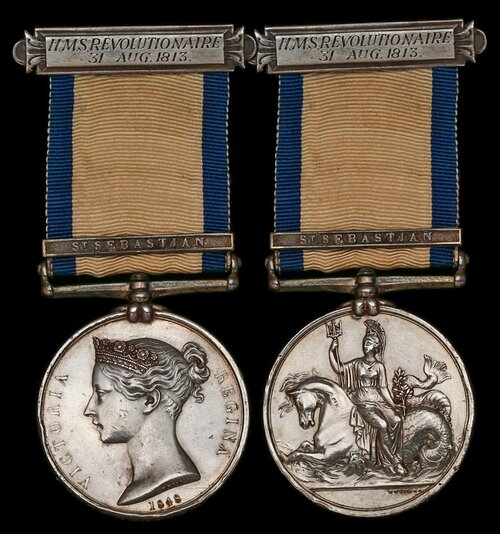
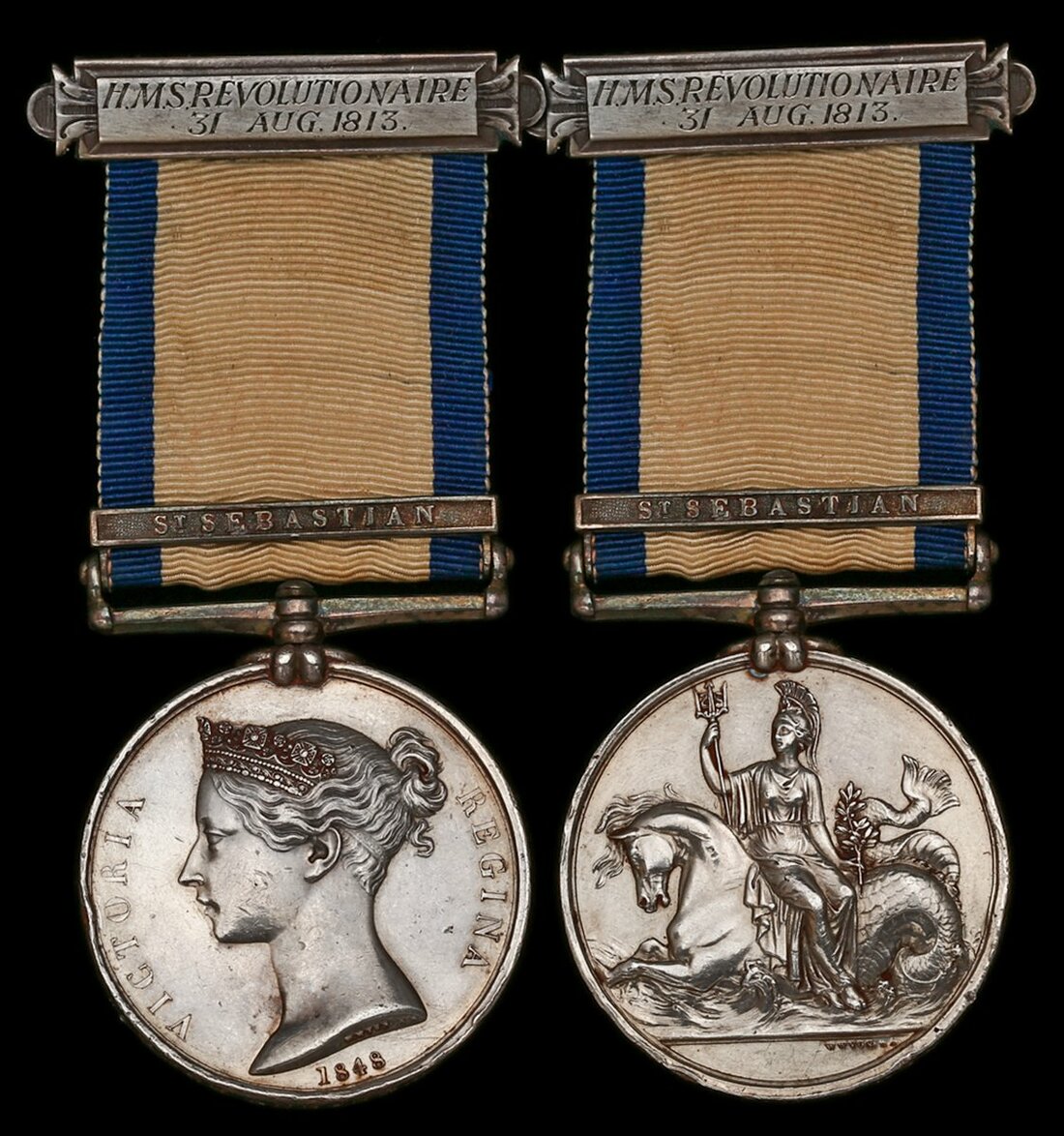
Naval General Service 1793-1840, 1 clasp, St. Sebastian (Owen Anning.), fitted with an attractive riband bar engraved 'H.M.S. Revolunionaire 31 Aug 1813' to the obverse, with 'St. Sebastian O.A.' engraved to the reverse, a number of edge bruises with edge wear, contact marks throughout, good fine possibly better
Provenance:
Sotheby’s, November 1986, formerly in the Murray Collection.
One of 31 of these clasps awarded to the men of H.M.S. Revolutionnaire.
Owen Anning was born in Exeter and worked as a cabinet maker prior to enlisting with the Royal Navy, at which time he had been living at King’s Cross, London. He first entered the books of the 36-gun fifth-rate frigate H.M.S. Revolutionnaire on 14 December 1812 as a 21-year-old Landsman. She was originally a Seine-class French vessel, launched for the French Navy in May 1794, only to be captured by the British that October. Revolutionnaire then entered the service of the Royal Navy in April 1795 and thus turned her back on those who had laid her down. Anning presumably joined her during her refit at Plymouth when she was recommissioned under the command of Captain John Charles Woolcombe in October 1812.
Anning would have sailed with her to North America where she successfully recaptured H.M.S. Ajax from an American privateer who had taken her the previous March during her journey from Aberdeen to the Caribbean. Revolutionnaire also captured American privateer schooner Matilda in July 1813, who had been previously captured by the British but recaptured by the Americans. The next month, Revolutionnaire joined Captain Sir George Collier’s squadron and supported the British Army in the Siege of San Sebastian and participated in various naval operations. She took part in the squadron’s attack on Santa Clara and provided seaman for the battery then established on the island to man the guns hauled up from flagship H.M.S. Surveillante.
Beyond the action at San Sebastian, she captured Fire Fly that October and Gaditana the following month. At the close of the year, she was part of a convoy for the East Indies. Anning was advanced Carpenter’s Crew on 1 March 1814 and was still on board when Revolutionnaire was severely damaged by a hurricane in Simon’s Bay, South Africa in July 1816 after which she was forced to return home for repairs. Back in Britain, Anning left her on 24 December 1816 and does not appear to have seen further service aboard any other ships. He later appears in 1869 as a 76-year-old widower in receipt of a Greenwich Hospital Pension.
Anning is confirmed with entitlement to this medal and clasp; sold together with copied research.
Subject to 20% VAT on Buyer’s Premium. For more information please view Terms and Conditions for Buyers.
Estimate
£1,400 to £1,800
Starting price
£1300

Watch, listen and bid as if you were in the room. Now available for auctions worldwide.
Click here to bid live
An exclusive and confidential service for the discerning collector or vendor.
View the Gallery
Download every Spink catalogue on your iPad, iPod or iPhone using free Spink app.
Download From iTunes© 2026 Spink & Son. All rights reserved.