
Auction: 26002 - Orders, Decorations and Medals
Lot: 14
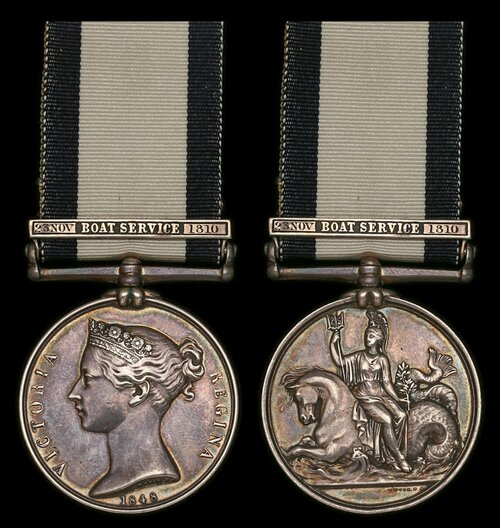
The rare Boat Service Naval General Service Medal awarded to Master’s Mate G. Smithers, Royal Navy, a long-served Officer who was taken Prisoner of War in December 1813; he later enjoyed command of H.M.S. Conflict, with whom he captured a slave schooner off the coast of Africa
Naval General Service 1793-1840, 1 clasp, Boat Service 23 Nov. 1810 (Geo. Smithers, Master's Mate.), small edge bruise at 6 o'clock, lightly polished and with mild toning, generally very fine
Provenance:
Sotheby's, May 1989.
Approximately 40 clasps for ‘Boat Service 23 Nov. 1810’ were claimed.
George Smithers was born circa 1789, entering the Royal Navy as a First-Class Volunteer as a young man in 1803. He served first with H.M.S. Prince before joining H.M.S. Salvador del Mundo as a Midshipman in May 1806. Thereafter, he served as a Midshipman under the great Captain Thomas Masterman Hardy on H.M.S. Triumph along the coast of North America and Cornwall. Smithers was next posted to H.M.S. Ville de Paris and assisted in embarking General Moore’s army at Corunna in January 1809. In 1810 he joined the sloop Wizard and then the bomber H.M.S. Aetna under the command of Captain John Fordyce Maples, with whom he earned his clasp.
The British had been working to defend Cadiz from a siege by the French, with the enemy having gathered a gun-boat flotilla to carry out that purpose. On 23 November 1810 Aetna was part of a company of bomb vessels together with H.M.S. Devastation and Thunder, as well as a number of English and Spanish gun boats, which attacked the French flotilla at Port St. Mary. Under the command of Captain R. Hall and under fire from Fort Catalina, hundreds of shells were thrown to the enemy which resulted in heavy damage to the French forces.
Smithers appears on both the Medal and roll as a ‘Master’s Mate’, though it is unknown when he entered this rank. It was common at the time for Midshipmen who had passed their Lieutenant's exam to be elected master’s mates whilst awaiting promotion. Given that Smithers received that promotion the following year, this would have been a logical appointment in the interim.
Later in 1810 Smithers joined Admiral George Cranfield Berkeley’s flagship H.M.S. Barfleur and was thus employed at the defence of Cadiz on the Lisbon Station. On 4 June 1811 he was nominated as Acting Lieutenant aboard H.M.S. Alfred and with her further engaged at the defence of Cadiz, and with her was confirmed in that rank on 23 August. Whilst at Cadiz he was taken ill with ‘lues venera’ (syphilis) and invalided to England in March 1812. After a few months recovery he was fit to return to sea, joining H.M.S. Goldfinch in September and sailing off the coast of France. However, the following year Smithers was taken prisoner in December 1813 under unclear circumstances. Regardless, he was back in the fold the next year and served with H.M.S. Centaur from December 1814-15. Aboard her Smithers reportedly became quite the traveller, sailing to Rio de Janeiro, the Cape of Good Hope, and the island of St. Helena.
At some stage Smithers returned home to England and on 13 September 1816 was married to his wife Caroline at St. Andrew’s Church in Plymouth. The couple went on to have issue of at least three sons: George James Smithers born October 1822; Charles Goldsworthy Smithers born October 1827, and Edwin Smithers born January 1838. All three sons followed in their father’s footsteps to embark on a career in the Royal Navy and were admitted to Greenwich Hospital School (in 1834, 1839, and 1848, respectively).
He was given his first independent command on 23 March 1830 of the 12-gun gun brig H.M.S. Conflict for service off the African coast. With her Smithers captured a slave schooner; a “gallant affair” on which the newspapers reported:
“The Conflict was on her return from the River Gambia on the 1st of December, when she fell in with a suspicious-looking sail, to which she immediately gave chase, but it falling a dead calm, an armed boat was sent…with orders to board and search the stranger. The latter, on the boat’s approach, discharged guns and small arms into her, which wounded several men. Mr. Rose then made a signal for another boat from the Conflict, which soon joined them, and together they carried the schooner, after a desperate resistance, in which the British had nine men wounded, the slaver seventeen men killed and drowned, the latter being driven overboard in the combat. The captors found one hundred and sixty-seven slaves on board, in a miserable condition, the whole of which were taken to Sierra Leone, where the Captain and crew were imprisoned, and were to be tried under a special commission.” (Dublin Morning Register 11 February 1831, refers).
Smithers left her in 1832, and does not appear to have had any subsequent postings. He is noted in 1849 as having been on half-pay since leaving Conflict, and appears on the Royal Navy list as a Lieutenant in 1850; sold together with copied research including medal roll and Smithers’ British Naval Biographical Dictionary entry.
Subject to 20% VAT on Buyer’s Premium. For more information please view Terms and Conditions for Buyers.
Estimate
£4,000 to £6,000
Starting price
£4000

Watch, listen and bid as if you were in the room. Now available for auctions worldwide.
Click here to bid live
An exclusive and confidential service for the discerning collector or vendor.
View the Gallery
Download every Spink catalogue on your iPad, iPod or iPhone using free Spink app.
Download From iTunes© 2026 Spink & Son. All rights reserved.