
Auction: 26002 - Orders, Decorations and Medals
Lot: 9
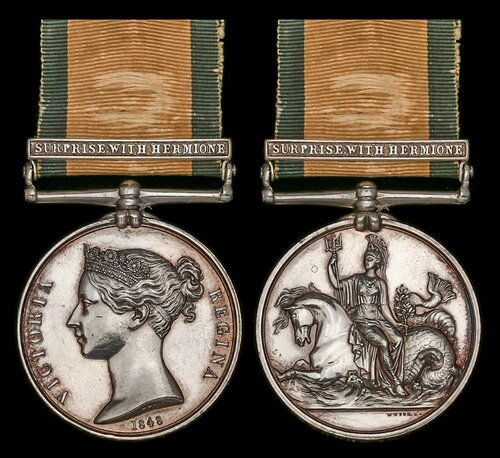
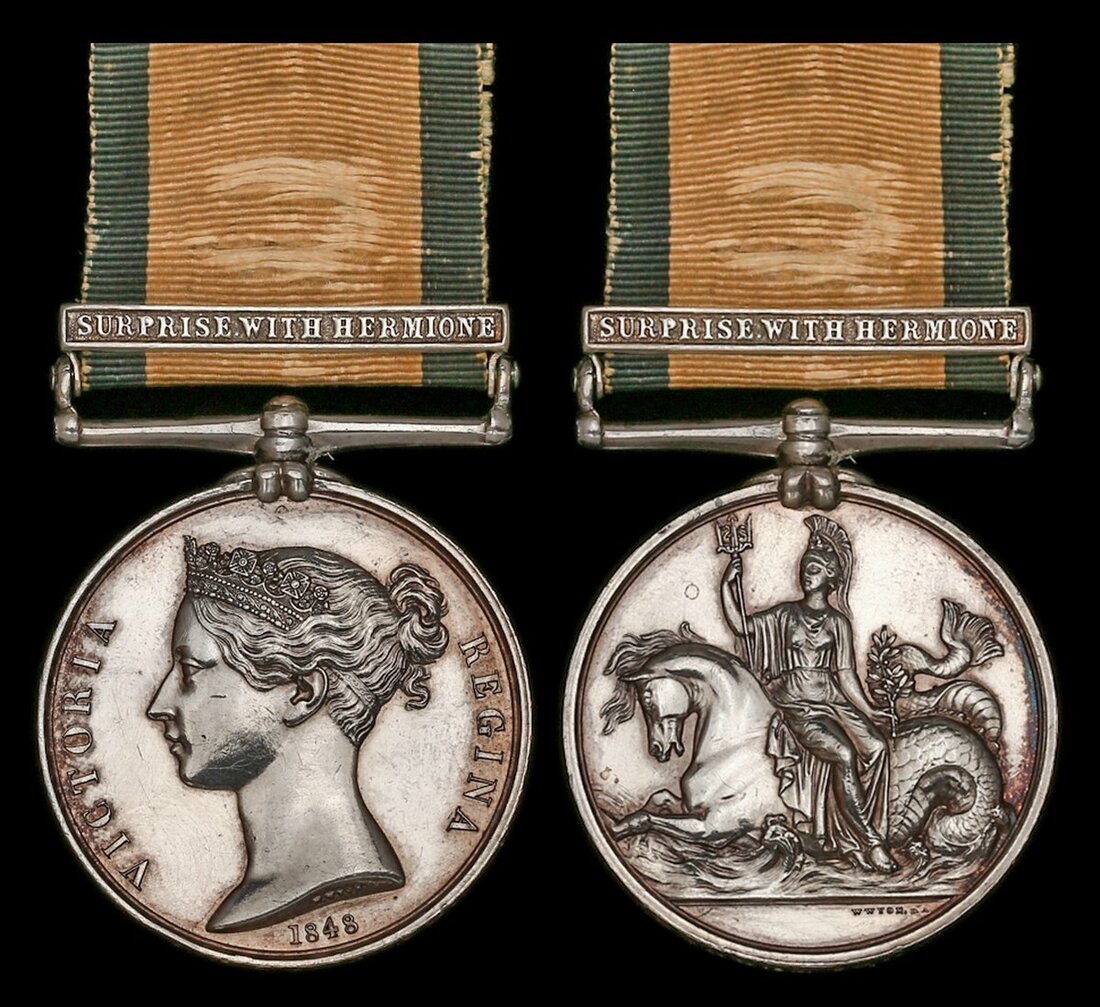
The Naval General Service Medal awarded to Ordinary Seaman T. Turner, who participated in the famous recapture of the former British frigate H.M.S. Hermione on the night of 25 October 1799: two years earlier, the crew of Hermione had risen up, murdering their Captain and most of the ship's officers in what, to this day, is the bloodiest mutiny in the history of the Royal Navy
Naval General Service 1793-1840, 1 clasp, Surprise with Hermione (Thos. Turner), upon a length of original silk riband, traces of old polish around suspension, a few minor scratches around obverse field and one small edge knock at 7 o'clock, otherwise good very fine and rare
Six men of the name Thomas Turner appear on the Medal Roll, all with single-clasp medals; only seven members of the ship's company of H.M.S. Surprise were awarded this clasp - the Captain, a Royal Marine, a Boy, a Ship's Corporal, a Landsman and two Ordinary Seaman - with Turner being one of the latter and confirmed upon the Roll. Of these seven, the Roll compiled by Colin Message notes two in museum collections and Captain Hamilton's medal sold alongside his other awards. This medal, therefore, must be one of the few extant examples of this rare clasp.
Mutiny aboard Hermione
The infamous and horrific episode aboard the 32-gun frigate H.M.S. Hermione on the night of 21 September 1797 has gone down in the annals of the Royal Navy as its bloodiest-ever mutiny. Her Captain, Hugh Pigot, was known to be a tyrant even by the severe standards of the day. Despite a poor track record of command and inflicting overly cruel punishments on his subordinates, Pigot was appointed to the command of Hermione in February 1797. It is some measure of his leadership that within nine months he had been killed at the hands of his own men, having in that time disrated, humiliated and flogged a Midshipman, had flogged multiple other members of his crew, and caused the deaths of three topmen. This latter incident, together with Pigot's disregard for their burial (ordering their bodies simply thrown over the ships' side with the highly offensive words "throw the lubbers overboard"), on 20 September 1797 was the final straw for the seriously unhappy crew.
On the following night a number of men, drunk on stolen rum, rose up. Frederick Hoffman, a naval officer and author later recounted speaking to one of the mutineers who was captured and turned King's evidence:
'The captain', said he, 'was very severe with the men, who were all good seamen, and they were determined to either run the ship on shore and desert, or else take her by force. This had been in their minds for months before it happened. At last,' said he, 'on a dark night when the young lieutenant had the watch, our minds were made up. A party went to the cabin-door, knocked down the sentry, and entered it. The captain was in his cot, and he was soon overpowered. We threw him out of the cabin-window. Another party threw the officer of the watch over the larboard quarter, but he, being young and active, caught hold of the hammock stanchion, when one of the men cut his hands off, and he soon dropped astern. The first lieutenant had been ill and keeping his cot, but on hearing the noise, he came up the hatchway in his shirt, when one of the carpenter's crew cut him down with an axe, and he was sent overboard with several others.'
('A Sailor of King George - The Journals of Captain Frederick Hoffman RN, 1793-1814', p. 60, refers)
Along with Captain Pigot, the First Lieutenant (Samuel Reed) and the Officer of the Watch, the mutineers also murdered another five officers including the Lieutenant of Marines, the Bosun, the Purser and the Surgeon. The Captain's Clerk and two young Midshipmen were also amongst those whose bodies were thrown over the side.
After this night of terror, the crew sailed to the Spanish-held port at La Guaria and handed her over to the enemy; not receiving the warm welcome they expected, Hermione was renamed Santa Cecilia and continued to be manned by 25 of her crew under a Spanish guard, remaining at La Guaria. The remainder were dispersed to join the Spanish army and navy and perform hard labour.
H.M.S. Surprise - Recapture and Retribution
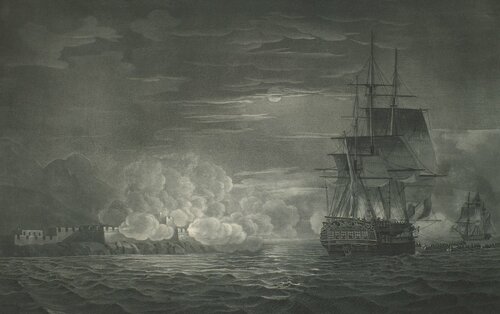
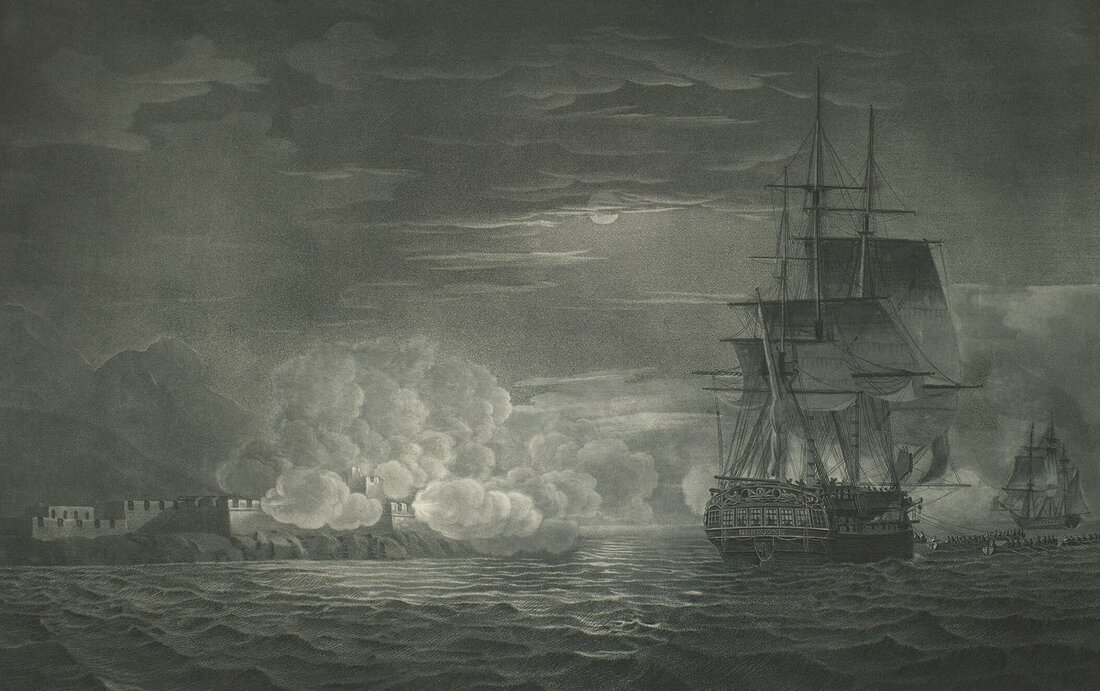
News of what had happened reached Admiral Sir Hyde Parker, who dispatched the 32-gun H.M.S. Surprise under the command of Captain Edward Hamilton to intercept Santa Cecilia should she put to sea. Upon locating her in the harbour at Puerto Cabello, moored under the guns of a powerful battery and further guarded by gunboats and other defences, Hamilton determined that he would cut the former British frigate out and recover her to restore justice and recover the honour of the Royal Navy. What happened next is perhaps best described in Hamilton's subsequent dispatch, which appeared on the front page of The London Gazette on 18 January 1800:
'Surprise, Port Royal Harbour, Jamaica, Nov. 1, 1799,
Sir,
The Honor of my Country and the Glory of the British Navy, were strong Inducements for me to make an Attempt to cut out, by the Boats of His Majesty's Ship under my Command, His Majesty's late Ship Hermione, from the Harbour of Porto Cavallo, where there are about Two Hundred Pieces of Cannon mounted on the Batteries.
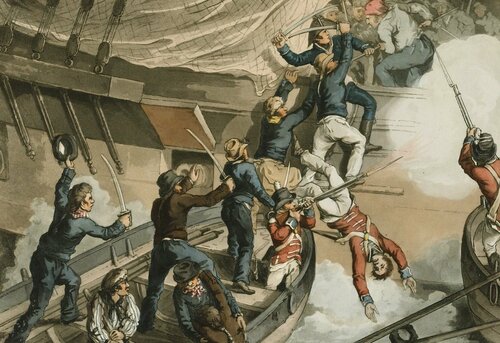
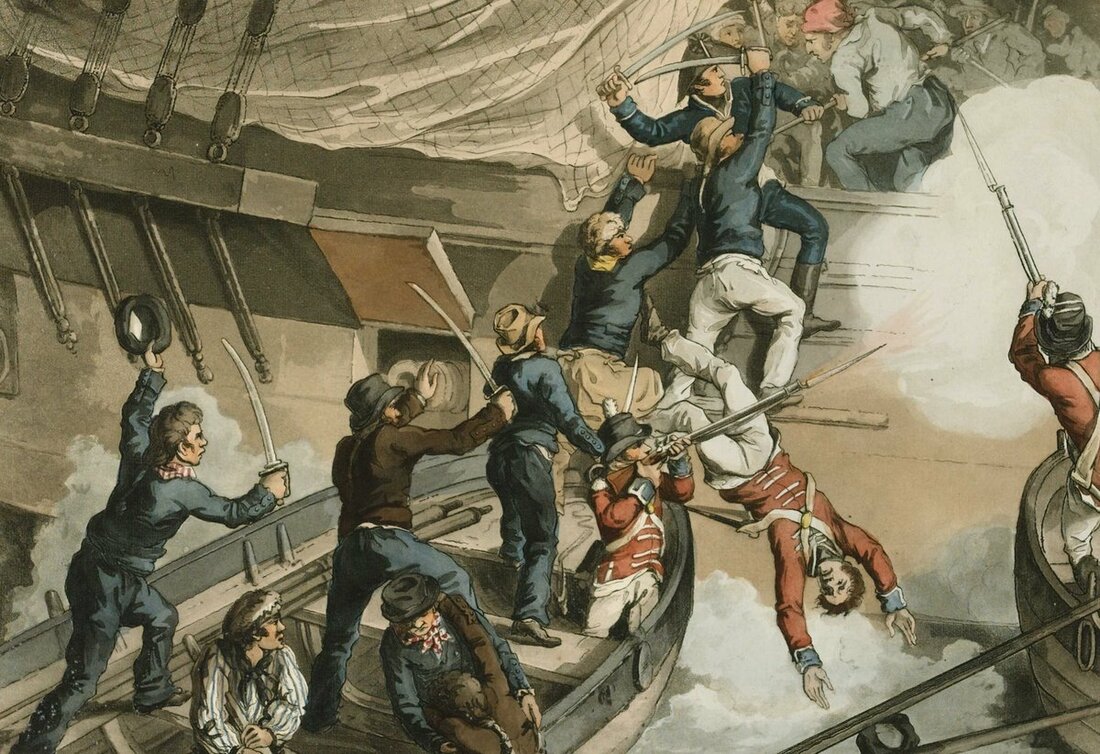
Having well observed her Situation on the 22nd and 23rd Ultimo, and the Evening of the 24th being favorable, I turned the Hands up to acquaint the Officers and Ship's Company of my Intentions to lead them to the Attack, which was handsomely returned with Three Cheers, and that they would all follow to a Man; this greatly increased my Hopes, and I had little Doubt of succeeding: the Boats, containing One Hundred Men, including Officers, at Half-past Twelve on the Morning of the 25th, (after having beat the Launch of the Ship, which carried a Twenty-four-Pounder, and Twenty Men, and receiving several Guns and small Arms from the Frigate,) boarded; the Forecastle was taken Possession of without much Resistance; the Quarter-Deck disputed the Point a Quarter of an Hour, where a dreadful Carnage took place; the Main Deck held out much longer, and with equal Slaughter; nor was it before both Cables were cut, Sail made on the Ship, and Boats a-head to tow, that the Main-Deck could be called ours; they last of all retreated to the 'tween Decks and continued firing till their Ammunition was expended; then, and not until then, did they cry for Quarter. At Two o'Clock the Hermione was completely ours, being out of Gun-Shot from the Fort, which had for some Time kept up a tolerable good Fire. From the Captain Don Romond de Chalas I am informed she was nearly ready for Sea, mounting Forty-four Guns, with a Ship's Company of Three Hundred and Twenty-one Officers and Sailors, Fifty-six Soldiers, and Fifteen Artillery Men on board.
Every Officer and Man on this Expedition behaved with an uncommon Degree of Valour and Exertion; but I consider it particularly my Duty to mention the very gallant Conduct, as well as the Aid and Assistance at a particular Crisis I received from Mr. John M'Mullen, Surgeon and Volunteer, and Mr. Maxwell, Gunner, even after the latter was dangerously wounded.
As the Frigate was the particular Object of your Order of the 17th September, I have thought proper to return into Port with her. Enclosed I transmit you a List of Captures during the Cruise, also Two Lists of Killed and Wounded.
I have the Honor to be, &c. &c. &c.
E. Hamilton'
Hamilton's success was down to both exceptional leadership and very good luck: meticulously planning the attack and relying on stealth (perhaps with liberal use of the pun "Surprise is on our side"), as he personally led his boats into the attack he was spotted by two Spanish gunboats which raised the alarm and opened fire; some of his men also temporarily grounded on boom defences, and the Spanish batteries ashore opened fire. Nevertheless, Santa Cecilia was successfully boarded, with Hamilton at their head. He found himself alone on the quarterdeck in hand-to-hand combat with four of the enemy and was wounded at least four times before being saved by a rush of British Marines and sailors, who shot down his assailants before charging in with cutlass, pike and bayonet. Indeed, William O'Byrne's famous naval dictionary notes in his entry on Hamilton: 'He received a tremendous blow from the butt-end of a musket, which broke over his head and knocked him senseless on the deck; and he next received a severe sabre-wound on the left thigh, another wound by a pike on the right thigh, and a contusion on the right shin-bone by a grape-shot. One of his fingers was also much cut, and his loins and kidneys were so much bruised that he still at times suffers considerable pain.' (A Naval Biographical Dictionary, 'Hamilton, Edward', W.R. O'Byrne, 1849, refers).
As the captain's dispatch states, there was much heavy fighting but, as the ships' cables were cut, sails loosed to catch the breeze, and boats positioned to tow her out of the harbour, Spanish resistance began to crumble as their ship was moved out of range of the guns ashore and their commanding officer wounded and captured. By 2 a.m. the battle was over and Hermione was British once again, meeting with Surprise an hour later.
Despite the attackers facing the odds so heavily stacked against them, and the ferocity of the fight, the casualties were astonishingly one-sided; whilst the Spanish had lost 120 killed and 231 taken prisoner (of which 97 were wounded), the British had not lost a single man killed and had just twelve wounded - one of them being Captain Hamilton himself. Ordinary Seaman Thomas Turner is not noted in the list of those wounded during this extraordinary battle, but one can only imagine what he saw, felt and experienced that night alongside his shipmates, following his captain's example to restore the honour of the Royal Navy and to set right a particularly horrible episode from its history. It is perhaps no surprise that Hermione shortly underwent two changes of name - firstly to Retaliation, then Retribution, though she was broken up in June 1805.
Unsurprisingly, Hamilton was lauded as a hero. Created a Knight Bachelor upon his return home, he received a Naval Gold Medal for the action and was (amongst other honours) awarded a £300 presentation sword, voted a freeman of the City of London and honoured with a banquet by the Court of Common Council. In 1815 he was nominated a K.C.B. and in 1819 created a Baronet. The fate of the mutineers aboard H.M.S. Hermione was far less pleasant and, indeed, the Royal Navy continued ruthlessly tracking them down for years afterwards, with occasional reports appearing in 'The Naval Chronicle' when a man was subsequently brought to justice:
'Hermione Mutineer Arrested
Portsmouth, March 22.
As David Forrester, alias Williams, was going through the Point Gates, he was recognized by the Ship's Steward, late of the Hermione, as one of the principals concerned in the mutiny on board that ship. He was accordingly secured and taken to the Main-Guard House, and from thence conveyed on board the Puisant. While in the Guard House, Admiral Holloway and several other Officers went to interrogate him concerning the mutiny, when he confessed himself to have been the person who killed, and afterwards threw Captain Pigot overboard; it appears that in the scuffle he was wounded in the foot by the Captain, who defended himself with his dirk. Admiral Holloway asked him, if he had been easy in his conscience since the transaction? He replied, Perfectly so, as he was ordered to do it by the Captain of the Forecastle, and that if he had not done it he should have been killed himself...'
('The Naval Chronicle: The Contemporary Record of the Royal Navy at War', Vol. II, 1799 - 1804, p. 265).
Of Thomas Turner, a Cheshire lad aged just 19 at the time he joined H.M.S. Surprise in 1799, no further records are immediately apparent - although the Medal Roll notes his award was sent to him in Stockport and so, an old man by the time he received recognition for his part in this famous battle, he had clearly returned to the county in which he was born and raised.
Subject to 20% VAT on Buyer’s Premium. For more information please view Terms and Conditions for Buyers.
Estimate
£8,000 to £12,000
Starting price
£7500

Watch, listen and bid as if you were in the room. Now available for auctions worldwide.
Click here to bid live
An exclusive and confidential service for the discerning collector or vendor.
View the Gallery
Download every Spink catalogue on your iPad, iPod or iPhone using free Spink app.
Download From iTunes© 2026 Spink & Son. All rights reserved.