
Auction: 25113 - Orders, Decorations and Medals - e-Auction
Lot: 567
'The first hit broke an awning ridge-pole on Penshurst's bridge, the second shell struck the angle of the lower bridge, severing the engine-room telegraph connections and the pipe connecting the hydraulic release gear, by means of which the depth charge aft could be let go from the bridge. This shell also killed the gun-layer and loading-number of the 6-pounder, wounding its breech-worker and the signalman who was standing by to hoist the White Ensign. So at 4.24 p.m. Penshurst opened fire, her first shot from the 12-pounder hitting the base of the enemy's conning-tower and causing a large explosion, as though the ammunition had been exploded. Large parts of the conning-tower were seen to be blown away, and a big volume of black smoke arose. The second British shot from this gun hit the enemy a little abaft the conning-tower and also visibly damaged the hull. The starboard 3-pounder hit the lower part of the conning-tower at least four times, and then the enemy sank by the stern.'
(The Q-Ship action in which A.B. Clarke was wounded as recounted in Q-Ships and Their Story by Edward Keble Chatterton)
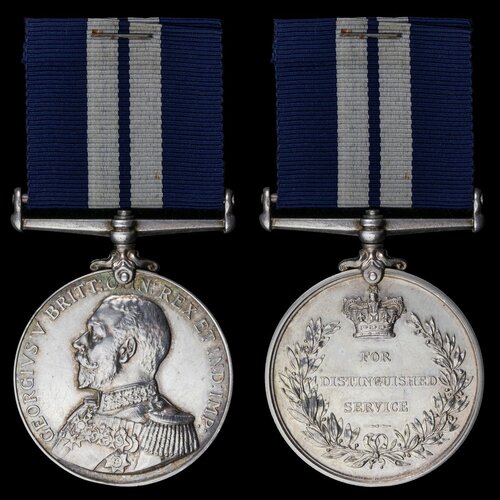
A 'Q-Ship 1917' D.S.M. awarded to Able Seaman S. J. Clarke, Royal Navy, who served with H.M.S. Penshurst -Q7- during her remarkable two year run of anti-submarine actions, being wounded on 14 January 1917, 'mentioned' in August and sunk with her in December
Distinguished Service Medal, G.V.R. (S.S.4531. S. J. Clarke, A.B. Anti-Submarine Opns. 1916-7.), good very fine
D.S.M. London Gazette 22 February 1918.
M.I.D. London Gazette 29 August 1917:
'…for services in action with enemy submarines'
Stanley James Clarke was born at King Williams Town, Cape Colony on 24 September 1893 and worked as a Steward prior to enlistment on 24 November 1913. Serving with the Battleship Benbow on the outbreak of the Great War, he was transferred back ashore in September 1915. Joining H.M.S. Cyclops for four months he joined the crew of the Q-Ship Penshurst on 1 April 1916.
This vessel proved to be one of the most successful of the Q-Ships Commander Grenfell, her captain, proving to be a cunning sailor who excelled at luring U-Boats into the trap. In one of her first engagements, they managed to sink UB-19 which was in the process of attacking the steamer Ibex. Penshurst opened fire at a range of just 250 yards, firing a total of 80 shells of which every one was seen to hit, the submarine sank by her bows.
She was in action again soon on 14 January 1917, the engagement quoted above. The enemy vessel UB-37 attacked Penshurst, hammering her with volleys of shot as she closed the distance, the Q-Ship sent out panic parties and appeared to surrender. Nevertheless the Germans kept up their attack, it took nerves of steel to allow them to close into range despite the hammering of their deck gun. As Keble Chatterton states:
'It was this kind of experience which always tested the discipline and training of the Q-ship, as a well-trained boxer can receive punishment without losing his temper, knowing his chance will come presently.'
Inevitably casualties were incurred in this action including Clarke whose service papers note 'Severely wounded in action 14 Jan 1917'.
Clarke was sent ashore to recuperate from 15 January - 7 April, missing an action which saw U 84 seriously damaged. He was certainly back her again went she went into auction in July and was 'mentioned' not long afterwards. However, it may also have been for the more immediate action on 19 August when the ship was torpedoed and nearly sank, saving herself whilst duelling the U-boat with her deck guns.
Penshurst set out on her final cruise in December 1917, sensing prey on Christmas Eve she began to zig-zag however she was unable to avoid the torpedo which caught her between the boilers and engine-room. The U-boat drew in close and began to shell the Q-ship which sprang her trap only to find that the enemy was too close and her guns couldn't be adequately brought to bear. Despite this she managed to get several good hits in, enough to scare the enemy vessel away.
It was too late for Penshurst however, whilst the crew were taken off safely the gallant ship final succumbed to her wounds and sank at 20:30. Clarke survived the action and was awarded his D.S.M. not long later, as a result of gallantry with the vessel over the last year, the recommendation noting that his actions during the sinking were a factor in the award.
Posted to the Mediterranean in March 1918, he joined the books of the stone frigate Egmont for service with 'S.S.V.' although if this relates to Special Service Vessels it is not clear which one. Clarke was demobilised on 11 March 1919 and joined the Royal Fleet Reserve the next day.
Subject to 20% VAT on Buyer’s Premium. For more information please view Terms and Conditions for Buyers.
Estimate
Starting price
£420

Watch, listen and bid as if you were in the room. Now available for auctions worldwide.
Click here to bid live
An exclusive and confidential service for the discerning collector or vendor.
View the Gallery
Download every Spink catalogue on your iPad, iPod or iPhone using free Spink app.
Download From iTunes© 2026 Spink & Son. All rights reserved.