
Auction: 25113 - Orders, Decorations and Medals - e-Auction
Lot: 488
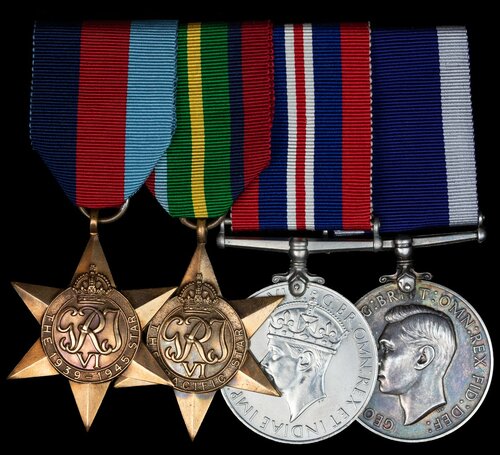
An emotive Second World War Far East P.O.W.'s group of four awarded to Able Seaman A. P. Allistone, Royal Navy, who was taken prisoner at the fall of Hong Kong and who survived the loss of the Japanese 'hell ship' Lisbon Maru in October 1942
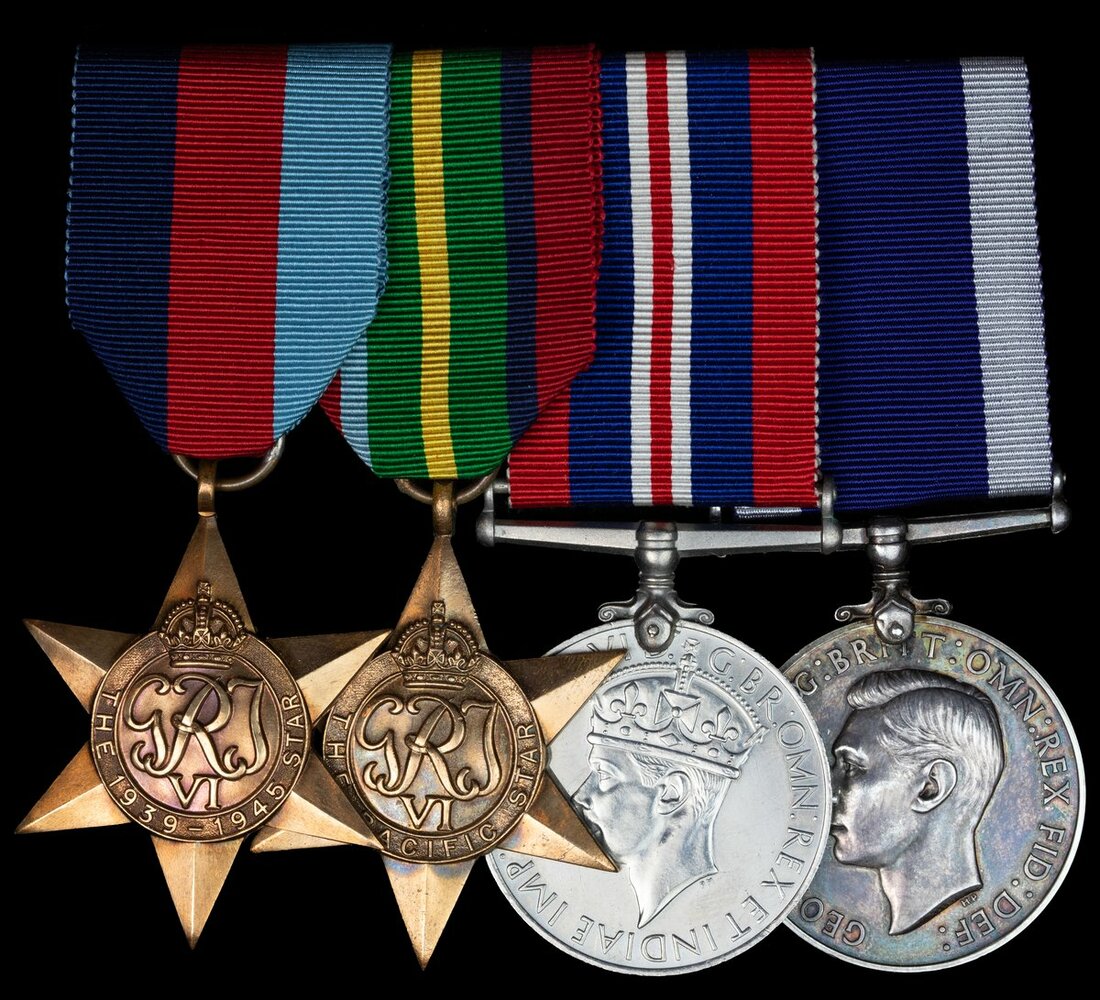
1939-45 Star; Pacific Star; War Medal 1939-45; Royal Navy L.S. & G.C. Medal, G.VI.R., 2nd issue (J. 97838 A. P. Allistone, A.B., H.M.S. Vernon), mounted as worn, good very fine (4)
Note:
The fact that the above described L.S. & G.C. Medal is a 2nd type George VI issue suggests it is a replacement for the loss of his original award in Hong Kong.
Albert Percy Allistone was born in Teddington, Middlesex on 12 May 1905 and entered the Royal Navy as a Boy 2nd Class in July1920. Advanced to Able Seaman in April 1924 and awarded the L.S. & G.C. Medal in April 1938, he was serving in the minelayer H.M.S. Redstart on the outbreak of hostilities.
FEPOW - loss of the hell ship Lisbon Maru
Based at the Hong Kong naval establishment Tamar, Redstart was scuttled on the 19 December 1941, in order to prevent her from falling into Japanese hands. Her crew subsequently served ashore in the defence of the colony and those who survived were taken P.O.W. less than a week later. Among them was Allistone, who was originally reported as killed but later confirmed as a prisoner.
Subsequently embarked in the armed Japanese transport - or 'hell ship' - Lisbon Maru, he was lucky indeed to survive her loss on 1 October 1942, when she was torpedoed and sunk by the U.S. submarine Grouper; the conditions endured in the four preceding days and the resultant loss of life on her sinking would become the subject of a war crimes trial in September-October 1946.
The Lisbon Maru had departed Hong Kong on 27 September 1942, bound for Shanghai and labour camps on the Japanese coast. She was armed, and carried 1,816 British prisoners of war, 778 Japanese troops and a further guard of 25 men for the prisoners. There was nothing that identified her cargo as prisoners of war.
Some 380 Royal Navy personnel were accommodated in No. 1 Hold at the front of the ship. A further 1,077 troops were crammed into No. 2 Hold, forward of the bridge, including the Senior British Officer on board, Lieutenant-Colonel H. W. M. Stewart, Commanding Officer of the 1st Battalion, Middlesex Regiment, whilst 380 men of the Royal Artillery were placed in the stern. Conditions were appalling, made worse by a lack of sanitation and the sea conditions. At the base of No. 2 Hold, Dennis Morley, a 22-year-old Private in the Royal Scots Regiment, later recalled being 'showered by the diarrhoea of sick soldiers above him … swimming in excreta, virtually.'
On 1 October 1942, the American submarine Grouper fired six torpedoes at the Lisbon Maru off Dongfushan in the Zhoushan Archipelago, to the south of Shanghai. Five of the unreliable Mark 14 'fish' either passed under the target or failed to detonate, but one exploded against the stern bringing the ship to a standstill. Grouper immediately came under retaliatory attack from enemy patrol boats and aircraft and departed the scene, enabling the Japanese troops aboard the Lisbon Maru to be taken off the stricken vessel. As they departed, they battened down the hatches, leaving their prisoners standing in the dark and running short of air to breathe.
Throughout the following night the prisoners remained trapped in the holds. Messages in morse code were rapped on the bulkheads between them, and gradually the stern began to fill with water. Something urgently needed to be done to prevent the men drowning or dying of asphyxiation. As the sun began to rise on the morning of 2 October 1942, the men felt the hull give 'a sudden drunken lurch', and a frantic escape effort began. Morley describes the scenes that he witnessed:
'Well, one chap, he was in the Middlesex Regiment, he was a butcher and the Japanese allowed him this knife, which he was able to put through the planks. He got through to the canvas, eventually - the whole lot. The canvas could be lifted out of the way and the planks moved which is how we got out.
A bit of panic started because everyone was trying to rush up to this ladder and everybody was fighting to get onto this ladder. Consequently, you're getting so far up and falling down into the bottom of this hold - until this officer, Captain Cuthbertson of the Royal Scots, stopped the panic and got them to quieten down.'
This account is challenged by another which states that Lieutenant Howell managed to cut his way out of the hold using a bread knife smuggled aboard ship, but whatever the case, the first P.O.W.s to reach the deck were fired at by a few remaining Japanese guards who were quickly dispatched. Then the British began to slide off the side of the ship into the water to get away from the vessel, but they were targeted by machine-guns from the Japanese who were watching on.
It was only when Chinese fishermen started coming to the aid of the soldiers and sailors in the water that the firing ceased and the Japanese began to gather them up as well. At the stern of the ship, men of the Royal Artillery continued to hoist themselves up a ladder which eventually broke; in one of the most harrowing scenes of the tragedy, the survivors in the water listened with horror as dozens of trapped men of the Royal Artillery went down with the ship singing 'It's a long way to Tipperary'.
In total, 828 Prisoners of War died either aboard ship or in the waters around the vessel (The Sinking of the Lisbon Maru, Britain's Forgotten Wartime Tragedy, refers). Especially tragic was the fact that the ship had been sunk by an American submarine, whose crew were completely unaware that there were Allies aboard until they picked up a radio signal several days later. Of the survivors, only 748 were still alive at the the cessation of hostilities.
No. 1 Camp, Osaka
Having survived the loss of the Lisbon Maru, Allistone and his fellow captives endured further trials:
'35 of the prisoners who were seriously ill were left in Shanghai and the remainder were then loaded in the holds of a Japanese transport, the Shensei Maru, in conditions similar to those on the Lisbon Maru. Dysentery and diphtheria were now rife and the men in poor shape, five of them dying on the journey to Japan. The ship docked at Moji on 10 October, where 36 of the worst cases of dysentery were removed to hospital. The remaining prisoners were directed into two groups, the larger, consisting of about 500 men, destined for Kobe, and the remainder for Osaka.
Press representatives spoke to some of the prisoners, who had been warned not to speak freely about their experiences because of inevitable reprisals, for it was obvious that the Japanese would not tolerate an accurate account of the matter. This reticence enabled the Japanese to claim that: 'with one voice and in the highest possible terms these surviving British prisoners referred to the strength and warm heartedness of the Imperial Forces and lauded the gallantry of the Japanese.
To their great surprise, the prisoners were loaded on a comfortable passenger train at Moji and were provided with regular meals of excellent quantity and quality. After several hours travelling, the train stopped at a station and an announcement was made that the prisoners who were most ill would be taken off the train and sent to hospital. About 50 of the worst cases were dropped off at Kokura, where 21 of them died, and others were off-loaded at a place which was later to become well known: Hiroshima. The remaining 326 were carried on to Osaka, where they were accommodated in barracks in the middle of the town.'
Those 326 men - including Allistone - were subsequently incarcerated at Camp No. 1, Osaka, where they were used as slave labour in the loading and unloading of ships. Life in the camp is perhaps best summarised by the words of Jack Rix, a young rating of the Royal New Zealand Navy:
'While in captivity, I have had scabies, tropical ulcers, Hong Kong Dog (similar to malaria), yellow jaundice, chronic diarrhoea, dysentery 3 times, boils, ulcer in ear, broken foot, dobie rash, bronchitis, beri beri and pneumonia... I had to take the bombs, torpedoes, dive-bombers, and starvation along with the enemy, instead of being with our allies on the dealing-out side … Many times I had one foot in the grave and the other on a bar of soap.'
A subsequent report collated for a war crimes trial stated that all three locations of the camp were situated along the Osaka waterfront and in the midst of vital military objectives. As a result, all three were bombed, two being completely burned out and the third severely damaged.
On 2 June 1945 the P.O.W.s were transferred to Tsumori Camp and, on 10 July 1945, they were again transferred to Minato Ku in Osaka. Here they were quartered in three rooms on the second floor of a large warehouse.
Allistone was finally liberated on 2 September 1945 and, on returning to the U.K., he was released as Class 'A' in June 1946.
Subject to 20% VAT on Buyer’s Premium. For more information please view Terms and Conditions for Buyers.
Estimate
Starting price
£130

Watch, listen and bid as if you were in the room. Now available for auctions worldwide.
Click here to bid live
An exclusive and confidential service for the discerning collector or vendor.
View the Gallery
Download every Spink catalogue on your iPad, iPod or iPhone using free Spink app.
Download From iTunes© 2026 Spink & Son. All rights reserved.