
Auction: 25113 - Orders, Decorations and Medals - e-Auction
Lot: 273
'"The Afridi," remarks Major Beevor, "uses bullets of almost every description, and not only bullets, but missiles of various kinds. So long as he can have a go at his enemy with something hard, he does not care a rap what that hard thing is- a stone, a piece of lead of any sort, or a piece of telegraph wire. He relies upon the telegraph wire for one of his chief amusements, because he likes to chop it into little bits and have a 'snapshot' at his enemy, whether one of his own people or a heathen i.e., a white man.'"
Major W. C. Beevor expressing stern disapproval of the Afridis, quoted in The Strand Magazine
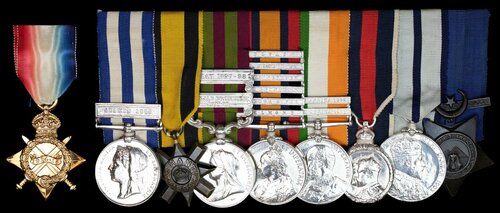
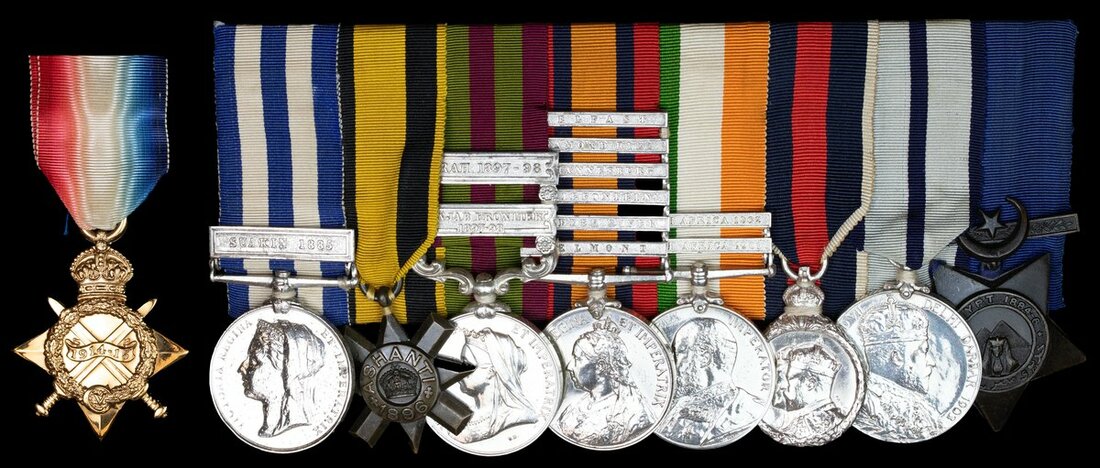
The superb campaign group of nine awarded to Colonel W. C. Beevor C.B. C.M.G., Army Medical Services, attached Scots Guards, a pioneer of field medical care and X-rays
Egypt and Sudan 1882-89, undated reverse, 1 clasp, Suakin 1885 (Surgn W. C. Beevor. M.B. 5.1. Scott. Div. R.A.); Ashanti Star 1896, unnamed as issued; India General Service 1895-1908, 2 clasps, Punjab Frontier 1897-98, Tirah 1897-98 (Surgn: Major W. C. Beevor. A.M.S.); Queen's South Africa 1899-1902, 6 clasps, Belmont, Modder River, Driefontein, Johannesburg, Diamond Hill, Belfast (Major W. C. Beevor., M.B., C.M.G. R.A.M.C.); King's South Africa 1901-1902, 2 clasps, South Africa 1901, South Africa 1902 (Surg:Major: W. C. Beevor, M.B., C.M.G., ScotsGds:); Coronation 1902; Delhi Durbar 1903, unnamed as issued; Khedive's Star, dated 1884-6; 1914-15 Star (Col. W. C. Beevor A.M.S.), the last unmounted, the rest mounted court-style as worn, clasp back-straps adapted to facilitate mounting, contact wear overall, very fine (9)
[C.B.] London Gazette 14 January 1916.
[C.M.G.] London Gazette 27 September 1901.
Walter Calverley Beevor was born at Newark-Upon-Trent, Nottinghamshire on 8 October 1858, the son of Indiana and Dr John Beevor M.D., MP of Newark-on-Trent, notably his mother's father was Rear-Admiral James Norton. Attending the Royal College of Surgeons at Edinburgh he graduated M.B., M.R.C.S. in 1880 and undertook work as House Surgeon at the Royal Portsmouth Hospital, the Newark-on-Trent hospital and the Midland Counties Eye Infirmary. During this time Beevor began to develop his academic profile, publishing an article entitled 'Morbilli Rashes in Typhoid Fever' in the British Medical Journal 1883.
It was perhaps this work in the treatment of tropical fevers which led Beevor to undertake an examination for the Army Medical Department on 4 February 1884, which he passed well, coming 4th in his class of twenty. Commissioned Surgeon on 2 August 1844 he was serving with the 5th Battery, Scottish Brigade of the Royal Artillery when they were posted to Suakin in 1885. After that intervention Beevor transferred to
the Scots Guards to serve as their Medical Officer on 28 November 1885, an association which was to last for most of his career.
He was still stationed with this unit when he was ordered to the Gold Coast for service in the Second Ashanti Expedition 1896. Despite facing no serious opposition, the expedition was beset by medical problems, suffering a large number of people killed by disease. Amongst these was Prince Henry of Battenberg, son-in-law of Queen Victoria, over 50% of the force had fallen ill during the course of the march. Beevor's work during this time must have been exemplary as he was specially promoted Surgeon Major in 1896.
Beevor was next to see service on the Tirah Expedition, where he served with 2nd Division under General Sir William Lockhart Scott. On this same expedition he made history by taking with him a Rontgen (or X-Ray) machine to help improve the quality of his surgeries, he had purchased the machine himself for use of the North-West Frontier. An article in The Strand Magazine entitled The Röntgen Rays in Warfare notes an episode in which his insistence on bringing the equipment came to good use was in the case of a British General. General Woodhouse was wounded in the leg during a skirmish and was subsequently operated upon, under fire in an improvised hospital, apparently successfully. It was not until he was X-rayed by Beevor that it was found a piece of the bullet had broken off and was still in his leg.
The same article quotes Beevor's own words on the case of a Native Cavalryman, stating:
'He returned saying that he could not use his elbow: he got it at a certain angle, and then it locked suddenly; he could throw a stone, and even use a lance, but he was a cavalryman, and all his actions were awkward because he could not get his arm extended. They thought he was humbugging. The Indian soldier, no matter who he is, is a champion at humbug when it pleases him; he is a charming fellow in every way, but if he likes to "put on the agony", he can do it very successfully. Well, the surgeon said to me, 'Will you have a look at this man, because he is such a good chap, and I don't think he is humbugging, but he wants to get married and go away on a pension? We examined him with a fluorescent screen, and instantly detected the cause of his disability; the bullet had slipped down through the muscular fibres of the biceps muscle into the sheath of a tendon, and had become incrusted or surrounded by adventitious fibrous material. The surgeon cut down upon it, and it took him about an hour and a half to dissect the bullet from the tendonous material with which it was surrounded, and when the tendon had been massaged and stretched the man returned to duty. I suppose he got his wife, but he was an excellent fellow, and probably more pleased at being cured than he would have been at getting his pension.'
General Scott clearly valued Beevor's work, 'mentioning' him in dispatches (London Gazette 5 April 1898), although the same document suggests he was perhaps not enamoured of the new technology, stating:
'The officers of the Army Medical Staff and of the Indian Medical Service have fully maintained their high reputation by their attention to the sick and wounded-, both under fire and in hospital. The hospital arrangements were generally excellent, but I consider that the field equipment is too heavy and elaborate for mountain warfare, and that it might be materially reduced without hardship to the patients. The conspicuous colour of the canvas with which- the doolies are covered is very objectionable, as it attracts the enemy's fire'
Upon the outbreak of the Anglo-Boer War Beevor entered the war bringing his Rontgen equipment with him again. However not content with his work in the field of medicine he was on the forefront of another revolution, the development of film. When the Scots Guards boarded ship for South Africa on 21 October 1899 they were filmed by Beevor who had procured a camera from Robert Paul, another pioneer in his own field of Theatrograph production.
Once in the country he served with the Guards on General Methuen's advance to relieve Kimberly, seeing action at Belmont and Enslin as well as filming all the while including footage of the victorious army crossing the Modder River after the battle. He was doubtless present at the bloody reverse of Magersfontein and was certainly too busy with the wounded to film the action.
However after the victory at Paardeburg Beevor was behind the camera again to capture a historic moment, the surrender of General Piet Cronje. He further captured the arrival of the Scots Guards at Bleomfontein, capturing the moment they marched into the city.
He was present for further engagements at Dreifontein, Vet River, and Zand River as well as operations in Transvaal, actions at Pretoria, Johannesburg, Diamond Hill, and Belfast. Beevor's service was again exemplary, and he was 'mentioned' in addition to his C.M.G. the same year (London Gazette 10 September 1901 refers). Notably Beevor does appear to have spent a year between 1901-1902 serving at the Headquarters of the South African Constabulary, appearing on the same roll as Robert Baden-Powell.
After South Africa he was posted to India, serving upon the staff of the Duke of Connaught at the 1903 Delhi Durbar, ironically considered a founding moment in the history of film in India. The next year he joined the staff of Lord Northcote, the Governor of Bombay. Finally, Beevor reverted back to the R.A.M.C. as a Major on 25 May 1904 and was advanced Lieutenant Colonel on 2 August 1904.
Joining the retired list on 20 August 1913 he returned to the colours for the Great War and was appointed Deputy Assistant Director of Medical Staff with the North Midland Division, Territorial Force. Advanced Colonel on 3 December 1914 the promotion came with a further appointment to Assistant Director of Medical Staff and it was in this roll that Beevor entered the war in France on 20 February 1915.
Thrown into the action quickly he was faced with the appalling slaughter of the Western Front and some of the worst weapons then in use. The Reading Mercury quotes him in May 1915 on the subject of poisonous gas, stating:
'Ask all to try and realise themselves overcome by a stifling gas, which soon made them feel as if they had inhaled vitriol, that great pain gradually overcame them throughout the whole body, and that each fight for a morsel of air caused an agony as if a red-hot iron were piercing their chest, that the hopeless feeling of a crushing weight was squeezing them gradually to death, and every attempt to lift it from the chest failed and left them with an exhaustion from which there is no escape, no hope. Each change of position only bringing exacerbation of the pain in the chest, and at times a sickness, ten times more nauseous then seasickness, racked their aching bodies till they tried to vomit, thereby lighting up again an exaggeration of the affront attending each effort to get a deep breath, the muscular effort to vomit causing as much pain as the struggle for breath. Slowly and surely the consciousness of impending death is all that is left to those who have made a gallant fight for life, and as the despairing look fixes its beseeching call for help on those who are powerless to help, you may imagine we burn with an insatiable desire for revenge.'
As his words imply Beevor appears to have met these atrocities with marked bravery and determination. It may be however that there was another motive behind his words however as his eldest son Charles had been killed flying a seaplane out of Eastchurch with the R.N.A.S. Once again serving with such distinction he added to the laurels conferred by his C.B. with a brace of 'mentions' (London Gazette 1 January 1916, 20 May 1917, refer).
Returning to the Retired List after the war Beevor hailed a cab on 6 February 1927 at Clifton Hill, St. John's Wood. At the end of the journey the driver attempted to rouse him only to find his passenger dead, Beevor was survived by his wife and two of their children.
Subject to 20% VAT on Buyer’s Premium. For more information please view Terms and Conditions for Buyers.
Estimate
Starting price
£1400
Watch, listen and bid as if you were in the room. Now available for auctions worldwide.
Click here to bid live
An exclusive and confidential service for the discerning collector or vendor.
View the Gallery
Download every Spink catalogue on your iPad, iPod or iPhone using free Spink app.
Download From iTunes© 2026 Spink & Son. All rights reserved.