
Auction: 25113 - Orders, Decorations and Medals - e-Auction
Lot: 36
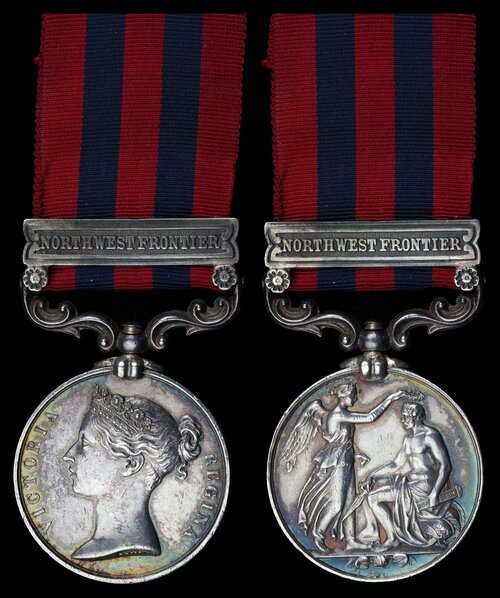
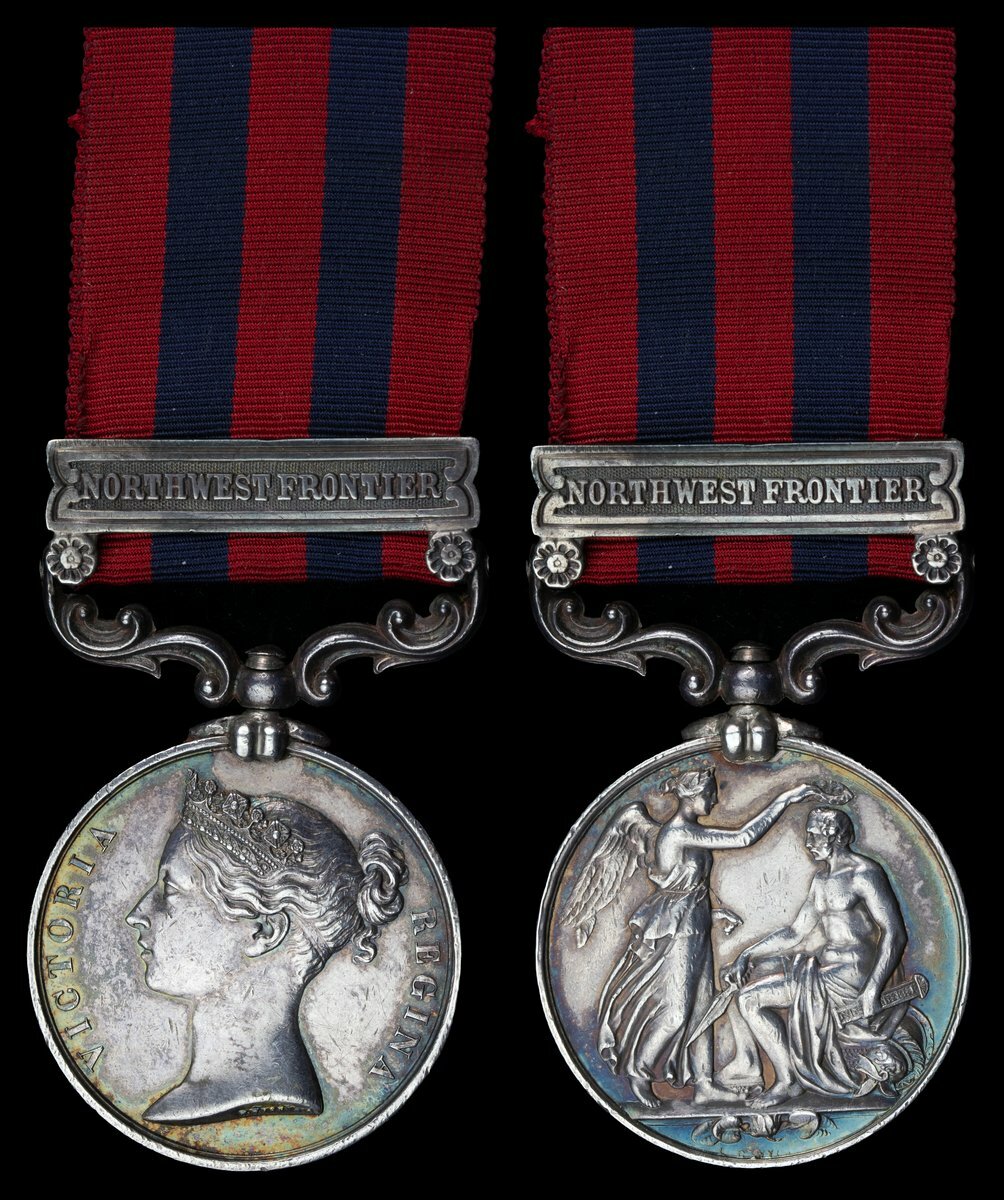
India General Service 1854-95, 1 clasp, Northwest Frontier (3150. J. Foley. H.Ms, 81st, Regt), suspension somewhat slack, minor contact wear, very fine
James Foley was born at Cashel, Tipperary, Ireland on 19 January 1836, the son of Edmund and Winney Foley. Baptised at Casel & Emly on 30 May 1836 he remained in Ireland until attesting with the 50th Foot on 19 January 1853 at Waterford, he was only seventeen at the time. Transferring to the 81st Foot on 1 July, he came of age with them the next year.
He served overseas for a total of over 14 years, with 9 years and 183 days spent in India with another 4 years, and 244 days spent in Gibraltar. The 81st Foot were posted to India in 1854 and were posted to the recently conquered Punjab, forming part of the Garrison of Lahore. There, surrounded by Sepoy Battalions, they first heard news of the outbreak of the Indian Mutiny.
Their tenuous position required decisive action and as soon as word reached them the spreading disorder they moved fast, a parade on the Meean Meer for inspection provided them with the opportunity to disarm most of the Sepoys. Immediately afterwards three companies tricked their way inside Lahore Fort and disarmed those guarding it as well, leaving them in control of the city.
As the British efforts to suppress the revolt got underway the Punjab began to stabilise with much of the fighting focused on Northern and Central India. This freed up units such as the 81st Regiment to help with the suppression of the rebels. They were transferred to the Sittana Field Force in February 1858 under Sir Sydney Cotton with orders to defeat a mixed force of local tribes and mutinous Sepoys who had risen from a garrison near Peshawar.
They saw heavy fighting here, first at Mangal Thana but later at Sittana itself. There Upper Sittana was taken and held by a column under Lieutenant-Colonel H. Renny of the 81st while the village itself was destroyed by the Sappers and Miners. With the rebels' main centres of power destroyed by the British, their objectives on the frontier were completed and they returned to India. Their actions at Sittana entitled the Battalion to the Northwest Frontier clasp, Foley remained with the unit being advanced Corporal on 6 January 1864.
He was not to keep the rank however, losing it in a Court Martial the next year and forfeiting his good conduct pay. Foley was discharged on 23 February 1875 his trade upon discharge was given as 'musician'; sold together with copied research.
Further entitled to an Indian Mutiny medal with no clasps.
Subject to 20% VAT on Buyer’s Premium. For more information please view Terms and Conditions for Buyers.
Estimate
Starting price
£100

Watch, listen and bid as if you were in the room. Now available for auctions worldwide.
Click here to bid live
An exclusive and confidential service for the discerning collector or vendor.
View the Gallery
Download every Spink catalogue on your iPad, iPod or iPhone using free Spink app.
Download From iTunes© 2026 Spink & Son. All rights reserved.