
Auction: 25112 - Orders, Decorations and Medals - e-Auction
Lot: 379
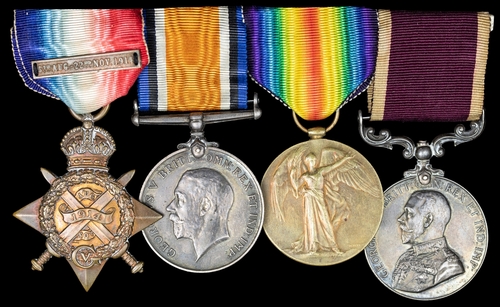
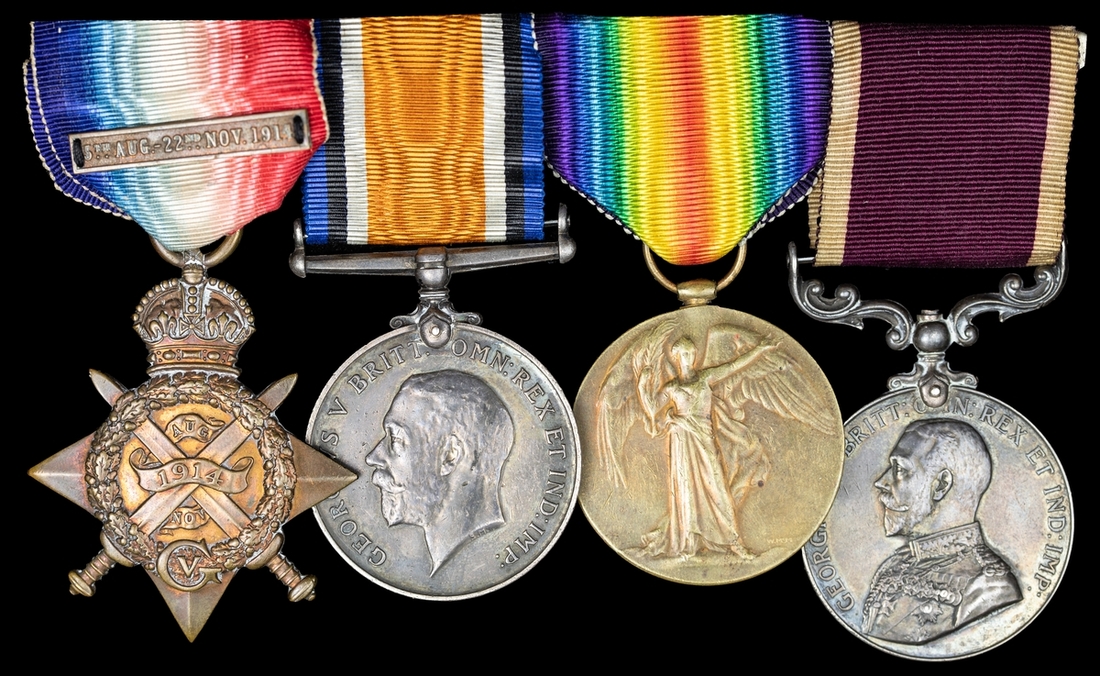
(x) Four: Sergeant G. F. Bonnick, 2nd Battalion, Connaught Rangers, who was wounded and taken a Prisoner of War the day after the action at Le Grand Fayt on 27 August 1914
1914 Star, with clasp (9045 Pte G. Bonnick. 2/Conn: Rang.); British War and Victory Medals (9045 Pte. G. F. Bonnick. Conn. Rang.); Army L.S. & G.C., G.V.R., (7143143 Sjt. G. F. Bonnick. R. Innis. Fus.), mounted as worn, very fine (4)
George Frederick Bonnick was born in London on 8 December 1888. The 2nd Battalion Connaught Rangers along with Bonnick embarked for France on 13 August 1914 from Southampton on the S.S. Herschal and S.S. Seahound.
The Battalion landed at Boulogne on 14 August and marched to the rest camp. As the soldiers marched through Boulogne, the Daily Mail correspondent heard the Rangers sing a song about one of their hometowns: "It's a Long Way to Tipperary". The story was printed in the Daily Mail on 18 August. From that day, the music-hall song, written by Jack Judge in 1912, was made the iconic tune of the war. It is said the men sang so lustily the local population thought it must be the British National Anthem.
On the night of 25 August 1914, units of I Corps halted at the villages of Maroilles and Pont sur Sambre (6th Brigade and XXXIV Brigade RFA). In the early hours of 26 August 1914, the 5th Brigade took over the river defences around Pont sur Sambre, in turn marching south to Maroilles at around 5.30am. They encountered considerable difficulty in marching south, as there were substantial numbers of French troops moving across the British line of march.
2nd Connaught Rangers, under Lieutenant-Colonel Abercrombie, and XXXIV Brigade RFA, acting as brigade rearguard, set off from Taisnières, a village to the north of the main road running east to west, from Avesne to Maroilles, and reached the main road at a crossroads to the west of Marbaix, in the mid-afternoon of 26 August. Here the pressure of French troops marching on the road caused the battalion to become split; A Company, under Captain Hamilton, managed to follow the rest of the 5th Brigade to the south. Lieutenant-Colonel Abercrombie, with A and C Companies and Battalion Headquarters, remained at the cross-roads west of Marbaix, forming a defensive position with French troops. Firing could be heard from the direction of Avesnes in the east, and Abercrombie made a move in that direction, before moving south again towards Le Grand Fayt, where his detachment formed a defensive position above the village and came under fire.
During the afternoon, Abercrombie pulled back towards Le Grand Fayt, where he expected to find the 5th Brigade HQ. He was informed by a French civilian that there were no Germans in Le Grand Fayt. In fact, troops of the German Guard Cavalry Corps were in the process of occupying the village. The Connaught Rangers entered Le Grand Fayt and were immediately enveloped in heavy fighting; both sides were apparently taken by surprise by the presence of the other. The Connaught Rangers became further split. 2nd Connaught Rangers lost 5 officers and 284 soldiers, killed or captured, in the course of the fighting in and around Le Grand Fayt.
Bonnick who was then serving in 'C' Company was captured on 27 August 1914 in the vicinity of Horville, France. He was housed at both the Hameln and Soltau POW camps for the remainder of the war, one of the German records for Bonnick notes that he was also wounded in action.
Subject to 5% tax on Hammer Price in addition to 20% VAT on Buyer’s Premium.
Sold for
£500
Starting price
£100

Watch, listen and bid as if you were in the room. Now available for auctions worldwide.
Click here to bid live
An exclusive and confidential service for the discerning collector or vendor.
View the Gallery
Download every Spink catalogue on your iPad, iPod or iPhone using free Spink app.
Download From iTunes© 2026 Spink & Son. All rights reserved.