
Auction: 25112 - Orders, Decorations and Medals - e-Auction
Lot: 155
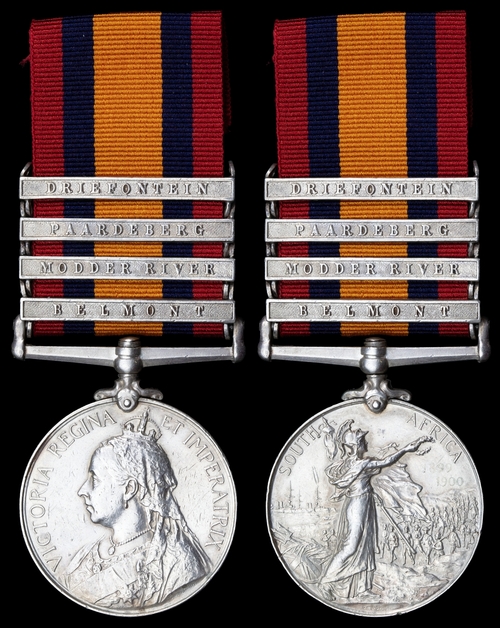
The Queen's South Africa Medal awarded to Sergeant J. Reid, Royal Engineers who was 'mentioned' for good service in South Africa as part of No. 7 Company Royal Engineers
Queen's South Africa 1899-1902, 4 clasps, Belmont, Modder River, Paardeberg, Driefontein (26347. Corpl: J. Reid. R.E.), light contact marks very fine
M.I.D. London Gazette 29 July 1902.
James E. Reid was born at Mary Hill, Glasgow on 29 August 1875 and was a carpenter and joiner by trade. He enlisted into Royal Engineers at Sudbury, Suffolk on 9 February 1892 and served in South Africa between 15 July 1899 -28 September 1902, during his time in South Africa he was 'mentioned' for good service and appeared in the London Gazette of 29 July 1902 and was also promoted to the rank of Sergeant on 1 August 1902, all the time serving with No.7 Company. He returned Home serving between 29 September 1902 - 17 November 1904. Reid then served in Gibraltar from 18 November 1904 - 14 February 1908 before returning Home on 15 February 1908 until he was discharged at Guernsey on 30 November 1908 as being medically unfit for further service. He appears in the Register for 1939 living in Wimbledon and working as a War Office clerk and died on the 27 October the same year.
He is further entitled to the King's South Africa Medal 1901-02 with both clasps.
Conan-Doyle Chapter 19 Paardeberg
"The two brigades at either end of the Boer lines had lost no chance of pushing in, and now they had come within striking distance. On the night of February 26th it was determined that Smith-Dorrien's men should try their luck. The front trenches of the British were at that time seven hundred yards from the Boer lines. They were held by the Gordons and by the Canadians, the latter being the nearer to the river. It is worth while entering into details as to the arrangement of the attack, as the success of the campaign was at least accelerated by it. The orders were that the Canadians were to advance, the Gordons to support, and the Shropshires to take such a position on the left as would outflank any counter attack upon the part of the Boers. The Canadians advanced in the darkness of the early morning before the rise of the moon. The front rank held their rifles in the left hand and each extended right hand grasped the sleeve of the man next it. The rear rank had their rifles slung and carried spades. Nearest the river bank were two companies (G and H. ) who were followed by the 7th company of Royal Engineers carrying picks and empty sand bags. The long line stole through a pitchy darkness, knowing that at any instant a blaze of fire such as flamed before the Highlanders at Magersfontein might crash out in front of them. A hundred, two, three, four, five hundred paces were taken. They knew that they must be close upon the trenches. If they could only creep silently enough, they might spring upon the defenders unannounced. On and on they stole, step by step, praying for silence. Would the gentle shuffle of feet be heard by the men who lay within stone-throw of them? Their hopes had begun to rise when there broke upon the silence of the night a resonant metallic rattle, the thud of a falling man, an empty clatter! They had walked into a line of meat-cans slung upon a wire. By measurement it was only ninety yards from the trench. At that instant a single rifle sounded, and the Canadians hurled themselves down upon the ground. Their bodies had hardly touched it when from a line six hundred yards long there came one furious glare of rifle fire, with a hiss like water on a red-hot plate, of speeding bullets. In that terrible red light the men as they lay and scraped desperately for cover could see the heads of the Boers pop up and down, and the fringe of rifle barrels quiver and gleam. How the regiment, lying helpless under this fire, escaped destruction is extraordinary. To rush the trench in the face of such a continuous blast of lead seemed impossible, and it was equally impossible to remain where they were. In a short time the moon would be up, and they would be picked off to a man. The outer companies upon the plain were ordered to retire. Breaking up into loose order, they made their way back with surprisingly little loss; but a strange contretemps occurred, for, leaping suddenly into a trench held by the Gordons, they transfixed themselves upon the bayonets of the men. A subaltern and twelve men received bayonet thrusts--none of them fortunately of a very serious nature.
While these events had been taking place upon the left of the line, the right was hardly in better plight. All firing had ceased for the moment--the Boers being evidently under the impression that the whole attack had recoiled. Uncertain whether the front of the small party on the right of the second line (now consisting of some sixty-five Sappers and Canadians lying in one mingled line) was clear for firing should the Boers leave their trenches, Captain Boileau, of the Sappers, crawled forward along the bank of the river, and discovered Captain Stairs and ten men of the Canadians, the survivors of the firing line, firmly ensconced in a crevice of the river bank overlooking the laager, quite happy on being reassured as to the proximity of support. This brought the total number of the daring band up to seventy-five rifles. Meanwhile, the Gordons, somewhat perplexed by the flying phantoms who had been flitting into and over their trenches for the past few minutes, sent a messenger along the river bank to ascertain, in their turn, if their own front was clear to fire, and if not, what state the survivors were in. To this message Colonel Kincaid, R. E., now in command of the remains of the assaulting party, replied that his men would be well entrenched by daylight. The little party had been distributed for digging as well as the darkness and their ignorance of their exact position to the Boers would permit. Twice the sound of the picks brought angry volleys from the darkness, but the work was never stopped, and in the early dawn the workers found not only that they were secure themselves, but that they were in a position to enfilade over half a mile of Boer trenches. Before daybreak the British crouched low in their shelter, so that with the morning light the Boers did not realise the change which the night had wrought. It was only when a burgher was shot as he filled his pannikin at the river that they understood how their position was overlooked. For half an hour a brisk fire was maintained, at the end of which time a white flag went up from the trench. Kincaid stood up on his parapet, and a single haggard figure emerged from the Boer warren. 'The burghers have had enough; what are they to do?' said he. As he spoke his comrades scrambled out behind him and came walking and running over to the British lines. It was not a moment likely to be forgotten by the parched and grimy warriors who stood up and cheered until the cry came crashing back to them again from the distant British camps. No doubt Cronje had already realised that the extreme limit of his resistance was come, but it was to that handful of Sappers and Canadians that the credit is immediately due for that white flag which fluttered on the morning of Majuba Day over the lines of Paardeberg."
Subject to 20% VAT on Buyer’s Premium. For more information please view Terms and Conditions for Buyers.
Sold for
£260
Starting price
£80


Watch, listen and bid as if you were in the room. Now available for auctions worldwide.
Click here to bid live
An exclusive and confidential service for the discerning collector or vendor.
View the Gallery
Download every Spink catalogue on your iPad, iPod or iPhone using free Spink app.
Download From iTunes© 2026 Spink & Son. All rights reserved.