
Auction: 25111 - Orders, Decorations and Medals - e-Auction
Lot: 591
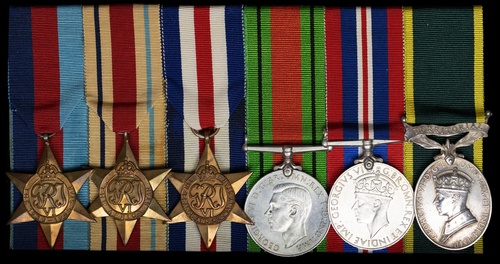
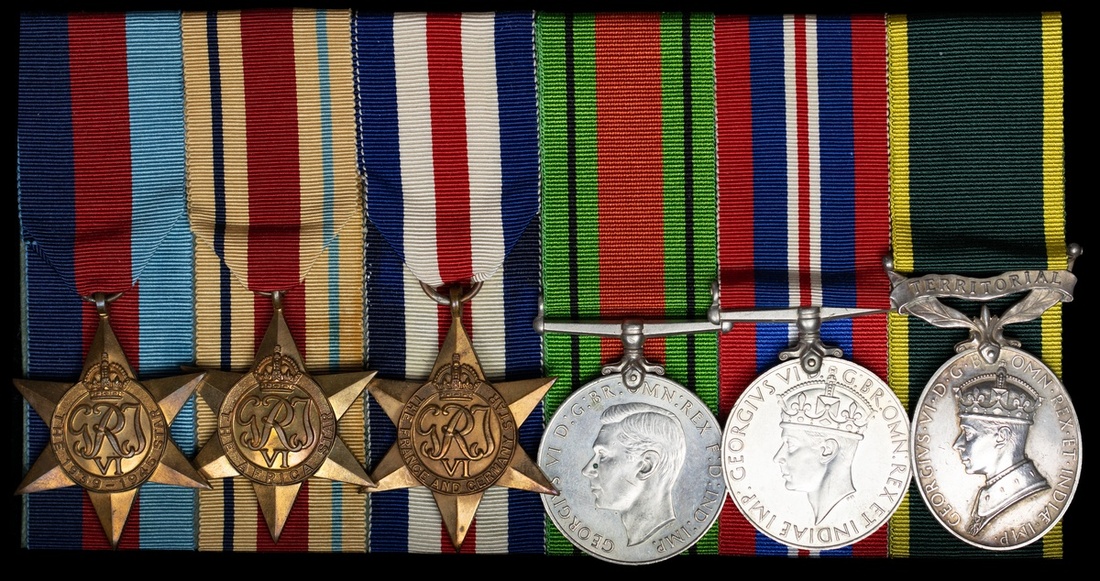
An escaper's group of six awarded to Gunner J. H. Davison, Royal Artillery, who was taken Prisoner of War at Tobruk and escaped from Baletta Hospital the next year, walking all the way to Allied lines
1939-45 Star; Africa Star; France & Germany Star; Defence and War Medals 1939-1945; Efficiency Medal, G.VI.R., Territorial (907403. Gnr. J. H. Davison. R.A.), contact marks, overall very fine (6)
John Herbert Davison was born on 26 September 1919 at Newcastle, prior to enlistment he worked as a Weighing Machine Apprentice whilst living at 94 Hamilton Street, Newcastle. Enlisting on 2 May 1939 with the Royal Artillery he was posted to No. 124 Field Regiment. He was serving with that unit at Tobruk on 20 June 1942 when the city was the subject of a major attack by the combined German and Italian armies.
The initial assault on 20 June was successful but didn't actually fall until the next day with some fighting continuing until 22 June. Davison was taken prisoner of war during the initial assault on 20 June and taken to Tarhuna, Libya and his escapee questionnaire notes of his dislike of the camp commandant while there:
'Commandant of P/W Camp at Tarhuna, Libya between June and Oct 1942. His behaviour, while falling short of actual brutality, was particularly anti-British.'
Transported to Italy on 27 October he was taken first to Campo 65 before being transferred to Campo 132/8 on 1 May 1943. While at a work camp in August Davison injured himself and was taken to Hospital at the nearby city of Barletta. He was there in September 1943 when the Armistice was signed between the Allies and the Italians and the Germans scrabbled to react.
Barletta was on the forefront of that reaction and soon came under attack what followed is best outlined in he citation for the Al Valore (Military) presented to the city's garrison after the battle which states:
'On 8 September 1943, the garrison of Barletta, modestly armed, but supported by the spontaneous and effective support of the citizens, wanted to continue on the path of honour and loyalty to the homeland, strenuously opposing the fierce German units and inflicting considerable losses on them. Only on 12 September, after the arrival of overwhelming German reinforcements, the garrison, tried by the losses suffered and under the threat of the destruction of the city, was forced to surrender. The enemy troops occupied Barletta, barbarously slaughtered 13 defenceless citizens in retaliation, who thus united their sacrifice to the valor of the military in a common yearning for freedom. The city of Barletta, a shining example of the virtues of the people of southern Italy, hands over the future generations the witness of the values resulting from the rebirth of the homeland and the conquest of democracy and peace. Barletta 8-13 September 1943.'
Despite the German forces defeating the Italian garrison they did not assume full control of the area until 24 September. The day before this several of the inmates of the Barletta Hospital escaped, the escapee questionnaire again refers:
'From Barletta Hospital.
Walked south with some companions (names and units of these not known but they were last seen in U.K.).
He travelled on foot the whole way, receiving no assistance, and joined the Allied lines south of Barletta.'
Returning to Britian Davison was discharged on 6 March 1946, having his medals issued on 24 February 1949; sold together with copied research and a medal mounting bar.
Subject to 20% VAT on Buyer’s Premium. For more information please view Terms and Conditions for Buyers.
Sold for
£220
Starting price
£140
Watch, listen and bid as if you were in the room. Now available for auctions worldwide.
Click here to bid live
An exclusive and confidential service for the discerning collector or vendor.
View the Gallery
Download every Spink catalogue on your iPad, iPod or iPhone using free Spink app.
Download From iTunes© 2026 Spink & Son. All rights reserved.