
Auction: 25111 - Orders, Decorations and Medals - e-Auction
Lot: 449
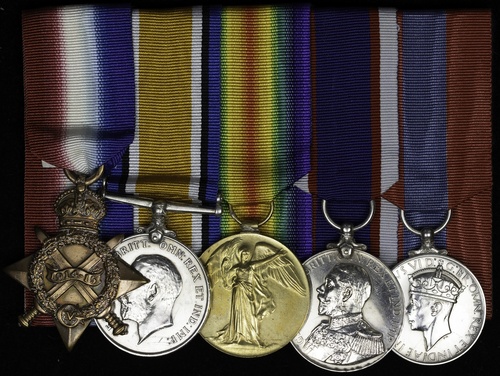
An outstanding Great War campaign and long service group of five awarded to Leading Stoker W. T. Brown, Royal Navy, who was present in H.M.S. Broke's epic encounters at Jutland in May 1916 and in the Dover Straits in April 1917
On the former occasion, Broke was caught close-range in the searchlights of the enemy battleship Westfalen and pulverised by heavy calibre fire which resulted in the loss of more than 40% of her ship's company
On the latter occasion Broke rammed the enemy destroyer G-42 at 27 knots, almost turning her adversary over on her beam-ends: a brutal boarding party hand-to-hand encounter ensued, so much so that Broke's decks were 'literally running in blood'
1914-15 Star (SS. 100068 W. T. Brown, A.L. Sto., R.N.); British War and Victory Medals (SS. 100068 W. T. Broen, L. Sto., R.N.); Imperial Service Medal, G.VI.R., 1st issue (William Thomas Brown), officially corrected naming; Royal Fleet Reserve L.S. & G.C., G.V.R., 1st issue (SS. 100068 Po. B. 2809 W. T. Brown, L. Sto., R.F.R.), generally good very fine (5)
William Thomas Brown was born in Ilford, Essex on 12 August 1882 and entered the Royal Navy as a Stoker 2nd Class in October 1903. Having then joined the Royal Fleet Reserve in October 1908, he was recalled on the outbreak of hostilities and joined the destroyer H.M.S. Broke in December 1914. And he would remain likewise employed until August 1918, thereby sharing in her honours at Jutland and in the Dover Straits.
Jutland
As neatly summarised in The Jutland Honours by Chris Bilham, Broke suffered shocking casualties and damage:
'At around 23:15 hours ships were seen approaching from the starboard beam, i.e. the west, on a converging course. When they were only 600 yards away Tipperary, the flotilla leader, challenged them. The reply was a storm of gunfire, leaving Tipperary a sinking, burning wreck. Broke and some of the other destroyers then attacked the ships - enemy light cruisers, closely followed by battleships - and a torpedo from one of them hit the light cruiser Elbing.
The destroyers resumed their course south but, only a few minutes later, encountered the battleship Westfalen. The Broke had just begun her torpedo attack when she was illuminated with searchlights and then subjected to heavy gunfire at close range. As one of her lieutenants put it, 'It was perfectly damnable having their light right in our faces (about four or five cables off) and being properly biffed.' Nearly all the gun crews were killed; among the casualties was the helmsman and as he fell, he pulled the wheel to one side and Broke rammed the Sparrowhawk at speed. One of Broke's officers went forward to inspect the damage and found a stranger, who turned out to be Sparrowhawk's Sub-Lieutenant who had been pitched on board by the force of the collision. Commander Allen sent the man back with a message to his C.O. that in view of the serious damage to Broke, the Sparrowhawk should prepare to take his crew on board; Lieutenant Commander Hopkins of the Sparrowhawk replied that it was a pity because he had just sent a message to Allen requesting him to take Sparrowhawk's crew! While the two ships were locked together in clouds of hissing steam from ruptured pipes, the Sparrowhawk was then rammed by the Contest as well. Fortunately, the Germans had moved on and the three destroyers were separated.
Broke then began an arduous passage back to the U.K. At 01:30 she was approached by enemy destroyers which fired a few shells at her, killing a few more men, then inexplicably made off. The weather became so bad that she had to turn towards the south-east, as to continue on her homewards course to the west would have risked the collapse of her bulkheads. She eventually made port on the evening of 3 June.
Broke's casualties were forty-seven killed, thirty-six wounded. This was more than 40% of her company and by far the heaviest of any of the destroyers, excepting those which were sunk.'
Action in the the Dover Straits
A superb account of Broke's famous encounter with six enemy destroyers in the Dover Straits on the night of 20-21 April 1917 is to be found in Taffrail's Endless Story, from which the following extracts have been taken:
'It is impossible to describe the sensations of those on board both these ships as the collision occurred - the Broke's grimly triumphant; the Germans filled with terror-stricken amazement and horror. It was a dreadful moment; but worse was yet to come.
Man were screaming and shouting for help as the Broke's guns, at their maximum depression, pumped shell after shell at a few yards' range into the mass of men huddled on the deck of her stricken enemy. One of the German's torpedo-tubes had stuck into the Broke's side and was torn off its mounting. The anti-aircraft 2-pounders added to the din with their stuttering uproar, while the British seamen that remained alive in the forepart of the ship, with rifles and fixed bayonets, and revolvers and naked cutlasses, headed by Mr. Midshipman Donald Gyles, R.N.R., already wounded by a shell splinter in the eye, swarmed forward on to the
Taffrail continues:
'Many casualties had occurred among the guns' crews of the forecastle through two enemy shells, one of which had detonated projectiles in a ready rack. All the electric cables and voice-pipes from the bridge had been shot away, while the after compass, after wireless-room, and searchlight were demolished. The foremost funnel was pierced through and through by splinters until it resembled a huge nutmeg-grater. A shell passing in through the side above the waterline had penetrated a coal-bunker, to explode in the boiler-room beyond, killing or wounding every man in the compartment and severing the main steam-pipe, from which the steam escaped with a deafening roar. And, besides the damage from enemy shell, the British flotilla-leader had a badly bent and crumpled bow, and two huge gashes forward above the waterline. Dead and wounded lay everywhere … In the space of a few moments the Broke was converted into a smoking-shambles. In places, her decks were literally running in blood. She sustained 57 casualties, of whom 21 were killed outright, and no part of the ship was immune … '
Broke eventually limped home and news of her spectacular action soon hit the headlines. Her captain - 'Teddy' Evans of Antarctic fame - and crew also received the warm approbation of Their Lordships of the Admiralty.
William Brown saw out the rest of the war with shore appointments and was finally demobilised as a Leading Stoker in the summer of 1921. He opted however to rejoin the Royal Fleet Reserve on the same occasion and received the L.S. & G.C. Medal in February 1923; his subsequent award of the I.S.M. was in respect of his services as a messenger in the Civil Service.
Sold with his original Certificate of Service, together with a Great War period picture postcard of H.M.S. Broke.
Subject to 20% VAT on Buyer’s Premium. For more information please view Terms and Conditions for Buyers.
Sold for
£220
Starting price
£210

Watch, listen and bid as if you were in the room. Now available for auctions worldwide.
Click here to bid live
An exclusive and confidential service for the discerning collector or vendor.
View the Gallery
Download every Spink catalogue on your iPad, iPod or iPhone using free Spink app.
Download From iTunes© 2026 Spink & Son. All rights reserved.