Auction: 25111 - Orders, Decorations and Medals - e-Auction
Lot: 286
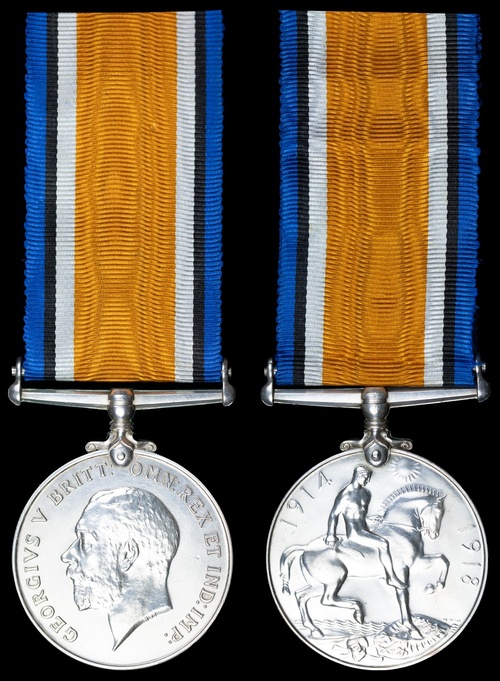
The British War Medal awarded to Captain J. J. Hammond, Royal Air Force, a New Zealander and probably the first aviator from that country, a holder of many 'firsts' including a cross country flight in Australia and the first person to fly at what is now Sydney Kingsford Smith airport, but who sadly died in a flying accident in Indianapolis on 22 September 1918
British War Medal (Capt. J. J. Hammond. R.A.F.), extremely fine
Joseph Joel Hammond was born at Fielding, Rangitikei, New Zealand, on 19 July 1889. He was the son of Joseph and Mary Hammond and the grandson of Matthew and Sarah Hammond who had arrived at Port Nicholson, Wellington, on 9 November 1842. He was also the husband of Ethelwynd Hammond. Hammond attended St.Patrick's College, Wellington New Zealand, after his education he farmed in Australia before heading to the Klondike, Canada where he tried gold digging and later toured North America with William "Buffalo Bill" Cody. He arrived in Europe in 1909 and began to learn to fly under the famous aviators Henri Farman and Leon De Lagrange and obtained his Pilot's Aviators Certificate (Aero Club of France) at Rheims on 4 October 1910 (Fr258). Later the same year he moved to England and jointed the Larkhill Flying School and gained his certificate (No.32 R.A.C.) on 22 November 1910.
Now a qualified aviator, Hammond headed a trade mission to Australia as a pilot with two Bristol Box Kites. On 9 January 1911, at Perth, Western Australia, he made the first significant demonstration in Australia flying for some 45 minutes at heights exceeding 2,500 feet in front of the Governor General Sir Gerald Strickland K.C.M.G.. This was followed up with flights carrying a passenger and also cross country flights in other parts of Australia. On 23 February 1911 he achieved the first cross-country passenger flight in Australia between Altona (Melbourne) and Geelong.
On 18 April 1911 he flew the Box Kite over Ascot Racecourse, Sydney, in front of thousands of spectators. The racecourse now long gone is now part of the eastern end of Sydney's Kingsford Smith airport east-west runway and current long term car park.
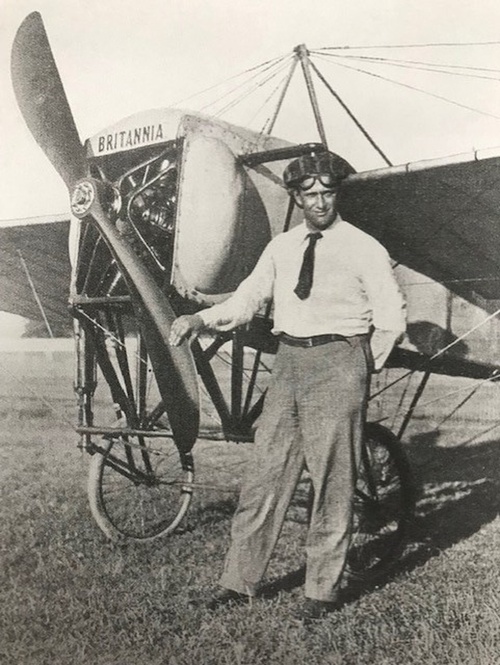
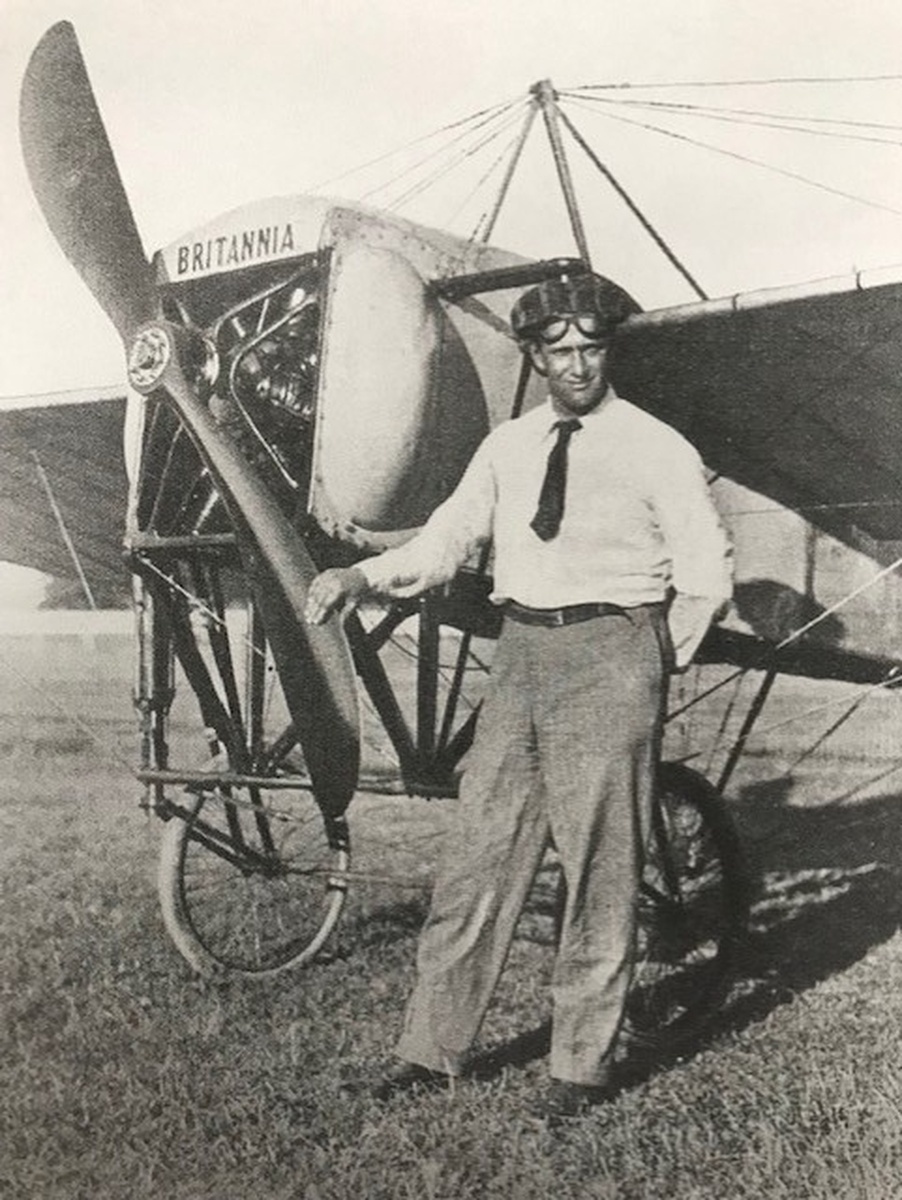
He returned to New Zealand in May 1913 and during this time he was commissioned Second Lieutenant with the Royal Flying Corps Special Reserve on 26 May 1913. Hammond was appointed New Zealand's first official government pilot later that year. He was to fly a Bleriot XI-2 (two seater) that had been presented to the New Zealand government. Dubbed 'Britannia' it was to become the first military aircraft. After several proving flights he was ready to take a passenger, and as officials vied for the opportunity Hammond elected to take a woman member of the Royal Pantomime Company instead, a Miss Esme McLalland. Alas the great and the good were not amused and consequently Hammond was sacked and the aeroplane placed in storage before being returned to England in January 1915 where it was delivered to Brooklands, Weybridge, Surrey. In 1914 Hammond flew over Auckland in a Bleriot monoplane in front of many spectators at the Auckland Exhibition.
Hammond returned to England in late 1914 and was a flying instructor at the Eastbourne Aviaition Company before he was made a Flying Officer on 29 January 1915.
However a letter dated 13 February 1915 continued to add to his limited respect for authority:
Dear Swettenham.
I think the General ought to know that Lieutenant Hammond, R.F.C. is most unsatisfactory at Lydd; we cannot get him to fly when he is wanted. Last week although we had two or three very fine days and practice was ordered, he absented himself without leave and when I succeeded in getting him back, said he was ill.
I wrote twice about him last week to Lieut. Colonel Ashmore who came down to see the R.F.C. here but had no reply.
I have no official information or evidence, but the general opinion here is that Hammond spends his time away from Lydd in undesirable ways.
Perhaps you have heard a second machine arrived at Lydd on the Friday, but was absolutely broken up on Sunday in a practice flight. We were left consequently with Hammond's machine only.
I regret to say that unless a more reliable officer than Hammond is sent here, any attempts to train B. Cs to work in co-operation with aeroplanes will not be successful.
Yours sincerely,
(sd) John Wynne.
The matter is urgent, as I can get no work done with the aeroplane at present, not due to the weather, but the present pilot.
Yours sincerely,
(sd) John Wynne.
The letter in response resulted in the withdrawal of Hammond from Lydd and he was posted to No.1 Reserve Aeroplane Squadron from 16 February 1915 - 17 May 1915. He then transferred to No.4 Reserve Aeroplane Squadron on 18 May 1915 - 18 November 1915. During this period he suffered a confusion to the leg and was admitted to hospital on 3 September 1915 but had recovered by the 8 October 1915. He joined the Aeronautical Inspection Department (A.I.D.) on 19 November 1915 - 9 February 1916, firstly as a Testing Pilot and then as a Flight Commander from 10 February 1916. Hammond was promoted to Temporary Captain on 13 June 1916.
His exploits continued and his obituary included this anecdote from C. G. Gray of the Aeroplane which appeared in the October 1918 edition:
'When flying a huge experimental machine (the first Robey Peters Fighting Machine in late 1916) near Lincoln something went seriously wrong, and he was unable to turn, so he endeavoured to glide straight for a field. Finding he was unable to reach his objective, he planted the machine skilfully on the capacious roof of a lunatic asylum, where it promptly caught fire. Having no means of putting it out, he calmly strolled to the other end of the roof, and sat smoking cigarettes while he watched it burn. The local fire brigade arrived and tried to put it out, and one heard at the time that gallant efforts were made to rescue the supposedly roasting aviator. It was not until he had seen quite a good fire-fighting performance that the said aviator thought it worthwhile to disclose to the sympathetic crowd that he was very much still alive.'
Hammond was seconded to the Bristol Aeroplane Company from 17 January 1917 as their full-time test pilot. Once the U.S.A. entered the war in 1917 Hammond was posted over to the States on exchange duties as an instructor and demonstrator.
Hammond was killed on 22 September 1918, at the time he was with the British Air Mission to the United States and was returning to Indianapolis from the Fourth Liberty Loan War Bond Drive air display at Greenfield. At about 5.30 p.m. his Bristol Fighter F2B entered a right hand spin from 600 feet, it's left wing striking a tree before crashing in a cornfield of the Marion County Poor Farm near its boundar with the Indianapolis Speedway. One of the passengers, civilian J. L. Kinder, was killed on impact, while the other Lieutenant R. W. Pickett of the United States Army Air Service was seriously injured but recovered. At the funeral Hammond's coffin was draped with an American and British flag and was attended by U.S. and British soldiers, including a firing squad of American and British aviation officers. Thousands of citizens attended the ceremony, at which the Bishop of Indianapolis officiated.
Hammond was cremated and his remains were then stored in the family mausoleum of Carl Fisher who was the founder of the Indianapolis speedway. Fisher had graciously temporarily donated his own plot in the mausoleum until Hammond's family could come and claim the remains after the war, however Hammond's remains were never claimed. Hammond's remains still reside in Carl Fisher's mausoleum, Crown Hill cemetery, Indianapolis, Indiana, U.S.A.
Subject to 20% VAT on Buyer’s Premium. For more information please view Terms and Conditions for Buyers.
Sold for
£850
Starting price
£180

Watch, listen and bid as if you were in the room. Now available for auctions worldwide.
Click here to bid live
An exclusive and confidential service for the discerning collector or vendor.
View the Gallery
Download every Spink catalogue on your iPad, iPod or iPhone using free Spink app.
Download From iTunes© 2026 Spink & Son. All rights reserved.