

Auction: 24112 - Orders, Decorations and Medals - e-Auction
Lot: 1014
'Second Lt. Alvin G. McCormick...who was captured at Portvall, in Normandy, on June 19, said immediately after his capture an SS officer would shout to McCormick: "Americans, what the ---- are you doing in Europe?" McCormick shouted back: "What the ---- are you doing in France?"
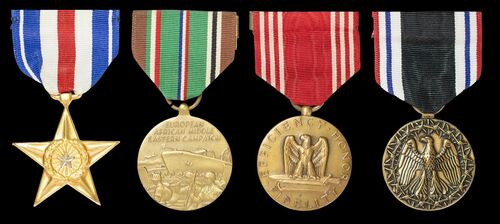
The historically interesting U.S. Silver Star group of four awarded to Lieutenant A. G. McCormick, 357th Infantry, who was taken prisoner-of-war in France shortly after D-Day; incarcerated at Oflag 64 in Poland, he later escaped and made his way to Moscow before being repatriated to the United States in 1945
United States of America, Silver Star (Alvin McCormick), engraved naming; Army Good Conduct Medal, edge officially numbered '12612'; European, African, Middle Eastern Campaign Medal, unnamed as issued, in its original card box of issue; Prisoner of War Medal, unnamed as issued, good very fine and better (4)
Silver Star, Headquarters 90th Infantry Division General Orders No. 148, 1945.
Alvin G. McCormick was born on 20 July 1920 in New Orleans, Louisiana and after gaining a degree at Louisiana State University was living in Rochester, New York, by the time of his enlistment in the United States Army on 5 December 1939. By 1944 McCormick was a Second Lieutenant in 357th Infantry, and on 8 June of that year the regiment landed on Utah beach for the Normandy campaign: they were ordered straight into the action and started suffering their first casualties a mere two days later, which increased rapidly over the coming days. The Regimental History states: 'At noon the enemy defence line was reached. Darkness found the Regiment still attacking in the face of withering enemy mortar and machine gun fire. It seemed that every German had an automatic weapon, and mortar shells seemed to follow the men right into their holes and ditches. Casualties were heavy and gains could be measured in yards. World War II has begun in earnest for the new 357th Infantry. The day had been the longest the men had ever spent. The initial shock of seeing old friends struck down had been great and it was evident that much fierce fighting lay ahead...By the end of the 13th, the Regiment in 4 days of combat had suffered a total of 703 casualties, including 133 dead. ('Regimental History of the 357th Infantry', p. 13-14 refers). McCormick would have experienced all this and more, but his war was about to take a different turn.
According to subsequent newspaper reports, Lt. McCormick was made prisoner-of-war at 'Portvall' on 19 June and immediately had a run-in with his captors by answering back to an SS officer; the prisoners were then force-marched for 15 hours without food or water through France and towards Germany, a journey taking some six days in total with little further sustainance forthcoming. By September McCormick found himself at Oflag 64, a U.S. Army-specific all-officers' P.O.W. camp in northern Poland; undoubtedly the most famous inmate of the camp was one Lieutenant-Colonel John Waters, son-in-law of none other than General George S. Patton. A copy of the unofficial camp newspaper ('The Oflag 64 Item') specifically states McCormick being a new arrival on the front page of the 1 September issue and he was given the Prisoner-of-War number 80784.
Oflag 64 was built around a Polish boys' school, and was unusually comfortable - prisoners recalled having proper beds to sleep on, toilets and sinks to every room, and even a library containing 3,000 books. The camp was also internally run entirely by the prisoners themselves, the Germans content to simply guard the exterior - an agreeable existence for all, though unfortunately this was about to change for the worse. As Russian forces advanced towards Germany, so many P.O.W. camps were emptied by their guards, the prisoners being force-marched (usually in appalling conditions) in an endeavour to always remain one step ahead; thousands of men from hundreds of camps died on these marches - but McCormick was one of those who endeavoured to escape and go the other way, towards Russia. Slipping out of Oflag 64 after the Germans made a precipitate retreat, he and 53 others decided their chances of surviving lay more with getting to Moscow than being caught up amongst the retreating Germans and advancing Russians. A New York newspaper took up the story: 'Fifty-four American prisoners, ragged and lousy, who "liberated" themselves from Oflag 64 in Szubin, Poland, have reached Moscow after a series of rollicking adventures, which included being mistaken for Germans on more than one occasion.
Tiring of riding the blinds of a passenger train, near Minsk, three of them managed to enter a sleeping car uninvited. When the conductor saw them she asked them how they had entered and was about to have them removed when one of the men, 2d Lt. Bill B. Everett, Sweetwater, Tex., made the mistake of saying in German, "Ein Moment."
"You could just see the suspicion light up in her eyes," said 2d Lt. Alvin G. McCormick, Livonia, N.Y. "She motioned us slyly, inviting us in German to sit down in a vacant compartment, while she went to get some reinforcements."
The Americans had a safe conduct replete with rubber stamps given them by a Polish major. When several tough Russian officers came up they handed them the pass and said, "Americanski! Americanski! Moscow!"
They had two overcoats, two blankets and one toilet kit among them. (Press and Sub-Bulletin, New York, Friday 23 February 1945, refers).
After a period of rest and relaxation in Moscow (including visits to the ballet and to the American ambassador) McCormick was flown back to Washington (via Teheran, Cairo, Casablanca and the Azores) in 56 hours, nine minutes (a fact specifically commented upon in The Atlanta Journal of Sunday 25 February 1945) together with seven other officers. His adventurous war was safely at an end, and he was relieved from active duty in October of that year. Returning to his native Louisiana, he died on 23 May 1986 and is buried with other members of his family in Masonic Cemetery No. 1, New Orleans.
Sold together with an extensive file of copied research including newspaper articles, Regimental History extracts, recent online articles relating to Oflag 64, and the recipient's Draft and P.O.W. cards.
Subject to 20% VAT on Buyer’s Premium. For more information please view Terms and Conditions for Buyers.
Sold for
£180
Starting price
£60


Watch, listen and bid as if you were in the room. Now available for auctions worldwide.
Click here to bid live
An exclusive and confidential service for the discerning collector or vendor.
View the Gallery
Download every Spink catalogue on your iPad, iPod or iPhone using free Spink app.
Download From iTunes© 2026 Spink & Son. All rights reserved.