Auction: 24112 - Orders, Decorations and Medals - e-Auction
Lot: 1013
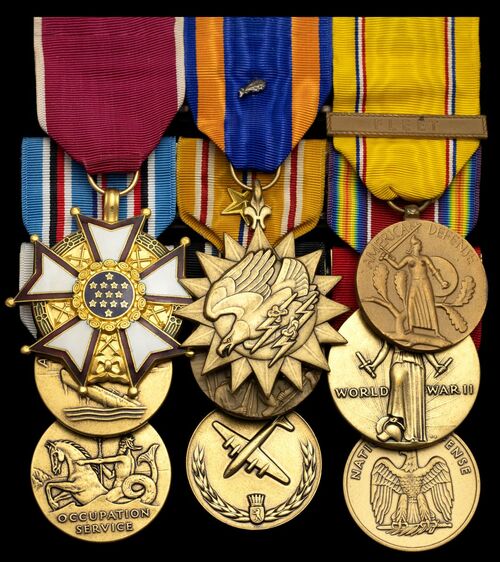
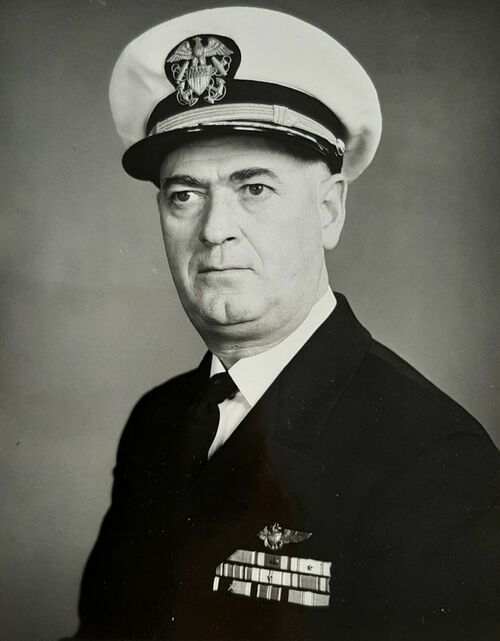
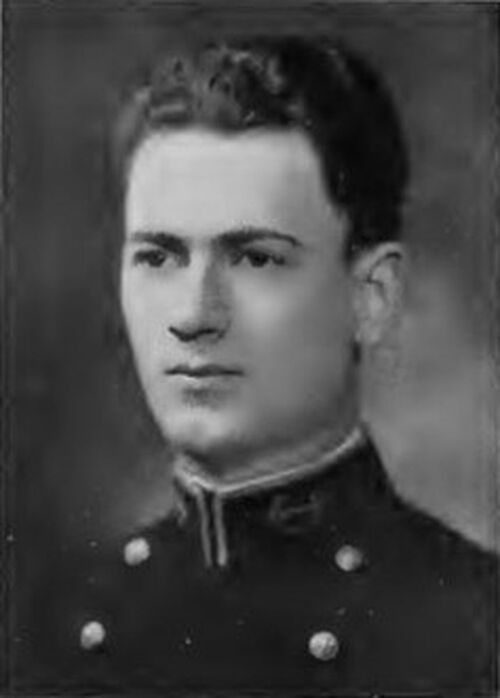
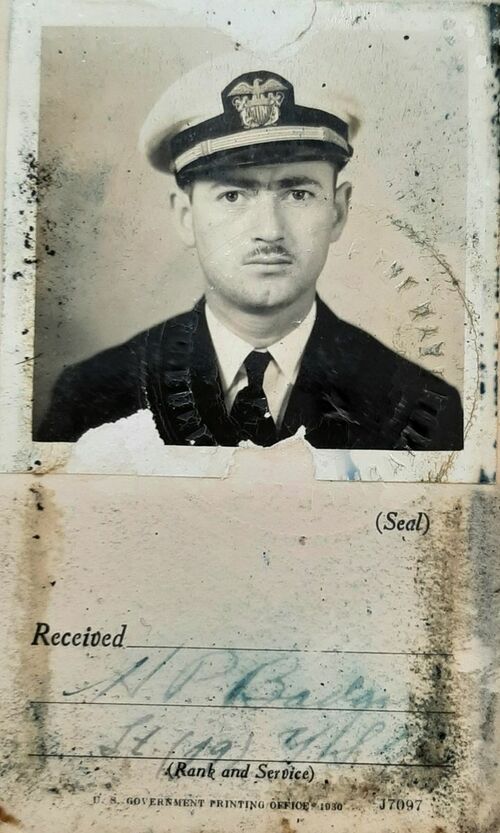
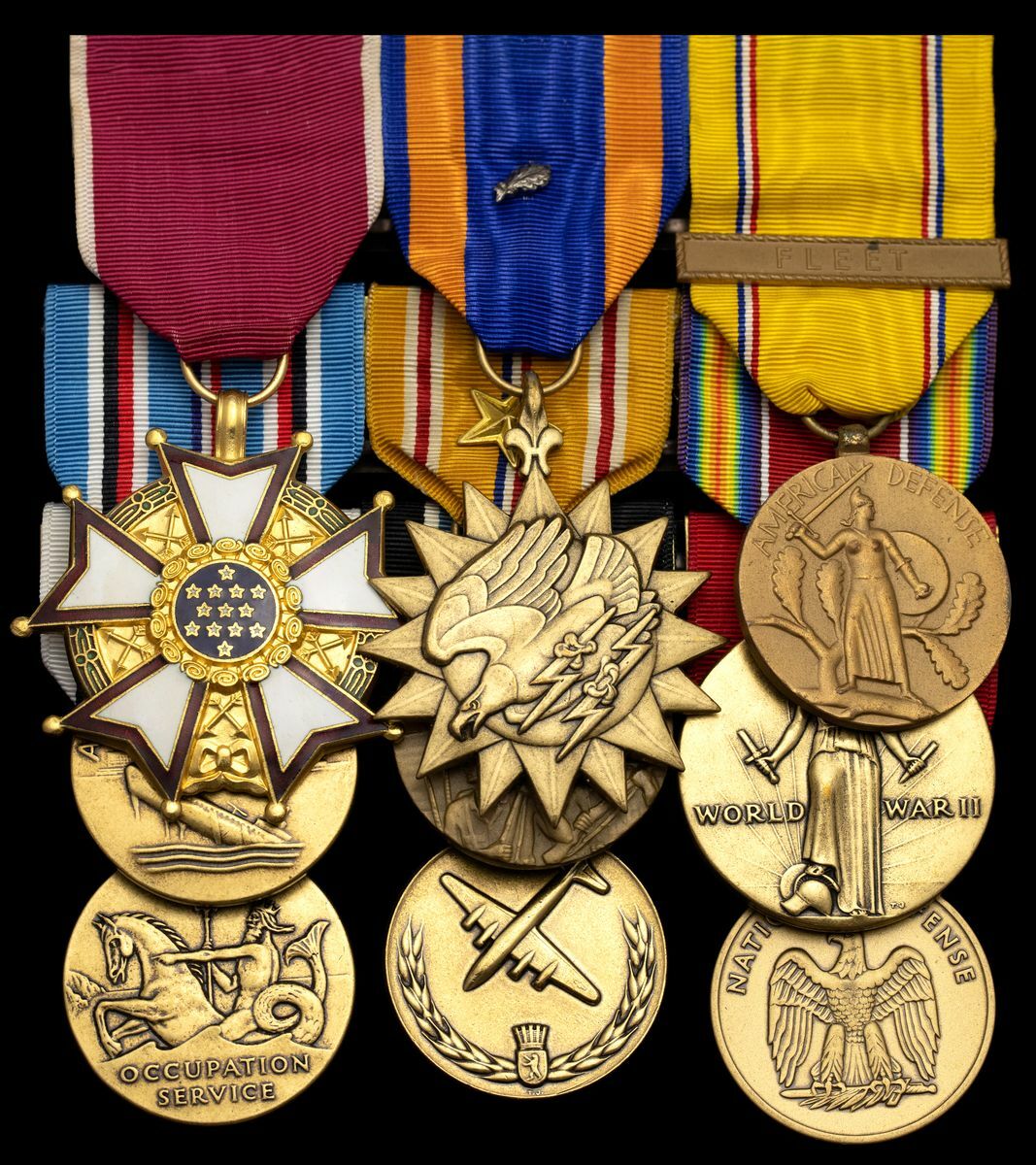
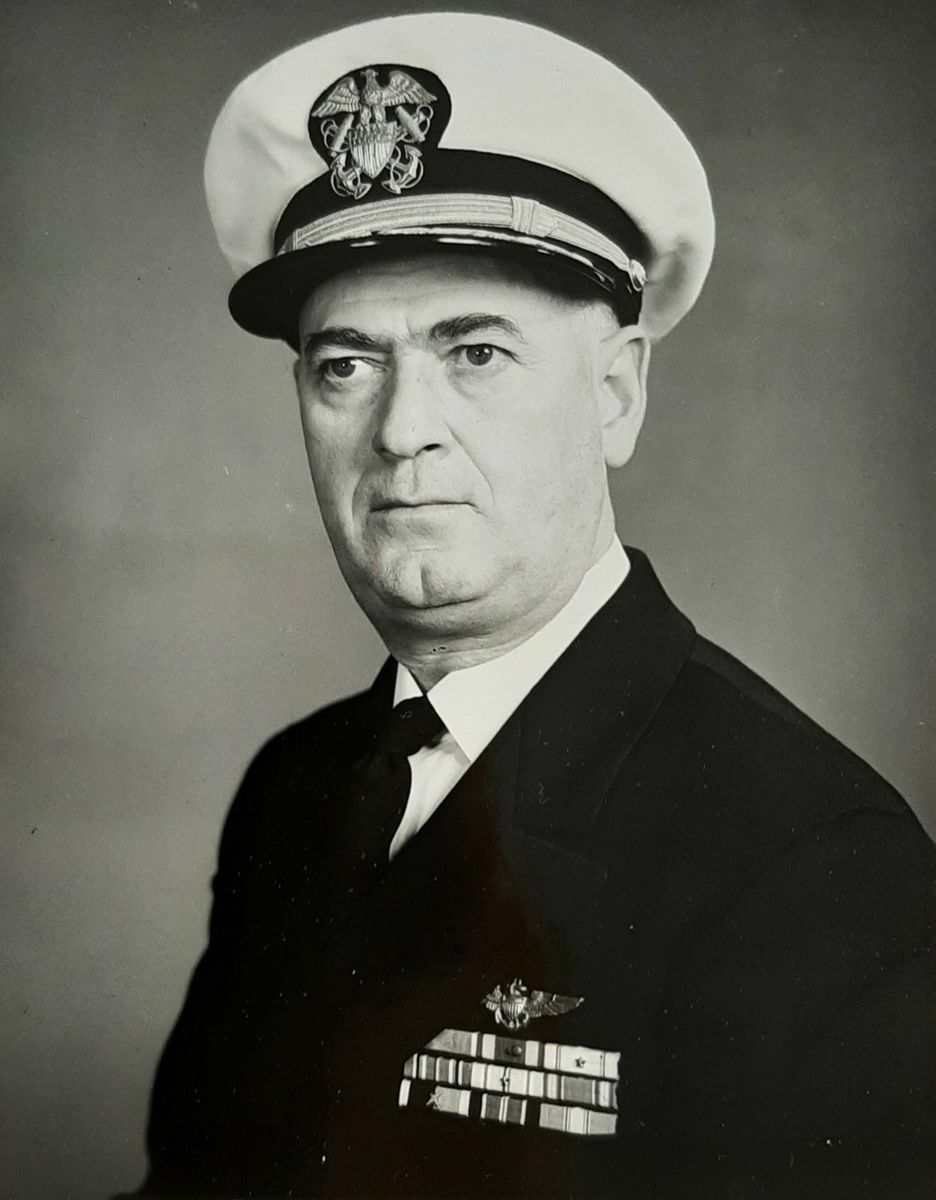
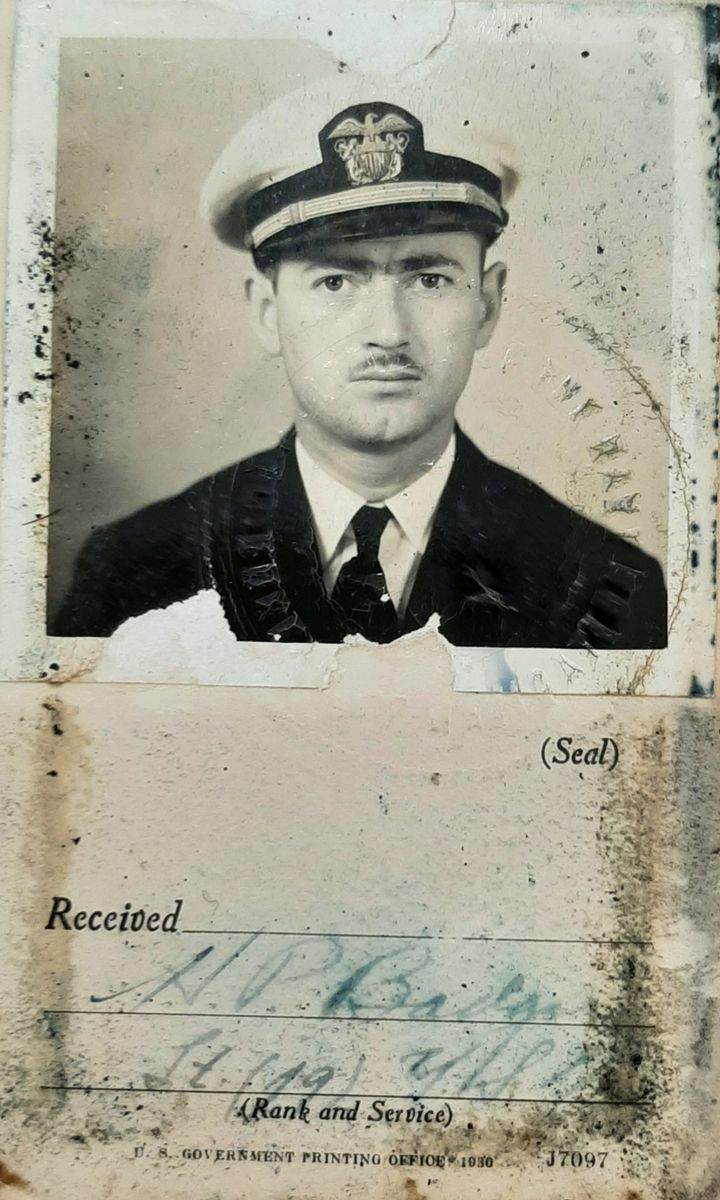
(x) The well-documented 'Berlin Airlift' Legion of Merit and 'Pacific War' Air Medal and 'Berlin Airlift' oakleaves group of nine awarded to Captain H. P. Badger, a United States Naval Aviator, who survived the Attack on Pearl Harbor, Commanded a Naval Air Squadron during the Berlin Airlift in 1947, and served as Commanding Officer of the Naval Air Station in Bermuda between 1957-60
Legion of Merit; Air Medal; American Defense Service Medal, with Fleet Clasp; American Campaign Medal; Asiatic-Pacific Campaign Medal, with campaign Star; Victory Medal 1939-45; Navy Occupation Service Medal with Berlin Airlift Clasp; National Defense Service Medal, mounted as worn, very fine (9)
Legion of Merit, General Order 84, 11 October 1949, the citation states:
'…exceptionally meritorious conduct in the performance of outstanding service during the period 9 January 1949 to 12 May 1949'
Air Medal, the original citation states:
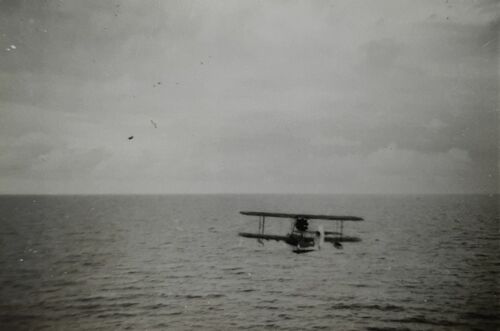
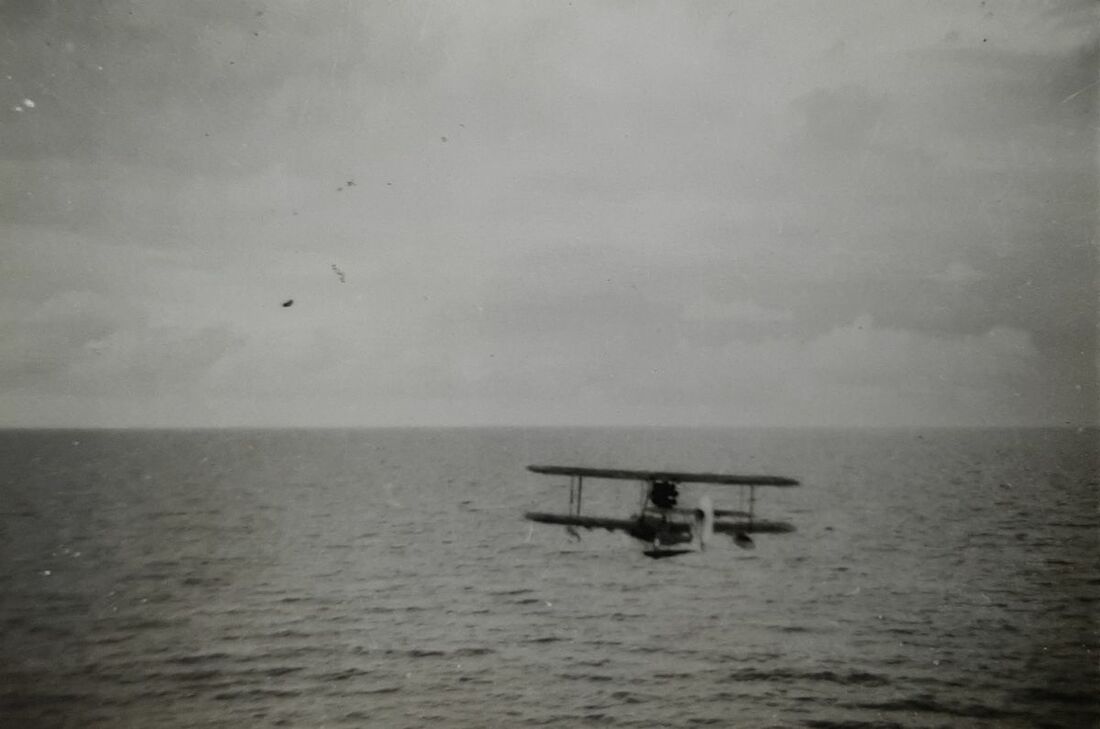
'For meritorious achievement in aerial flight as a Pilot in Utility Squadron ONE, during operations against enemy Japanese forces in the vicinity of the Hawaiian Islands from December 10, 1941, to April 11, 1942. During this trying period when the Naval Air strength in the Hawaiian Area was at its lowest ebb due to damage suffered by the Japanese attack, Lieutenant Badger flew numerous long patrol, search and convoy missions in non-combatant type aircraft which had already seen long service. These aircrafts which had been damaged during the attack were hastily repaired, armed with a small calibre gun and pressed into service during a time of great national stress. Frequently returning to a blacked-out base after dark without the use of navigational and radio aids, he effected safe landings on an unlighted field without the assistance of aircraft landing lights…'
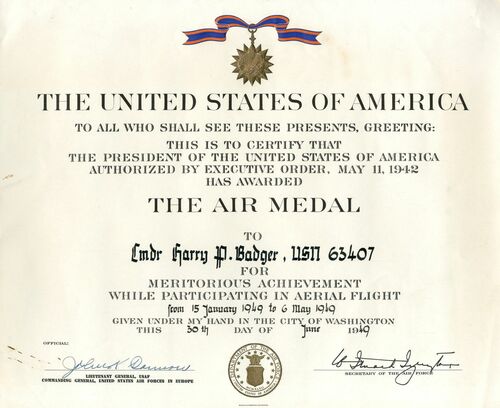
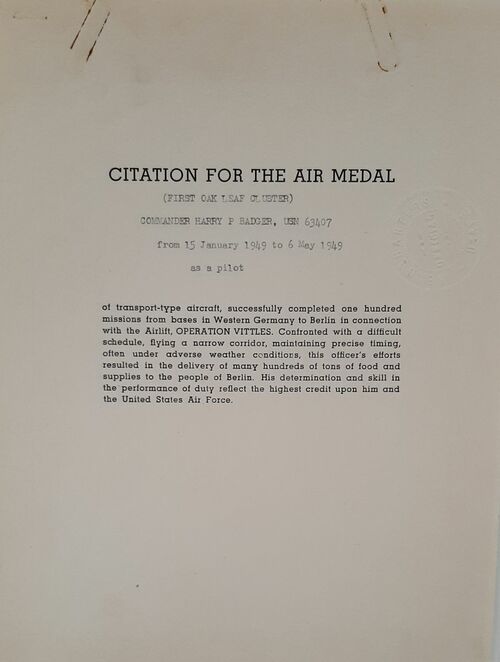
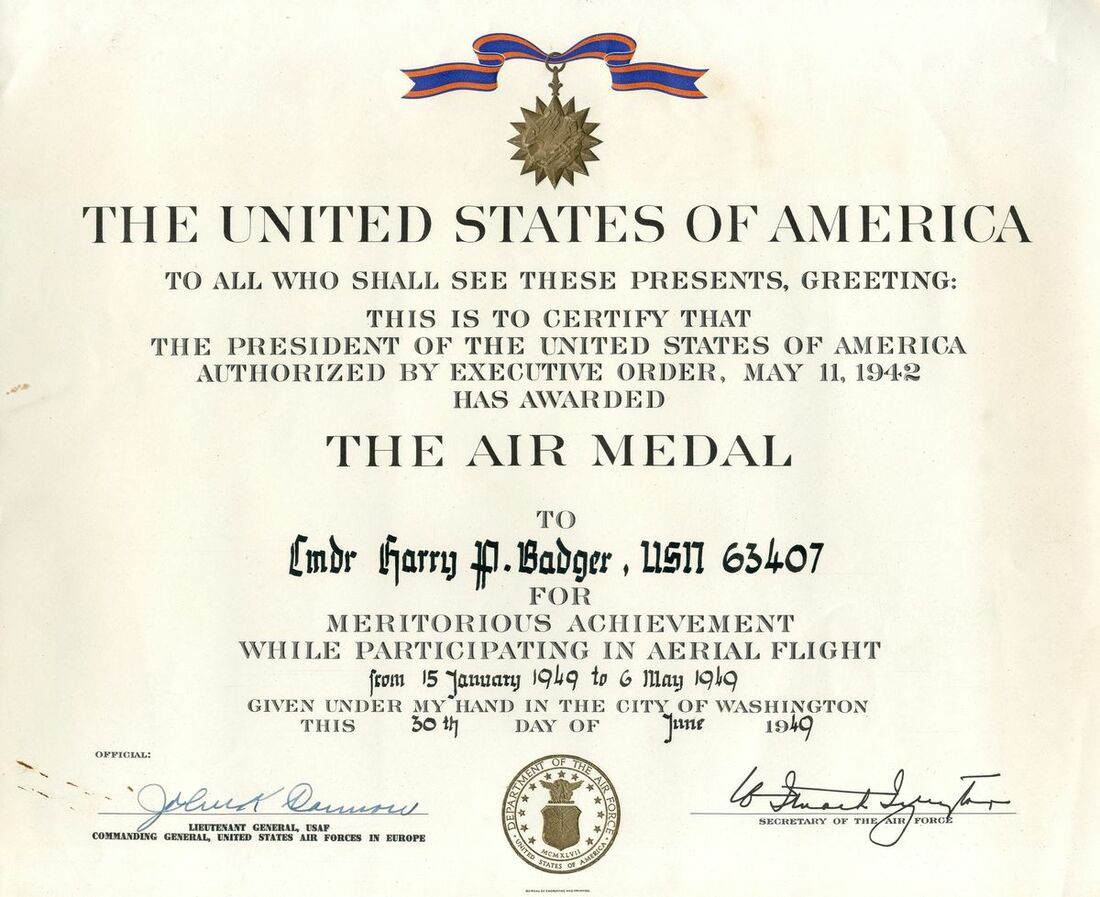
Air Medal, Oak Leaves, 30 June 1949, the original citation states:
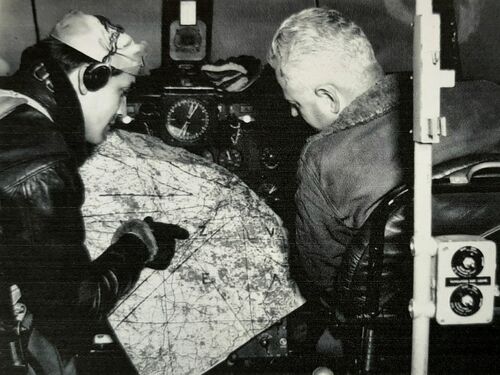
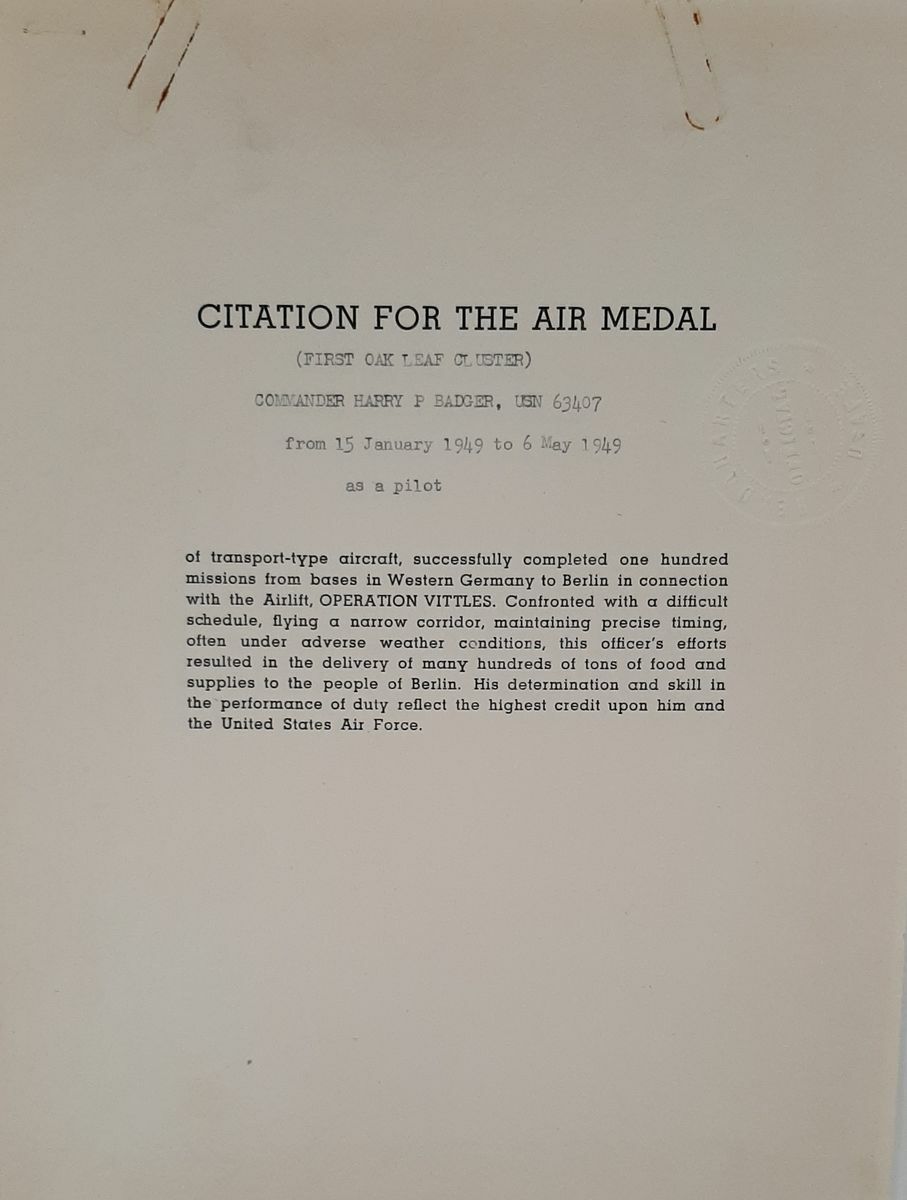
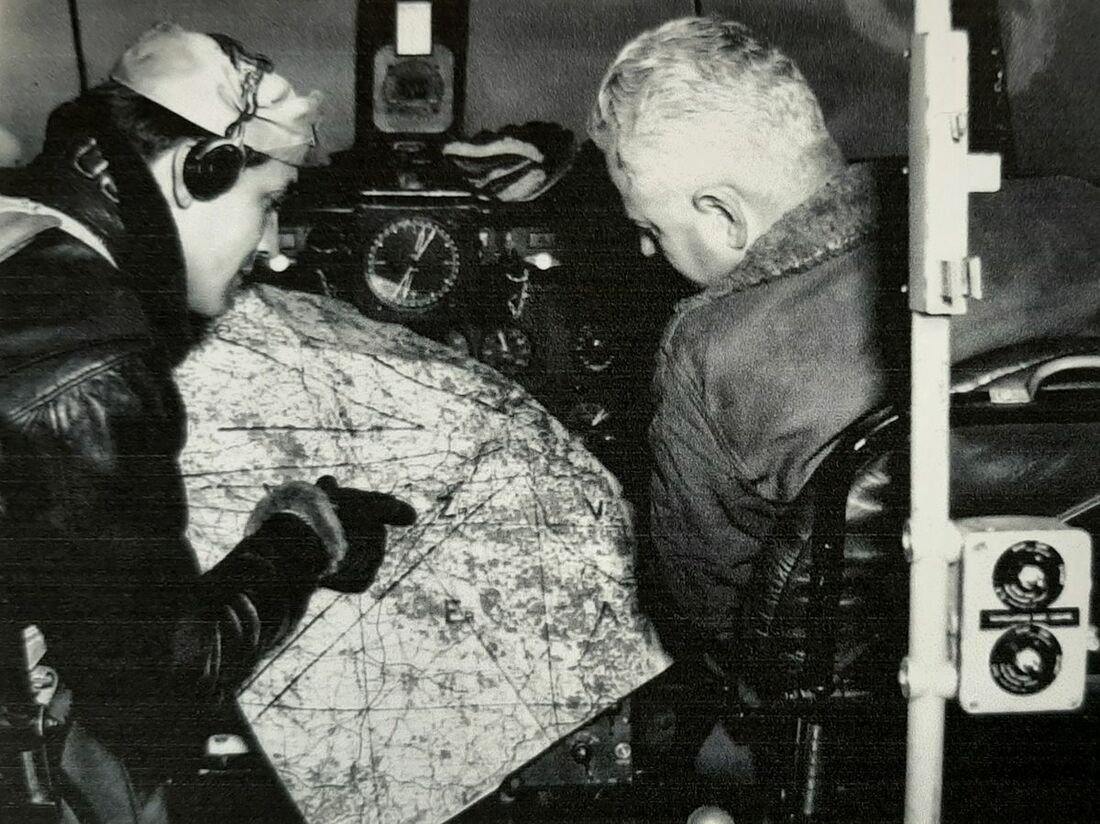
'Commander Harry P Badger, USN 63407 from 15 January 1949 to 6 May 1949 as a pilot of transport-type aircraft successfully completed one hundred missions from bases in Western Germany to Berlin in connection with the Airlift, OPERATION VITTLES. Confronted with a difficult schedule, flying a narrow corridor, maintaining precise timing, often under adverse weather conditions, this officer's efforts resulted in the delivery of many hundreds of tons of food and supplies to the people of Berlin. His determination and skill in the performance of duty reflect the highest credit upon him and the United States Air Force.'
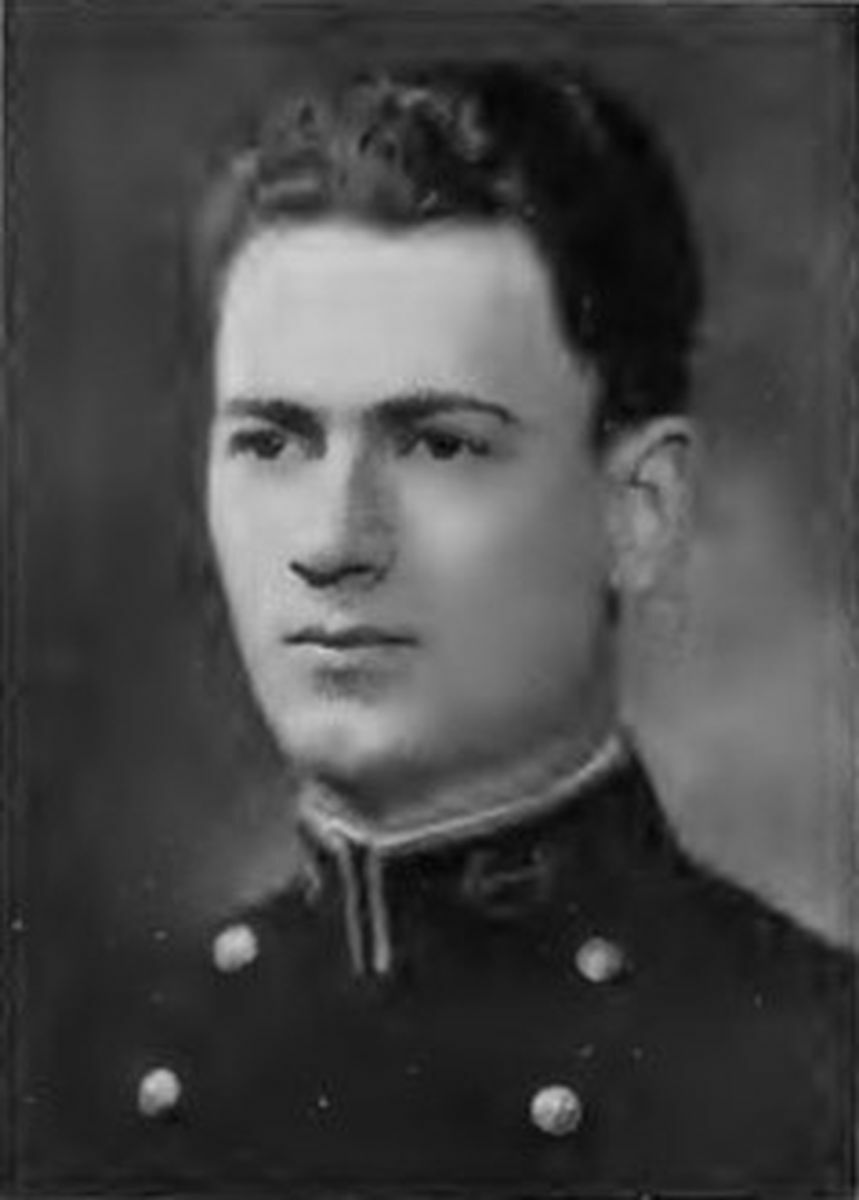
Harry Peaslee Badger was born in Malone, New York on 19 October 1907, son of John and Marion Badger. Educated at the Franklin Academy, he enlisted in the U.S. Navy on 30 June 1925 before being honourably discharged on 12 July 1926, to enter the US Naval Academy as a Midshipman in the class of 1930. Graduating successfully, he was commissioned Ensign on 5 June 1930, being posted to the USS Marblehead with which he served until September 1931.
Beginning flight instruction at the Naval Air Station, Pensacola, Florida, Badger was detached in March 1932 for further sea duty on board USS Milwaukee. Returning to Pensacola in March 1934 he completed flight training with designation as Naval Aviator (heavier than air) in April 1935. Ordered to report to Commander Aircraft, Battle Force, he was assigned as pilot to the USS Lexington as part of Fighting Squadron 5-b pilots from June 1935.
His obituary quoted on the Naval History and Heritage Command website states:
'Duty for six months with Fighting Squadron 4, of USS Ranger preceded a tour of shore duty as an instructor at the Naval Air Station, Pensacola, which ended in November 1939. He then reported to Utility Squadron ONE, and was serving with that squadron, aviation unit of USS Rigel (ARB 1), at anchor at Pearl Harbor, when the Japanese attacked the Fleet there on December 7, 1941. He remained with that squadron until June 1942, and for eighteen months thereafter served at the Intelligence Center for the Pacific Ocean Areas, Fourteenth Naval District Headquarters, Pearl Harbor.
He again returned to Pensacola in January 1944, this time for duty at the Naval Training School (Photography), and two years later was detached for a year's duty in the Naval Photographic Service, Office of the Chief of Naval Operations, Navy Department, Washington, DC. From January to May 1947, he served as Commanding Officer of the now Navy Photographic Center, Naval Air Station, Anacostia, DC. From July 1947 to November 1948, he served at sea as Commander, Observation Wing, Pacific Fleet, under cognizance of Commander Battleships-Cruisers, Pacific Fleet, with additional duty as Observation Sub-Type Commander, Air Force, Pacific Fleet.
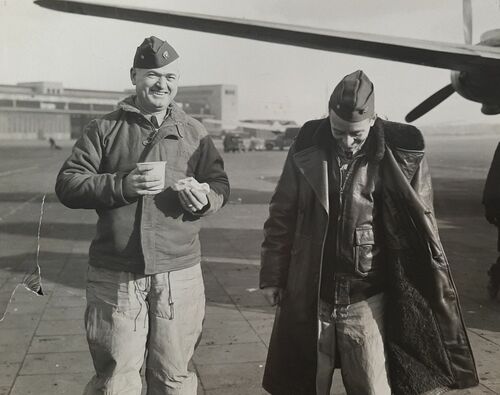
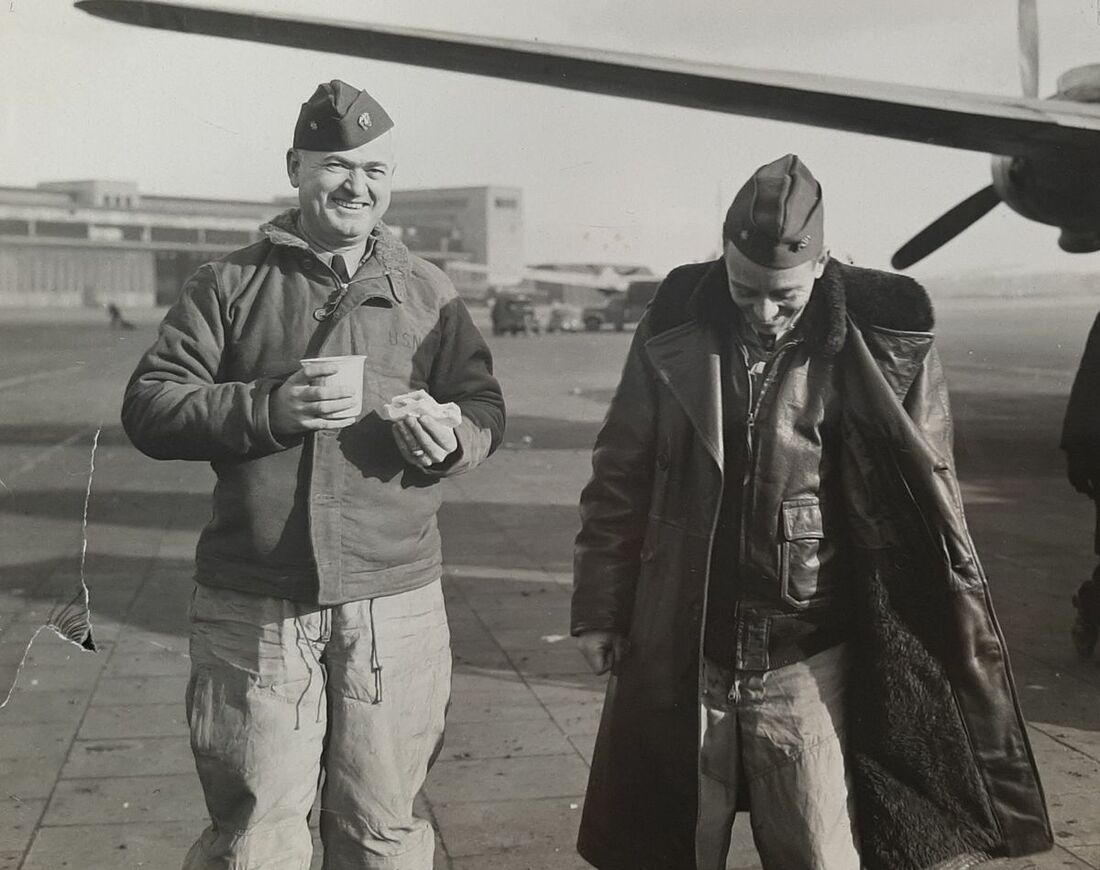
He reported in November 1948 to the Naval Air Station, Agana, Guam, for duty with Transport Squadron 6. His squadron was soon ordered to Germany, however, and he took command on January 12, 1949. VR-6 operated twelve planes from Rhein/Main Field, near Frankfurt, in the Berlin Airlift, and with another similar squadron, VR-8, flew many tons of supplies into Russian-blockaded Berlin during the crucial winter months of 1948-1949.'
This remarkable operation was undertaken at the most critical point of the Airlift: the harsh winter weather had prevented the Allies from landing in Berlin, seriously impacting the flow of vital fuel to the city. At one stage they reportedly had supply for only one week and were at their breaking point. As the weather improved in January, Badger took command of VR-6 and found himself at once ordered to Germany where they helped to once again establish the vital chain of supplies to the beleaguered city. As stated in the Naval Aviation News in March 1949:
'In their first two months of operations the two Navy squadrons [VR-6 and VR-8] flew 31,621.1 tons of supplies into Berlin in 3036.5 sorties.'
Posted away from the Squadron in 1951 Badger undertook a course of instruction at the Naval War College, Newport, Rhode Island, followed by a second tour in the Office of the Chief of Naval Operations. On this occasion in the role of Head of the Civil Aviation Liaison Branch, Flight Services Division. Detached in May 1954 he was placed in command of the USS Gilbert Islands (CVE 107) before joining the staff of Commander Military Air Transport Service in January of the next year at Andrews Air Force Base.
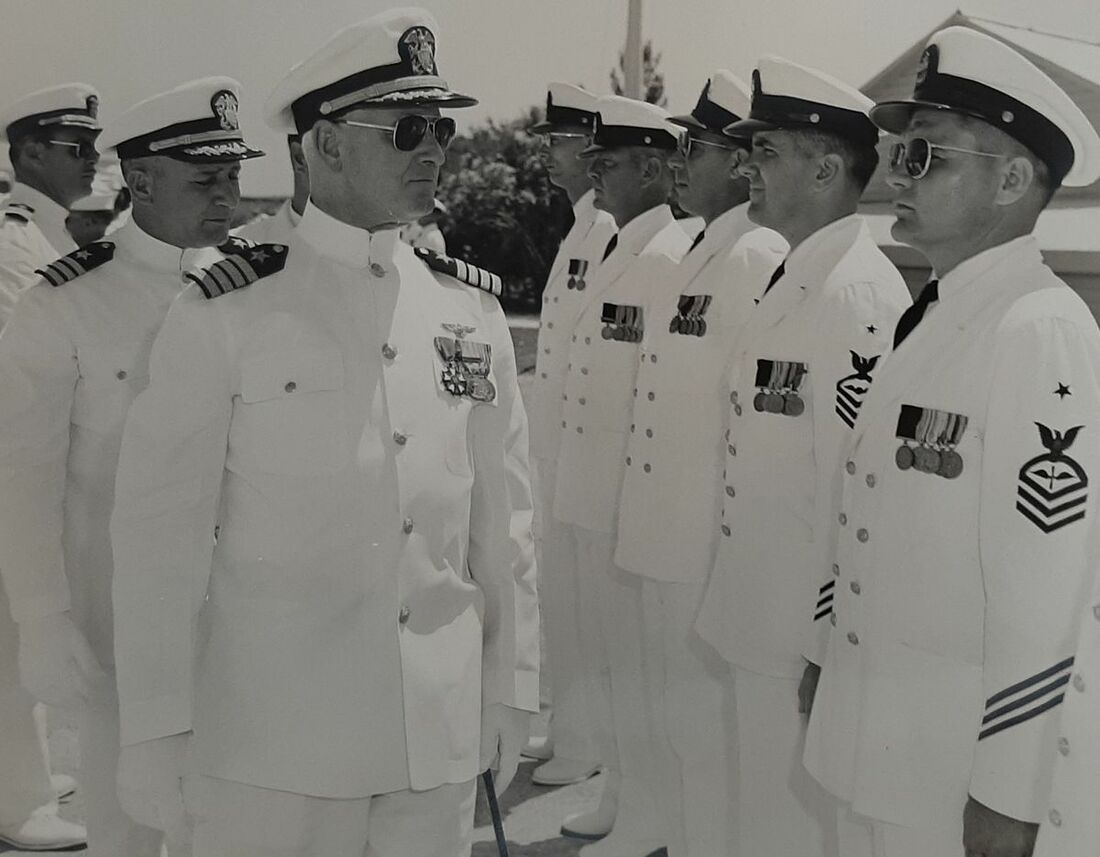
Badger's final posting was to be as Commanding Officer of the Naval Station, Bermuda in June 1957, here he worked closely with the British from whom the American Government was leasing the Island for use as a Naval Base. He was also required to undertake some efforts to repair relations with the local community who found the constant sound of aircraft overhead upsetting, Badger soon put the theory to the test by having a pilot fly over one of the local houses while he stood outside. His efforts helped to improve matters on the island, and he established himself as a popular commander and part of the community. He retired in June 1960 at Malone, New York on 13 December 1965, being interred with full Military honours at Arlington National Cemetery.
Sold together with copied research and an impressive collection of original documents including:
i)
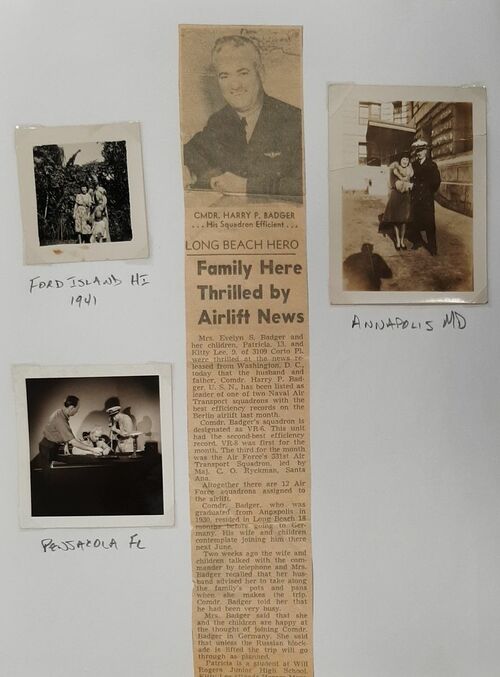
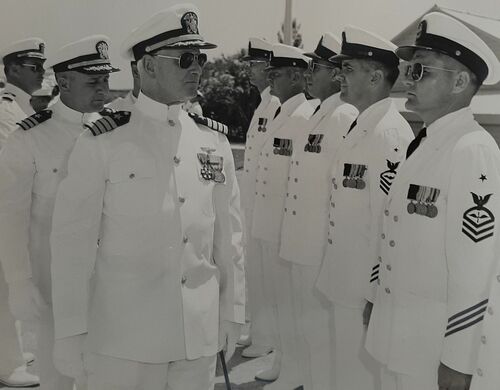
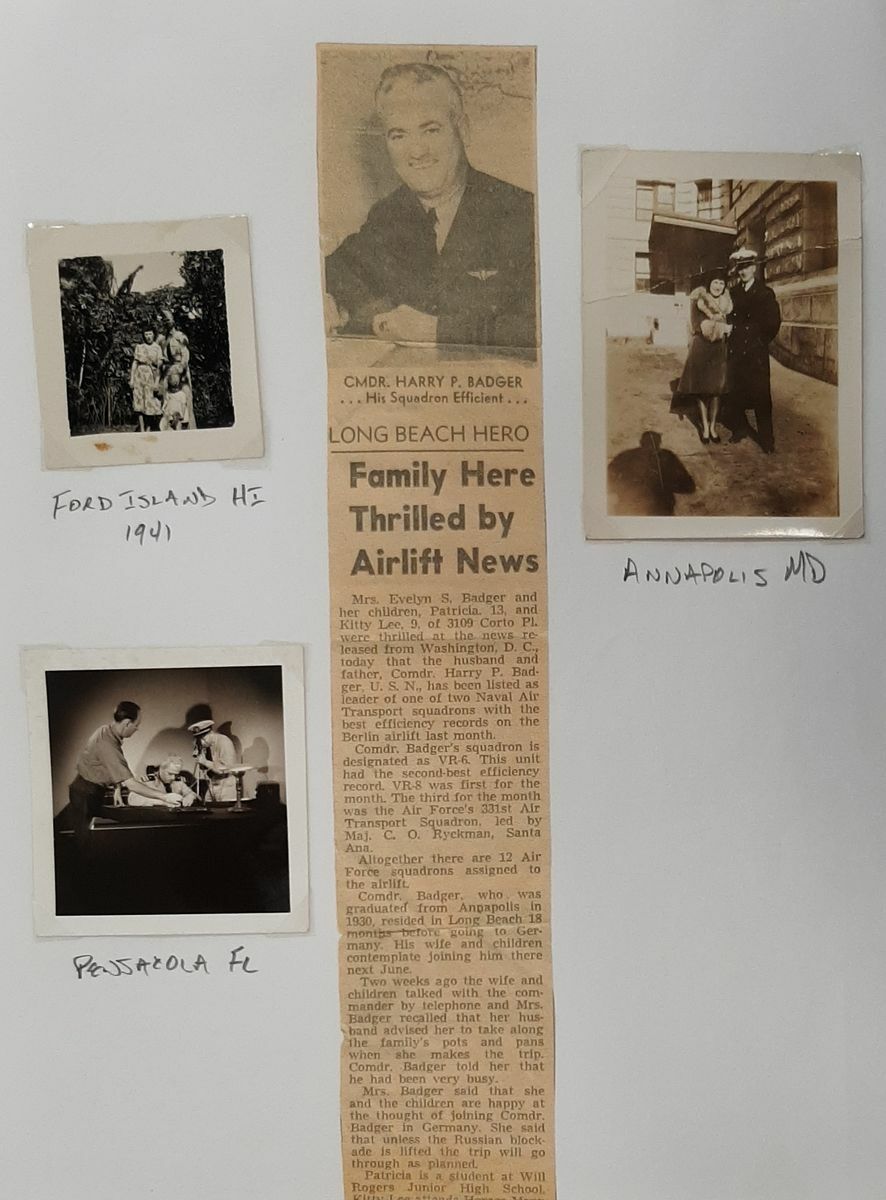
Original black and white photographic prints of various sizes including images relating to the Berlin Airlift, family photographs and time at Bermuda, notably the visit of H.R.H. Prince Philip and Sir Julian Alvery Gascoigne, Governor of Bermuda.
ii)
The original award scroll for the oakleaf cluster to the Air Medal in 1949.
iii)
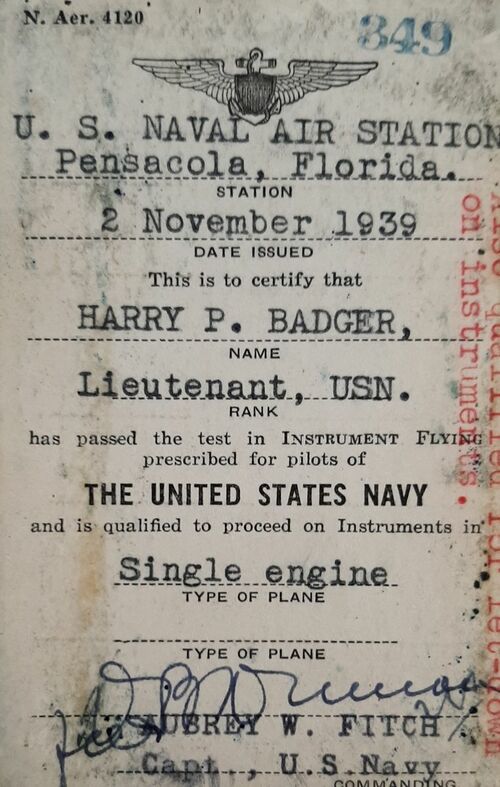
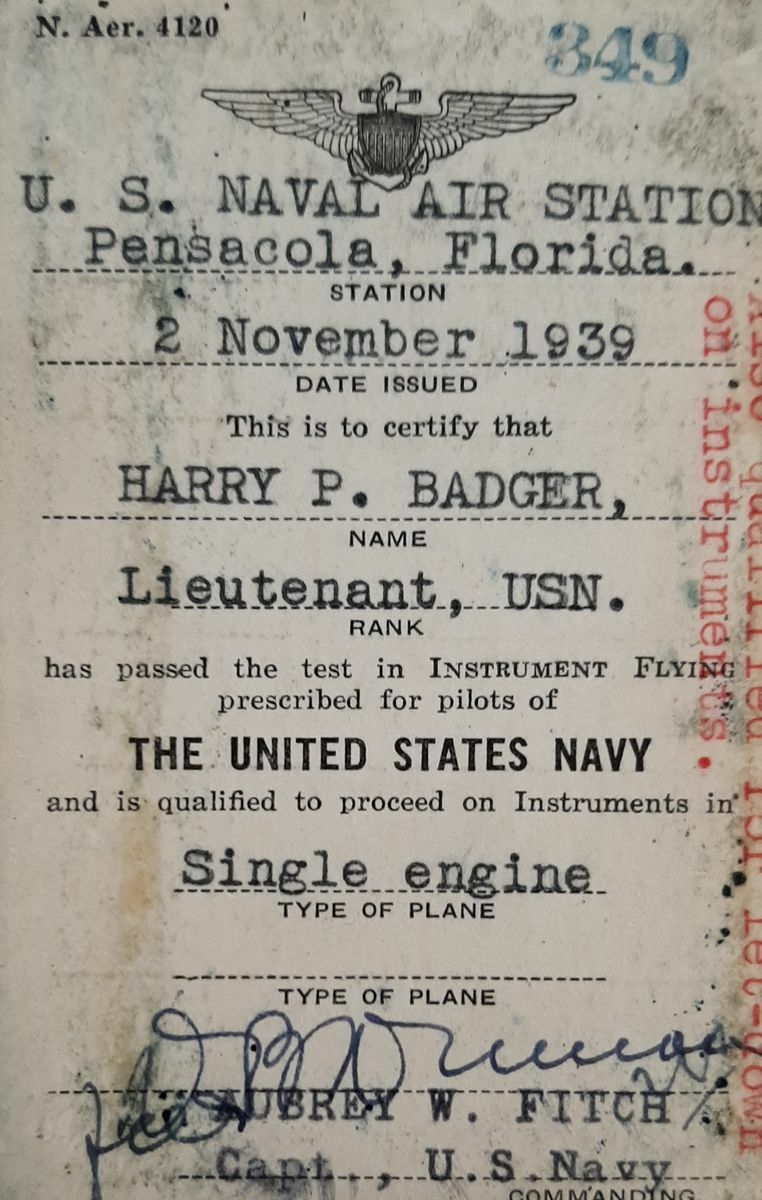
Early flying qualifications.
iv)
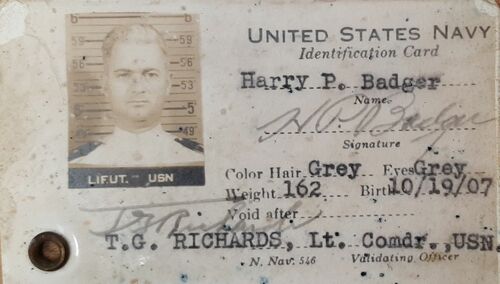
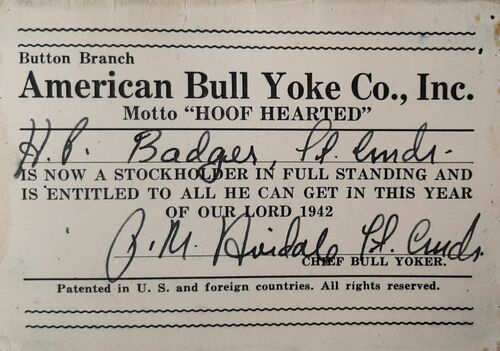
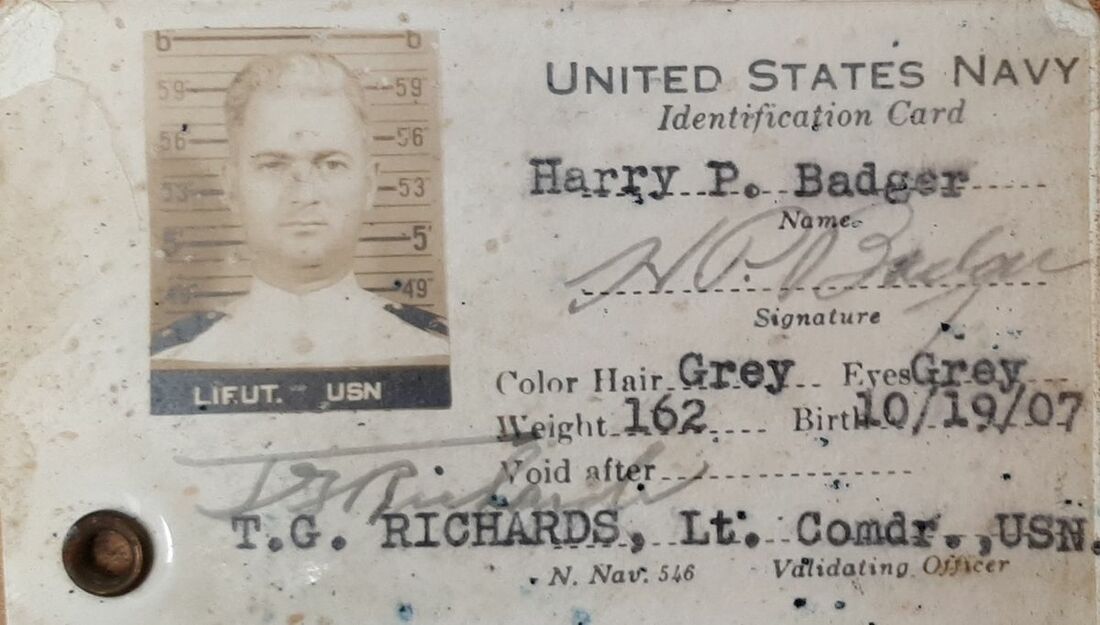
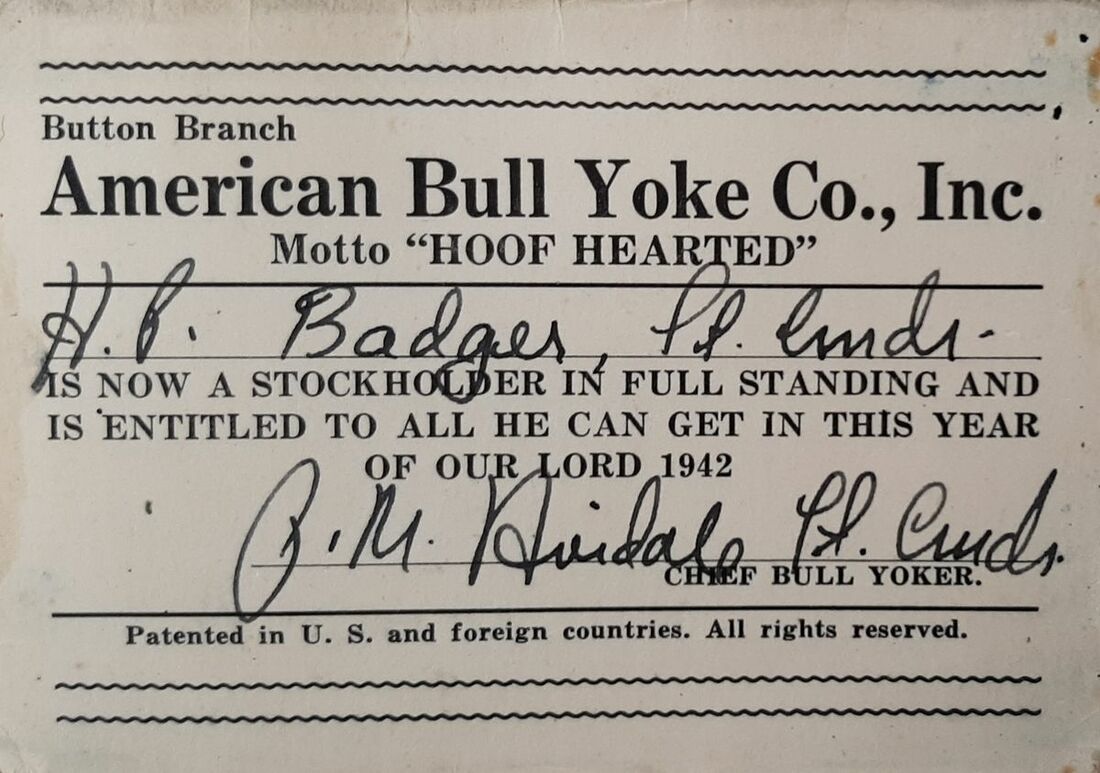
Several I.D.s and permits.
v)
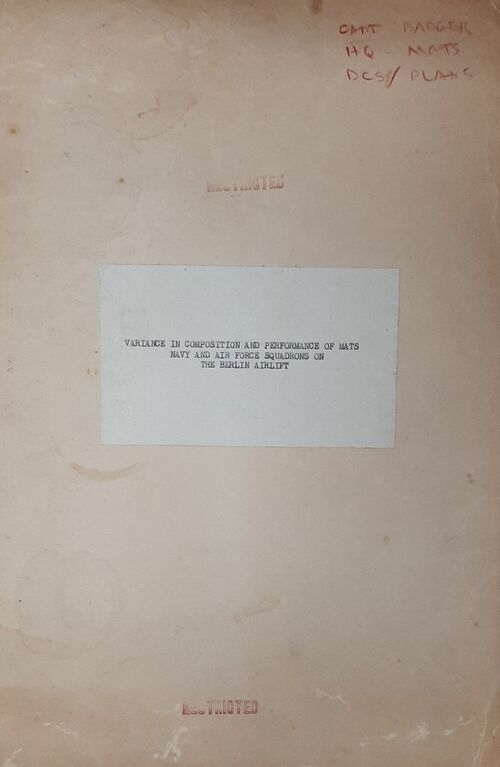
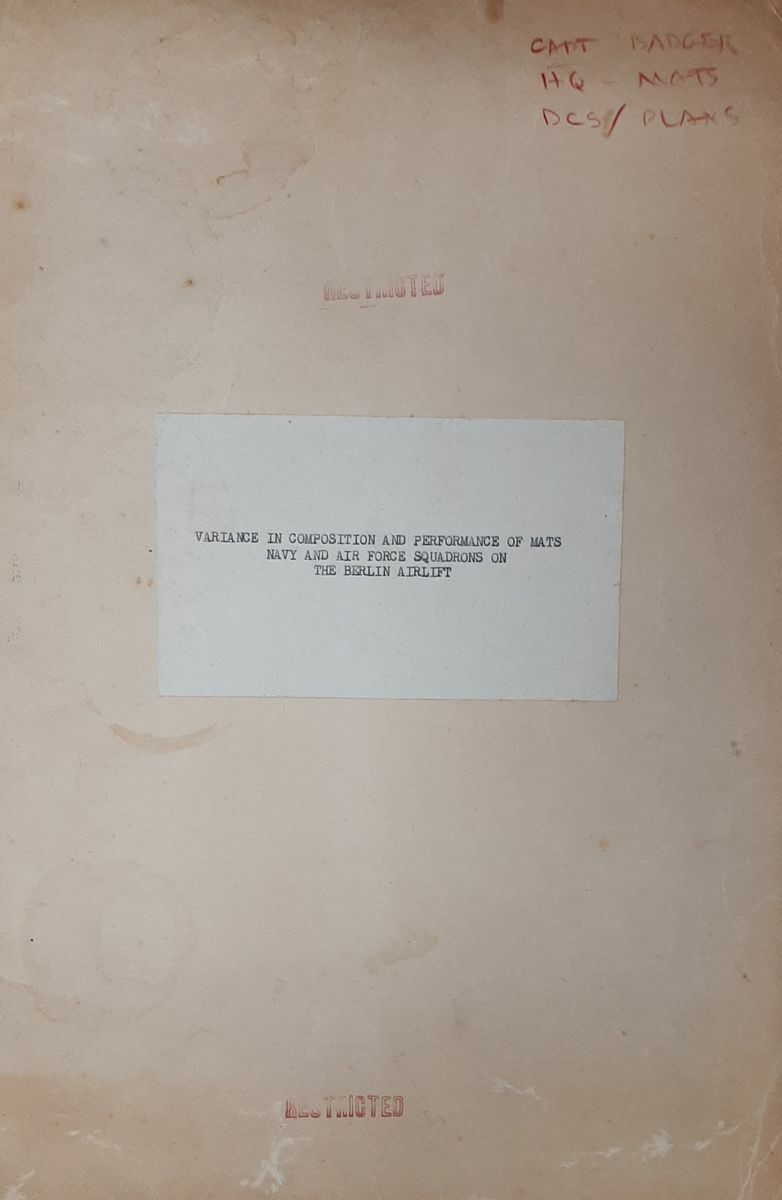
Photographs and Statistic reports related to the Berlin Airlift in a bound file with the recipient's name handwritten at the top.
vi)
Several local and base newspaper and newsletter clips.
vii)
Several national newspaper cuttings and obituaries.
viii)
Typewritten post-retirement correspondence from Base personnel, many expressing regret at the recipient's retirement.
ix)
Extracts from articles entitled, Navy Wings Over Berlin and Bermuda Seaplane Ops.
x)
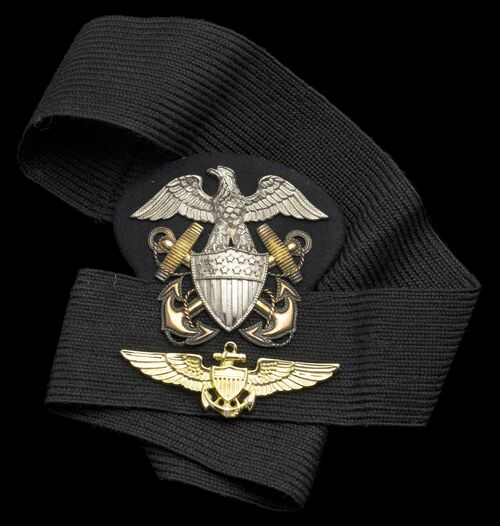
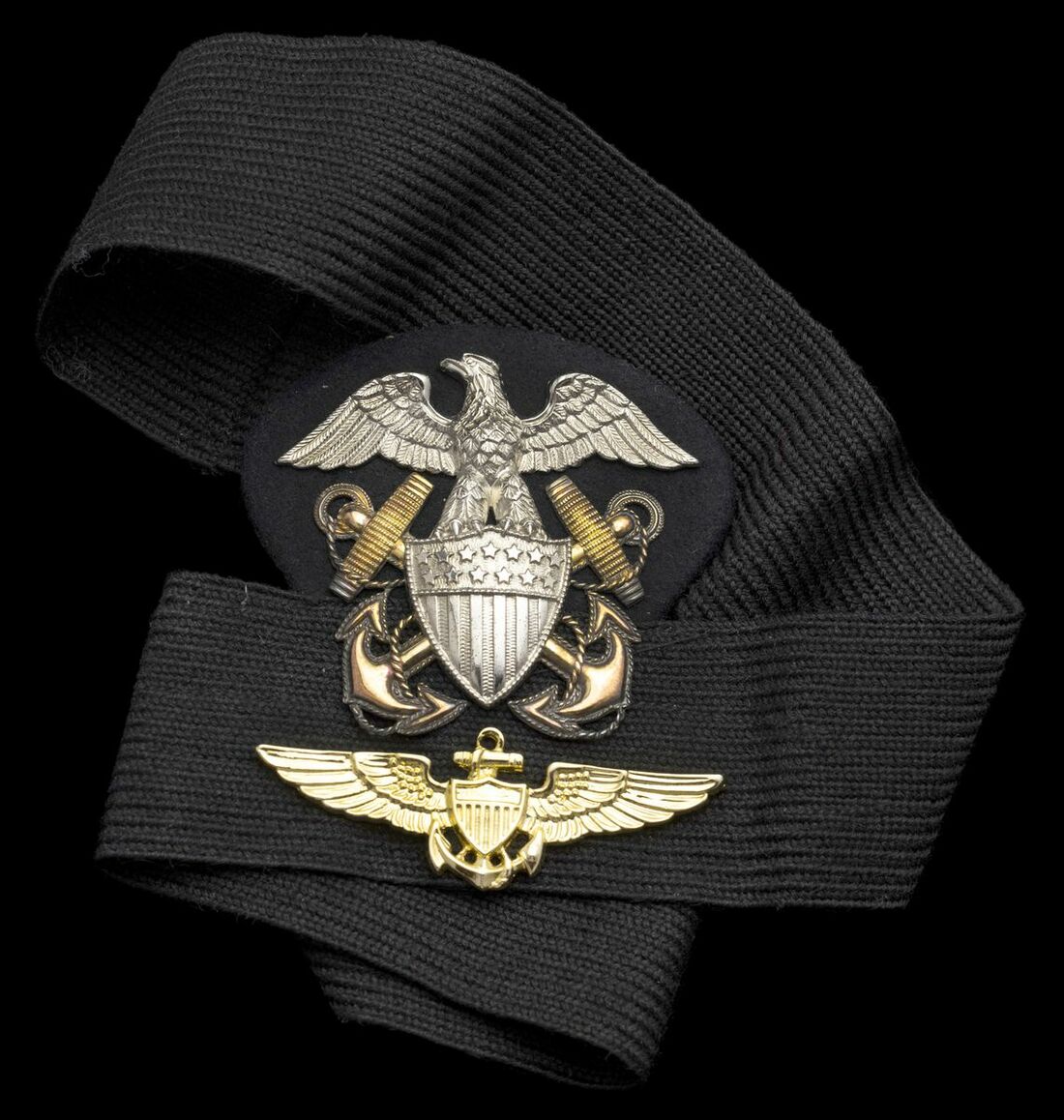
A selection of badges.
Subject to 5% tax on Hammer Price in addition to 20% VAT on Buyer’s Premium.
Sold for
£700
Starting price
£140
Watch, listen and bid as if you were in the room. Now available for auctions worldwide.
Click here to bid live
An exclusive and confidential service for the discerning collector or vendor.
View the Gallery
Download every Spink catalogue on your iPad, iPod or iPhone using free Spink app.
Download From iTunes© 2026 Spink & Son. All rights reserved.