Auction: 24112 - Orders, Decorations and Medals - e-Auction
Lot: 435
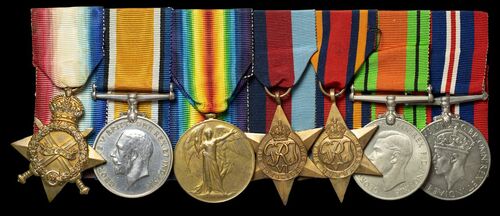
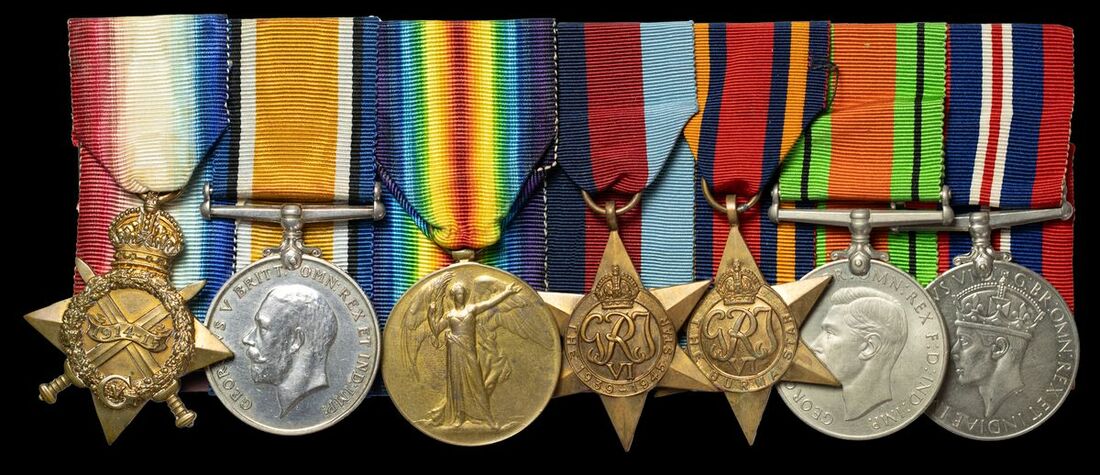
Seven: Lieutenant-Commander T.G. Egerton, Royal Navy who served on Hercules during the Battle of Jutland: he received the Habit in 1920 and became a member of the English Benedictine Congregation, taking the religious name Dom Philip Egerton
1914-15 Star (Mid. T. G. Egerton, R.N.); British War and Victory Medals (S. Lt. T. G. Egerton. R.N.); 1939-45 Star; Burma Star; Defence and War Medals 1939-45, very fine (7)
Thomas Graham Egerton was born at Dublin on 23 September 1899, the younger son of Sir Reginald Egerton, who at that time was Secretary to the Post Office. The Egerton family have a long association with Holy Orders and military service. He was educated at St Anthony's Eastbourne under Mr Patten, from which he entered Osborne in 1912 and proceeded to Dartmouth in 1914.
Commissioned Midshipman on 8 September 1915, he was serving on board Hercules at the Battle of Jutland.
During the first stage of the general engagement, the ship was straddled by five shells fired by a German dreadnought. Shortly afterward, she fired at the crippled light cruiser SMS Wiesbaden. Hercules engaged a German dreadnought beginning at 1825hrs with seven or eight salvos of her own. The poor visibility greatly hampered her return fire and was a problem for the entire battle. At 1912hrs, the ship opened fire at the battlecruiser SMS Seydlitz, and probably scored two hits. One of her shells penetrated through the upper superstructure and caused minor splinter damage. The second HE shell burst on hitting the upper hull armour, which dished in the armour plates and caused moderate flooding. About five to ten minutes later, she engaged several German destroyer flotillas with a few salvos from her main armament without result. Hercules was then forced to turn away to avoid several torpedoes, one of which was believed to have passed very close. Hercules received no damage and fired a total of 98 twelve-inch shells (82 HE, 4 armour-piercing, capped, and 12 common pointed, capped) and 15 shells from her four-inch guns during the battle. Egerton was next posted as an Acting Sub-Lieutenant on 1 November 1917 to Myrtle until 15 July 1918 followed by postings to Diligence, Barham and President, retiring from the Royal Navy as a Lieutenant on 15 May 1920.
In 1919 the Navy sent him on a short course to Trinity College, Cambridge, and in 1920 he received the habit from Abbot Smith. Following the usual course of studies, he was an undergraduate at St Benet's Hall, Oxford, reading mathematics and engineering science, in which he was placed in the second class in 1927. His long career in teaching then began, punctuated by reception of the usual orders up to the priesthood in 1930. At the same time, he was master of ceremonies and held a commission in the Officers' Training Corps, as it was called, and which had then an ex-regular officer of each of the three services (and was known locally in Northern Command as the N.A.A.F.I.!). He moved to the Junior House as assistant to Fr Illtyd Williams in 1932, which post he retained till in 1937 he was appointed Warden of the hostel which we opened for young unattached men in Paddington.
Father Philip was recalled to the Navy in 1939, to teach navigation, and served throughout the war, first at Chatham and later in Australia. He was commended for good service and devotion to duty by C-in-C Nore on 4 May 1944.
Taking his discharge in Australia, he taught for a time there in grammar schools, but returned to England and taught on loan at the Austin Friars' school in Carlisle, until he took up again his teaching career at Ampleforth in 1957.
This he continued to do until he was appointed assistant priest at St Mary's, Cardiff, in 1967. For two years, 1964-66, he was also Infirmarian at Ampleforth, and his principal work at Cardiff was with the hospitals, in addition to the ordinary parish routine. His health showed signs of failing about two years ago and he died in Llandough Hospital near Cardiff on 30 April 1973 and was buried there.
Subject to 20% VAT on Buyer’s Premium. For more information please view Terms and Conditions for Buyers.
Sold for
£160
Starting price
£110
Watch, listen and bid as if you were in the room. Now available for auctions worldwide.
Click here to bid live
An exclusive and confidential service for the discerning collector or vendor.
View the Gallery
Download every Spink catalogue on your iPad, iPod or iPhone using free Spink app.
Download From iTunes© 2026 Spink & Son. All rights reserved.