Auction: 24112 - Orders, Decorations and Medals - e-Auction
Lot: 357
Pair: Boy Class I W. J. Mantle, Royal Navy, who served in the Sea of Azoff with Wrangler when Joseph Kellaway won his Victoria Cross at Marionpol
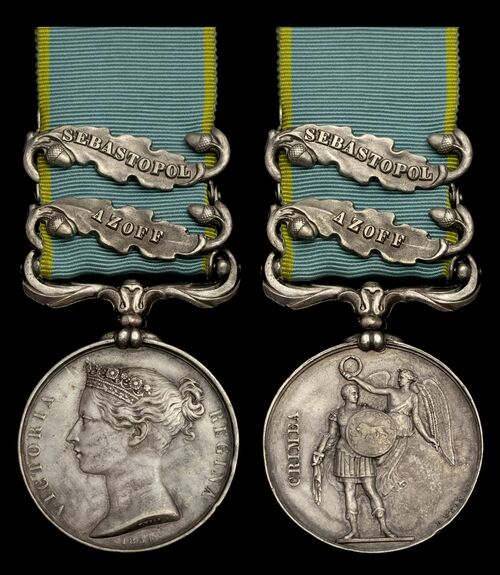
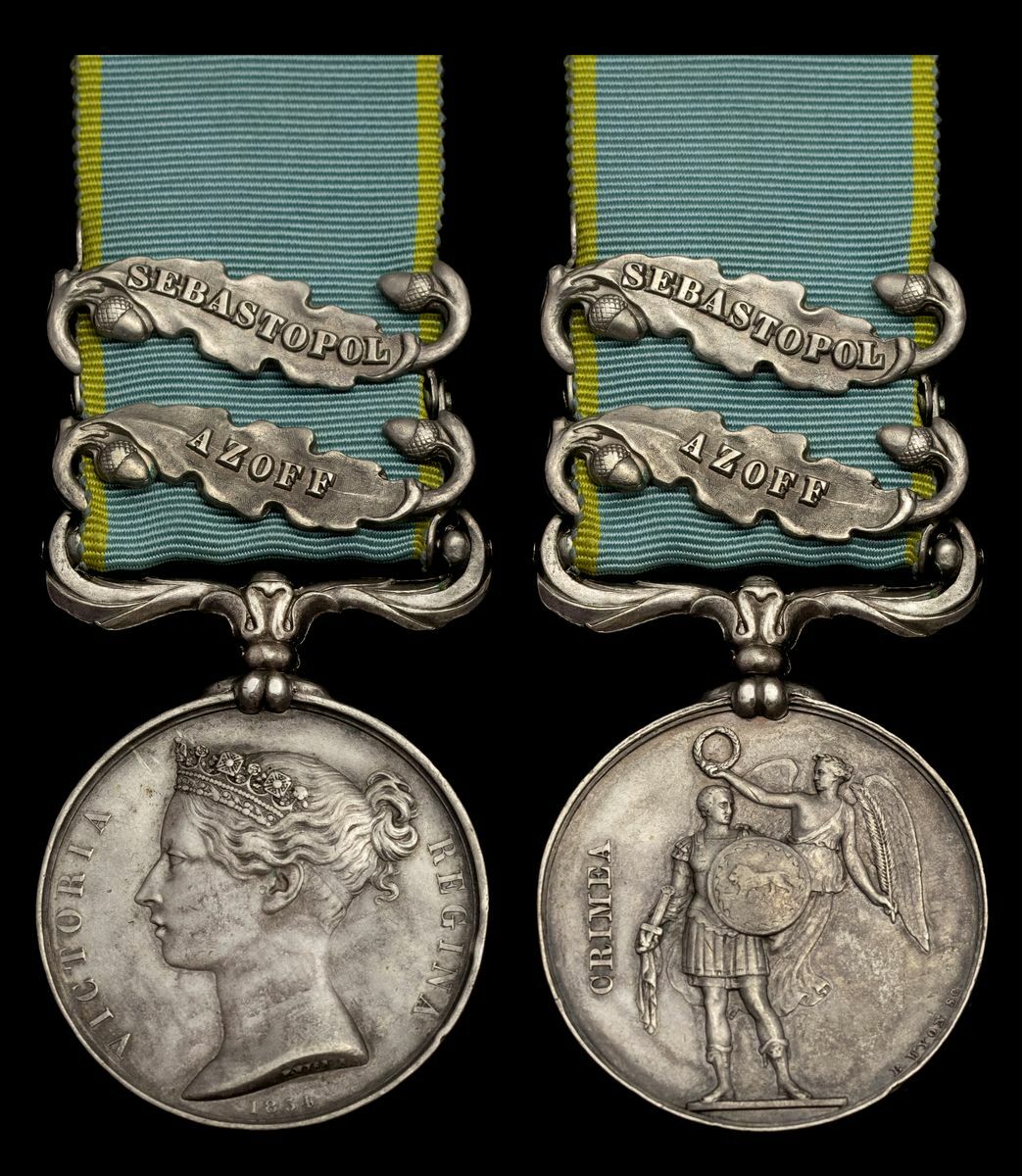
Crimea 1854-56, 2 clasps, Azoff, Sebastopol (W. Mantle, H.M.S. Wrangler.), contemporarily re-engraved naming in the style of Hunt and Roskell, the pin between first and second clasps replaced; Turkish Crimea, British issue, (W. Mantle, H.M.S. Wrangler.), slight edge bruising, overall good very fine (2)
One of 77 Azoff clasps to H.M.S. Wrangler.
William John Mantle served with H.M.S. Wrangler after her return from the Baltic. Having served in the Baltic operations, she then formed part of the Flying Squadron which operated in the Sea of Azoff. An article in the Spink Insider sets the scene:
'The Sea of Azoff lies to the north east of the Black Sea and is connected to it only by the narrow Straits of Kertch and Yenikale. Extending for about 90 miles north to south and 190 east to west, it is notoriously one of the shallowest seas on earth, the water only a few feet deep in most places, but it was nevertheless an important supply line for Russian forces, allowing the passage of men, materiel and supplies from other parts of the Russian Empire to the forces in the Caucasus and Crimea. All around the sea were fishing villages, farms, small ship yards and ports whose supplies of food and goods, especially fish, hay, grain, tar and timber, were of great importance to the Russian war effort. Its most important port was Rostov, but coastal towns like Azov, Taganrog, Mariaupol, Gheisk, Genitichi and Berdiansk were also locally significant as ports and producers of foodstuffs.
While the land campaign "before Sebastopol" was being waged in the winter of 1854 and the summer of 1855, early consideration was given to an attack on the ports of the Sea of Azoff. However, not until May 1855, when the siege of Sebastopol seemed to settling into something of a stalemate, was a serious expedition launched into the Sea. A large-scale Anglo-French naval force was ordered into the Straits of Kertch, carrying French and British troops intended to seize the major towns of Kertch and Yenikale, which they quickly and easily did; the Russians offered hardly any resistance and chose instead to destroy their fortifications and retreat inland.
The large warship fleet and its landing parties having secured the access point to the Sea, it was now time to unleash the squadron which was to operate within its shores throughout the summer of 1855. Because the Sea of Azoff is so shallow - especially around its actual coastline - no major British warships could operate within its limits. Therefore, a powerful squadron of smaller screw and paddle-steamers, "gunboats" requiring less depth of water, was sent into the Sea. This "Flying Squadron" initially comprised the Miranda, Vesuvius, Stromboli, Medina, Ardent, Arrow, Beagle, Lynx, Snake, Swallow, Viper, Wrangler and Curlew, with five French steamers in support. Their commander was the dynamic Captain Edmund Mowbray Lyons - the son of the commander of the British fleet in the Black Sea - and already well-known for his exploits in Miranda around Kola in the White Sea. Because these were smaller warships with small crews, many of their commanders were young men, often no more than Lieutenants, anxious to make a name for themselves and given considerable opportunity to show their powers of initiative and command.'
Between May and November 1855, these allied warships, sometimes in ones and twos and sometimes acting together in larger groups, simply wrought havoc along the coasts of the Sea of Azoff. They quickly halted all seaborne trade and fishing within the Sea, stopping and seizing any Russian vessels running between the coastal towns. In just three days of patrolling - the very first days of the allied invasion of the Sea - Lyons' ships destroyed over two hundred enemy vessels, ninety on 29th May alone. The small Russian warship squadron at Kertch fled into the Sea, where it was scuttled and the Russian "Azov Squadron" never ventured to sea to challenge what then happened. All along the coast the major towns were "visited" - some of them repeatedly over the summer months - and anything deemed to be a worthy target lying along the shore was attacked and (usually) destroyed.'
One such worthy target was Marionpol, when Mantle may have been employed as a Bluejacket for the 'commando' style raid. On 31 August 1855 however, the British would run head on into grouped Russian troops, armed to the teeth and ready for action. On that famous occasion Seaman Kellaway won himself the Victoria Cross.
His medal was delivered to him aboard Wrangler where he remained after the end of the war; sold together with copied medal rolls.
Subject to 20% VAT on Buyer’s Premium. For more information please view Terms and Conditions for Buyers.
Sold for
£480
Starting price
£210

Watch, listen and bid as if you were in the room. Now available for auctions worldwide.
Click here to bid live
An exclusive and confidential service for the discerning collector or vendor.
View the Gallery
Download every Spink catalogue on your iPad, iPod or iPhone using free Spink app.
Download From iTunes© 2026 Spink & Son. All rights reserved.