
Auction: 24111 - Orders, Decorations and Medals - e-Auction
Lot: 601
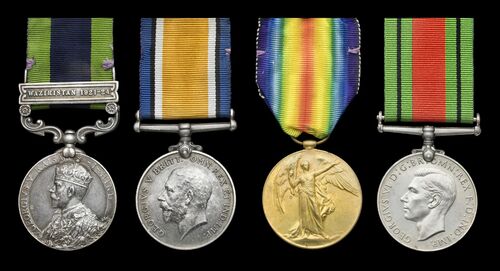
Four: Major R. C. Simpson, 130th King George's Own Baluchis (Jacob's Rifles), who served in the campaign in East Africa during the Great War
British War and Victory Medals (Maj. R. C. Simpson.); India General Service 1908-35, 1 clasp, Waziristan 1921-24 (Maj. R. C. Simpson. 5-10 Baluch. R.); Defence Medal 1939-45, good very fine (4)
Richard Charles Simpson was born at Manchester on 7 March 1886, the son of Charles & Constance Simpson. His uncle, Colonel Hall D.S.O., was regularly listed as his closest relative.
Young Simpson was initially commissioned into the 3rd Militia Battalion, Prince of Wales's Volunteers
(South Lancashire Regiment) in June 1905 and thence joined the Sherwood Foresters. He was commissioned into the Indian Army in October 1911 and joined the 130th Baluchis. Their Regimental full-dress uniform in 1914 included a rifle green turban and kurta (knee length tunic) piped in red, worn with red trousers and white gaiters. The red trousers were a distinctive feature of all five Baluch units in the Indian Army.
Simpson would have shared in their part of the East African campaign, when they contributed 450 rifles and 4 machine guns to the 1st East African Brigade's Advance in late 1916. The Western Front Association gives more detail:
'On New Year's Eve 1916 the attack began, it having been postponed from Christmas Day because of torrential rain that impeded movement until the ground had dried out. The 130th Baluchis crossed the Mgeta, capturing a forward enemy position and finding that the Germans in it were inebriated; the remaining German champagne was removed to the Baluch officers' mess. The Baluchis had been tasked with operating to the west of the brigade column in order to block the enemy from retreating through Wiransi. A double-company was detached to march to Wiransi whilst the remainder of the battalion cut the road from that village to Dakawa, and then advanced northwards to confront the withdrawing enemy.
Marching southwards on a collision course with the Baluchis was a German detachment under the command of Lieutenant Udo von Chappuis. Around 0730 hours the Baluchis encountered an enemy picquet near the Kipiruta stream. An hour later a strong German attack supported by two machine guns was delivered onto the Baluch advance guard. Heavy fighting ensued and von Chappuis' men got around the Baluch left flank and made a bayonet charge. But the Baluchis were not relinquishing any ground and they counter-charged into the enemy ranks, fighting man-to-man with the bayonet until the Germans were thrown back. Then a German charge on the opposite flank nearly over-ran a jammed Baluch machine gun; again the Baluchis stood firm, rescuing the gun and holding the firing line. Von Chappuis maintained pressure on the Baluch position until the sound of firing could be heard further north, signalling that the British brigade column was getting closer; then the enemy broke contact and moved off through the bush, by-passing Wiransi.
The Baluchis had fired over 15,000 rifle rounds and 5,750 machine gun rounds. They had lost Jemadar Saidan Khan and 35 sepoys killed, and 29 other men were wounded. Twelve enemy Askari corpses were found, and two wounded Germans and a few wounded Askari were captured.'
They were also present at Behobeho Chogwali, when the famed hunter Captain Frederick Courtenay Selous was killed. Captain Archdale of the 130th Baluchis provides his own view:
'Selous was killed in this action: he was wounded in the knee quite early on, but refused to give up, but an hour or so later he walked into a Jerry machine gun at Beho-Beho where we buried him. He was a great man Daddy Chai (the name the sepoys gave him as he liked to drink tea), and we missed him very much. Our Pathans recognized him as a man of adventure and a perfect shot which appealed to them more than anything. Their sorrow at his death was very genuine.'
Having been posted as Second-in-Command of the 67th Punjabis from April-August 1919, Simpson served with his unit in Waziristan. Retired from the Indian Army, he settled in Hampshire. He was a Member of the New Milton Round Table, presenting a talk on 'The Indian Frontier' and the tales of three generations of his family to have served there. By the time of the Second World War he was living at Sandygate, Christchurch, Hampshire and was an ARP Warden for the Home Guard unit based there. He died on 21 March 1952 at Bournemouth.
Subject to 20% VAT on Buyer’s Premium. For more information please view Terms and Conditions for Buyers.
Sold for
£190
Starting price
£100
Watch, listen and bid as if you were in the room. Now available for auctions worldwide.
Click here to bid live
An exclusive and confidential service for the discerning collector or vendor.
View the Gallery
Download every Spink catalogue on your iPad, iPod or iPhone using free Spink app.
Download From iTunes© 2026 Spink & Son. All rights reserved.