Auction: 1025 - The Turl Collection of Naval General Service Medals 1793 - 1840
Lot: 46
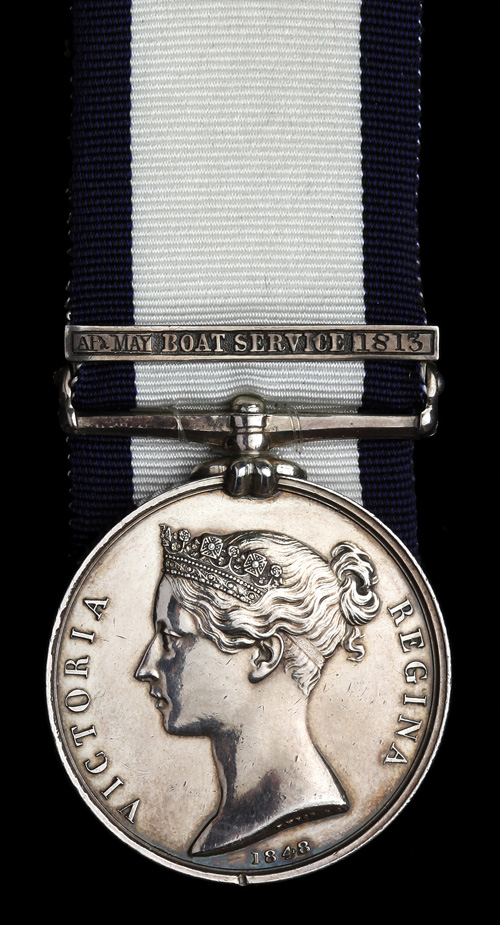
A Superb ´April & May 1813´ American Boat Action N.G.S. to Captain Henry Kent, Royal Navy, Who Was Commended For His Bravery and Meritorious Service, Particularly For His Presence in Two Separate Actions Fought Up The Elk River in the Chesapeake Bay 29th April and 3rd May. Kent Later Served on the Canadian Lakes Which Included an Incredible March of Almost 1,000 Miles, in Mid-Winter, Over Mostly Uninhabited Territory Naval General Service 1793-1840, one clasp, Ap & May Boat Service 1813 (Henry Kent, Lieut. R.N.), good very fine Estimate £ 6,000-7,000 Henry Kent served as Lieutenant in the brig H.M.S. Fantome and was present for two separate actions fought on the 29th April and 3rd May 1813, both up the Elk River in Chesapeake Bay. The same landing parties under the personal command of Rear Admiral Sir George Cockburn were engaged in each action. Approximately 57 clasps issued for this action. There were two varieties, with the early applicants receiving a clasp dated 29th April whilst later ones were engraved with April and May. The differential in numbers in unknown. Captain Henry Kent, R.N., born Glasgow, Scotland; joined the Royal Navy as First Class Volunteer, July 1800; his initial appointments included to the prison-ship Fortitude at Portsmouth and the guard-ship Salvador Del Mundo at Plymouth; appointed Midshipman H.M.S. Goliath (Captains C. Brisbane and R. Barton), March 1804; was principally employed with the Goliath off Rochefort and Ferrol and whilst on the latter station he assisted at the capture of two French corvettes, having on board part of the crew of the Blanche, whom the French had captured in July 1805; he was appointed to the frigate Revolutionnaire (Captain C. Fielding), stationed off the coast of Spain before removing as Master´s Mate to H.M.S. Hussar, May 1807, with whom he was present at the bombardment of Copenhagen; whilst serving in the latter in the West Indies, she captured four letters of marque from Guadaloupe bound for Bordeaux; appointed Acting Lieutenant H.M.S. Horatio (Captain G. Scott), June 1809; after appointments in the capacity of Midshipman in H.M. Ships Pompée and Neptune Kent was confirmed a Lieutenant in La Fantome sloop (Captain J. Lawrence), August 1810; served with the latter on the North Sea station, and on the coasts of Spain and North America, until January 1814; on quitting La Fantome he received the following testimonial of conduct from Captain Lawrence: ´These are to certify to my Lords Commissioners of the Admiralty, that Lieutenant Henry Kent served on board H.M. sloop Fantome, under my command, from the 4th August 1810, to the 21st January 1814, during which period he distinguished himself as a brave and meritorious officer, particularly in the different attacks made on the enemy´s works in Chesapeake Bay, and further that he volunteered from the said sloop to serve on the Lakes of Canada, with a zeal highly creditable to himself and worthy of imitation, being in the severity of the winter, and having a distance of nearly one thousand miles to march over an uninhabited country, covered with snow and woods: these circumstances will, I respectfully hope, entitle him to their Lordship´s favourable consideration.´ Kent set out from Halifax as a volunteer at the head of upwards 100 officers, seaman and marines with the purpose of proceeding to Lake Ontario to join the force there under Commodore Sir James Yeo; this was in response to increased naval activity on behalf of the Americans, who had begun to construct two frigates at Sackett´s harbour; British forces in the area consisted only of corvettes, brigs and schooners; Kent´s account of his march gives an indication of the severe conditions and privations faced: We left Halifax in the Fantome, on the 22nd January last, cheered by a large concourse of the inhabitants, and arrived at St. John´s on the 26th, making a passage of four days, the weather extremely bad: the brig appeared a complete mass of ice, it freezing as fast as the sea broke over us. The inhabitants of St. John´s came forward in the most handsome manner in a subscription to forward us in sleighs to Frederickston, the seat of government, a distance of eighty miles. The volunteer seamen from the Fantome, Manly and Thistle were divided into three divisions, each of seventy men, the first under Captain Collier, of the Manly, the second under Lieutenant Russel, and the third under myself. On the 29th of January, the first division proceeded about nine in the morning, and in the afternoon the second followed; the next morning I disembarked, the rigging of all the ships being manned, and the crews cheering us. On landing, we were received by the band of the 8th regiment, and a large concourse of people, who escorted us to the sleighs, when we set off at full speed. In eight hours we went fifty miles, and then halted for the night, at a small house on the banks of the river; started again in the morning, reached Frederickston in the afternoon, and found the other divisions halted there. The seamen were lodged in a barrack, which was walled in, but they soon scaled the walls and got scattered about the town. Having their pockets well lined with prize-money, they were anxious to lighten them, thinking this was the last opportunity they would have of enjoying themselves.´ It was at this point that desertion started to occur, and the three divisions now formed up into two - one under Collier and the other under Kent, ´From Frederickston we continued on the ice of the river St. John, except in places where, from shoals, it was thrown up in heaps..... I kept always in the wake of the first division, halting where they had the day before. On the third evening, at the house where I halted, I found the Master of the Thistle a corpse, having died with intense cold.´ By the 7th of February they were finally properly equipped, ´being furnished with a pair of snow-shoes and two pair of moccasins each person; a toboggan, or hand-sleigh, between every four men, and a camp kettle for every twelve, with axes and tinder-box..... We proceeded daily from fifteen to twenty-two miles, and though that appears but a little distance, yet, with snow up to our knees, it was as much as any man could do. The first night we reached two small Indian wigwams, the next the same accommodation, and the third slept in the woods. On the fourth reached the Great Falls, and next day a small French settlement on Grande Riviere. The march from it to Madawaska, another French settlement, was beyond anything you can conceive; it blew a gale of wind from the northward, and the drift of snow was so great it was almost impossible to discern a man a hundred yards distant: before I got half-way, the men lay down, saying they could not possibly go further. I endeavoured, by every persuasion, to cheer them, and succeeded in getting about one-half to accompany me. We reached it about nine o´clock at night, almost fainting, a distance of twenty-one miles. The following morning, got the men all collected, but out of 110 only ten able to proceed on the march; I was therefore obliged to halt for a day to recruit them. The next morning, renewed our march, leaving a Midshipman and twelve men behind, chiefly frostbitten. The three following nights, slept in the woods, after going each day about fifteen miles on the river Madawaska, where, finding the ice in many places broken through, I made the men take the banks of the river. On the 18th of February, crossed the Lake Tamasquata: it was here we were apprehensive of being cut off by the enemy, being in the territory of the United States..... On the 19th, commenced our march across the Grande Portage, or neck of land between the above lake and the river St. Lawrence; this was dreadfully fatiguing, continually marching up and down hill, and the snow upwards of five feet deep; got half way through this night, and again slept in the woods. On the 20th, ascending a high hill, the St. Lawrence opened to our view, when a general exclamation of joy was followed by three cheers at the enlivening sight of our native element.´ Point Levy was reached nearly a week later, and they successfully launched their canoes through the ice and crossed over to Quebec, Kent ´in attempting to launch one... fell through up to my neck, and was two hours before I could get my clothes shifted´; this was after he had taken a bad fall on some ice near Presque Isle, breaking a bone in his right hand; the final stage of his journey took eleven days, including a march ´through Montreal to La Chiene. On passing the monument erected to the memory of Nelson, we halted, and gave three cheers, which much pleased the inhabitants´; upon finally arriving in Kingston Kent was immediately appointed First Lieutenant of the Princess Charlotte (Captain Mulcaster), and although she was still under construction, ´his exertions in aiding the completion of the building of that ship - in preparing her rigging and stores - in launching and fitting her for service - were most officer-like, active, unremitting, and strenuous nature; and mainly contributed to enable that ship to join the expedition to Oswego in May 1814´ (Captain´s Testimonial refers); during a subsequent attack on an American held fort, Captain Mulcaster was dangerously wounded at the head of a 200 strong naval storming party, as a consequence of this Kent had full command of the Princess Charlotte for the attack on Oswego, where it was recorded that his conduct was ´most zealous, brave and intelligent´; after landing the wounded from this action at Kingston, the Princess Charlotte and her consorts made several diversions along the enemy´s shore; continuing in Canada Kent assumed command of a division of the flotilla on Lake Ontario, June 1814; he continued in a similar capacity on Lakes Erie and Huron over the course of the next two years; appointed Superintendent of the Naval Depot to aid construction of the naval establishment at Penetenguishene Harbour, Lake Huron, June 1817; he carried out this task in two years, until ´attacked with fever and ague in the beginning of 1819. During his illness, which lasted eight months, he was reduced to a mere skeleton´ (Marshall´s Naval Biography refers); after a period of recuperation he returned home in 1822, after an absence of ten years; promoted Commander 1822; served as Stipendiary Magistrate at Jamaica, 1834-1846; Captain 1856. Provenance: Sotheby July 1987
Sold for
£12,000


Watch, listen and bid as if you were in the room. Now available for auctions worldwide.
Click here to bid live
An exclusive and confidential service for the discerning collector or vendor.
View the Gallery
Download every Spink catalogue on your iPad, iPod or iPhone using free Spink app.
Download From iTunes© 2026 Spink & Son. All rights reserved.