
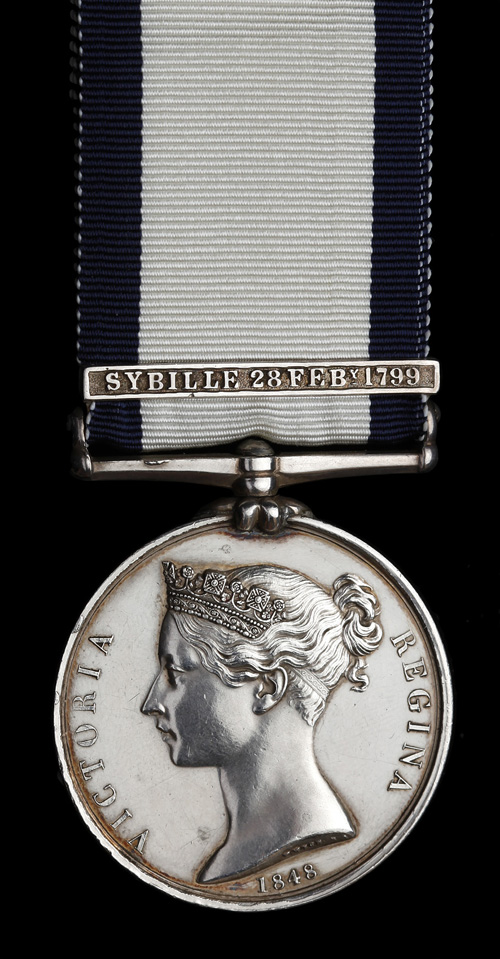
Auction: 1025 - The Turl Collection of Naval General Service Medals 1793 - 1840
Lot: 11
The Rare and Highly Emotive ´Fighting´ N.G.S. to Commander J. Long, Royal Navy, Who Took Part in the Ferocious Broadside-to-Broadside Engagement Between H.M.S. Sybille and the French Frigate La Forte, in the Bay of Bengal, February 1799. Despite Being Severely Out Gunned the Sybille Fought the Frenchman to a Complete Standstill, Killing Her Captain and Wrecking Her in the Process Naval General Service 1793-1840, one clasp, Sybille 28 Feby 1799 (J. Long, Lieut. R.N.), minor edge nicks, nearly extremely fine Estimate £ 13,000-15,000 James Long´s Lieutenant´s Passing Certificate of 1805 shows him serving as an Able Seaman in H.M.S. Sybille for the capture of the French frigate La Forte, off South Sand Head, near the Hugli (Hooghly) River in the Bay of Bengal, 1.3.1799, this is at variance with the recipient´s entry in the Lieutenant´s Services Survey of 1817, which gives him as Midshipman for this action. The published transcription of the roll also gives him as Able Seaman, however O´Byrne recounts Long´s part in an action as Midshipman in the Spanish harbour of Manila a year earlier than the engagement with La Forte. Approximately 12 clasps issued for this action. Commander James Long, R.N., born Melcombe Regis, Dorset, 1774; joined the Royal Navy as Able Seaman and was posted to H.M.S. Sybille (Captains E. Cooke, W. Waller and C. Adam), February 1797, ´and was a Midshipman of that ship in Jan. 1798, when, in company with the Fox 32, she entered the Spanish harbour of Manila under French disguise, although three sail of the line and three frigates belonging to the enemy were lying there, and succeeded, besides eliciting much information, in capturing seven boats, about 200 men, numerous implements of war, and a large quantity of ammunition. In the course of the same month, he joined in an attack made by the Sybille and Fox on the settlement of Samboangon in the island of Magindanao, where, in action with a fort and battery, the two ships sustained a loss of 6 men killed and 16 wounded; at the start of 1799 it was decided to seek and engage the French frigate La Forte (52 guns), one of the finest ever built at the time, which had been harassing British shipping in the Indian Seas; on the 19th February Captain Cooke in the Sybille (38 guns) set out with this endeavour in mind; on the evening of the 28th February (real date 1st March) the Sybille discovered the French frigate with two recent captures (Endeavour and Lord Mornington) off the sand-heads of the Hooghly River, ´and at midnight got near enough to receive a broadside from the larboard guns of La Forte, and a fire from one of her captures, which he [Cooke] did not return. After some manoeuvring the Sybille, got under the stern of La Forte, almost touching her spanker boom, and gave her the whole of her larboard broadside, and luffing up to leeward, poured in another broadside with the most destructive effect. These two broadsides killed and wounded between fifty and sixty men on board La Forte, and threw the enemy into such confusion that in their return they fired from both sides of their ship at once. The frigates then engaged broadside to broadside; the French Captain, a gallant veteran, was killed, and his first Lieutenant soon shared the same fate. About the same time Captain Cooke was mortally wounded by a grape shot and Lieutenant Hardyman took the command. At two thirty, the fire from the French frigate... entirely ceased, and the Sybille hailed to know if she had struck, receiving no reply Sybille recommenced firing, to which no return was made, and again hailed her opponent without effect. The Frenchmen then manned their rigging and attempted to escape, but their mizzen-mast being shot away in a few minutes after, their main and fore-masts with the bowsprit, went overboard, and the action ended´ (Medals of the British Navy and How They Were Won refers); the Sybille had had her sails and rigging cut to pieces, and her main and mizen-masts badly damaged but had only received six shots in her hull; five men were killed and Captain Cooke (mortally) and sixteen men wounded; La Forte was ´a perfect wreck.... Her Captain, first Lieutenant, and other officers, with sixty of her crew were killed, and eighty wounded, many of whom died afterwards´ (Ibid); the French frigate was taken into Calcutta for repairs and added to Royal Navy (under the command of the gallant Lieutenant Hardyman); Long continued his service in the Sybille as Master´s Mate, and on 23.8.1800, assisted in the capture and destruction of five Dutch armed vessels and twenty-two merchantmen in Batavia Roads; in October of the same year he contributed to making the prize of twenty-four Dutch proas; on the 19th August 1801, Long participated in a savage twenty minute action against La Chiffone (42 guns), off Mahé, the principal island of the Seychelles; during this action the British had suffered the disadvantage of fighting amongst the rocks and shoals and under the guns of an enemy battery; the Sybille suffered two killed and one wounded, whilst the French vessel was captured, having suffered twenty-three killed and thirty wounded; La Chiffone was added to the Royal Navy and Long was part of the crew that sailed her back to England; subsequent service included in the Monarch and the Edgar, before attaining the rank of Lieutenant, November 1806; appointed to the sloop Otter the following month and served with her during the evacuation of Montevideo, 1807, and the capture of St. Paul´s, Ile de Bourbon, 1809; Long went on to serve in the sloops Sapphire, Phipps, and Mosquito until 1813 when he left the service; commanded the Semaphore Station on Portsdown Hill, 1837-41; Commander 1842; in later life resided at Arms Hill, Gosport; Commander Long died 1.8.1864, leaving a widow, Mrs. Jacobina Long, residing at East Street, Titchfield. Provenance: Christie, November 1985 Ritchie Collection, September 2005
Sold for
£15,000


Watch, listen and bid as if you were in the room. Now available for auctions worldwide.
Click here to bid live
An exclusive and confidential service for the discerning collector or vendor.
View the Gallery
Download every Spink catalogue on your iPad, iPod or iPhone using free Spink app.
Download From iTunes© 2026 Spink & Son. All rights reserved.