Auction: 9024 - The Property of a Gentleman Orders, Decorations and Campaign Medals
Lot: 897
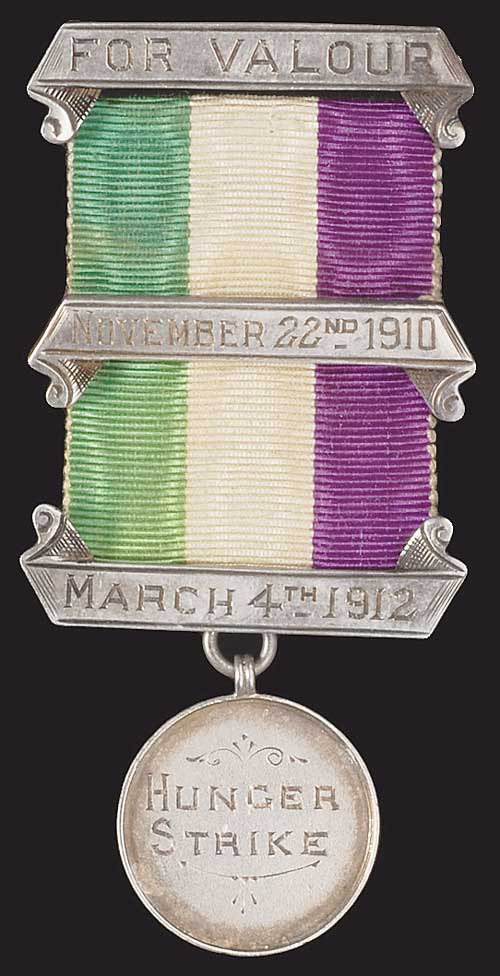
The Suffragette ´Hunger Strike´ Medal with Two Date Bars to Miss Eliza Evans Women´s Social and Political Union Medal, silver (Hallmarks for Birmingham 1911), 22mm, ´Hunger Strike´ engraved in block capitals on the obverse, and ´Eliza Evans´ on the reverse within wreath, with two date bars, November 22nd. 1910, and March 4th. 1912, and top riband brooch bar engraved ´For Valour´, nearly extremely fine, scarce Estimate £ 1,800-2,200 Miss Eliza Evans (referred to in the WSPU newspaper ´´Votes for Women´´ as both Elise and Elsie Evans) was a very active member of the Women´´s Social and Political Union (WSPU), whose members became known as Suffragettes. The main focus of the WSPU agenda was to campaign for female suffrage and in this endeavour, the organisation, which had been founded in 1903, became increasingly more militant. The first record of Evans arrest is in October 1908, a very active year for the Union, both in London and the Provinces, when she was found chalking a notice in the Strand to draw attention to a forthcoming Suffragette meeting. This activity, which drew a crowd of about a hundred people, resulted in her receiving a fine of twenty shillings, which was paid by a friend. A year later in October 1909 she appears to have been the Miss Evans who, together with other London-based Suffragettes, staged a protest in the Dundee constituency of the then Liberal Member of Parliament Winston Churchill. Here, she and Adela Pankhurst threw stones at the windows of Kinnaird Hall from the garret of the adjoining house, several of which crashed through the roof lights. During their protest, they are reported to have thrown ´´everything that came to hand´´ including two 2-pound weights attached to string which were excellent for breaking windows but which could not fall through and injure anyone. The stewards retaliated and threw slates back at the women. Both women were arrested after the Police broke down the door to the house with axes and crowbars, taking half an hour to effect an entry. Together with other women arrested that day for taking part in the protests, the pair was sentenced to ten days imprisonment, but were released on the fourth day because they had been on hunger strike. ´´Votes for Women´´ suggests that the reasons the women were set free and not force fed were because Churchill did not want to arouse any hostility among his electorate, and also because two of the arrested women had important family connections one was the sister of an MP and the other was the daughter of the founder of an influential Scottish newspapers. The newspaper also notes that Evans was as devoted a worker for the WSPU cause as anyone and had taken part in ´´other militant action´´. On her release she is reported to have stated: ´´I am quite convinced the prison system can never uplift but only debase those upon whom it falls. I am determined to go on with militant protests until the Government grants the just demand of women´´. Miss Evans next came to attention in November 1910. During this year, WSPU frustration grew as various Parliamentary procedural devices prevented the subject of female suffrage receiving even any further discussion. On Friday, 18 November 1910, four hundred women attended a meeting at Caxton Hall called by Mrs Pankhurst. The intention was for a deputation to go to Westminster to speak to Prime Minister Asquith to seek clarification. It was planned that the women would set off for Parliament Square in small groups of about twelve. The first deputation, led by Mrs Pankhurst, met with rough treatment, much buffeting and jeers from the crowd, and was soon largely deserted by its police escort. Other groups followed. Some got through with the help of sympathisers and a few women even reached the steps to the House of Commons. Instead of using their powers of arrest, the police attempted to gain control by physical force. Hence ´´fighting´´ and rough treatment continued and after an hour mounted police were called out. Even after the Square was cleared, still more groups of women approached. The whole event lasted six hours and many arrests were made, mainly over one hundred WSPU members. As a result of these events, this day became famous as ´´Black Friday´´. Asquith then made a statement confirming that no female enfranchisement Bill would be introduced during the Parliamentary session. This led to more demonstrations on Tuesday 22 November when many women descended on Downing Street (Mrs Pankhurst arriving in a taxi) and threw stones at Government offices. About one hundred and fifty women were arrested. Among the arrests during this period was Nurse (this is the only time she is recorded as a Nurse) Elise Evans, who subsequently appeared at Bow Street and was sentenced to imprisonment in default of paying a fine for, amongst other things, breaking a window. Again in prison she went on hunger strike and as a result was released early. She took the opportunity to affirm that she had been badly treated, saying that her dress was taken away by force and she was left without it for four hours. She attended the Christmas luncheon of 23 December for the heroines of ´´Black Friday´´. On 1 March 1912, still frustrated by the Government´´s handling of the Suffrage question, almost two hundred members of the WSPU, some in possession of hammers and bags of stones, staged a demonstration in Parliament Square and went on to break a large number of windows, primarily in Whitehall, the Strand and the West End, damaging over 270 premises and causing more than £6000 damage. Many women, including Mrs Pankhurst and several other WSPU leaders, were arrested and this number swelled to over two hundred as demonstrations continued over the next few days. Elise was amongst the arrests during this period and appeared at Bow Street Court. She was sentenced to hard labour (though the length of sentence is not clear) for breaking windows at government offices, even though it was stated in court that she was responsible for not more than a few shillings damage. Again she was released before completing her sentence as a result of going on hunger strike. Her name is recorded on the Suffragette Roll of Prisoners, compiled in the 1950s, as Elise Evans.
Sold for
£5,000


Watch, listen and bid as if you were in the room. Now available for auctions worldwide.
Click here to bid live
An exclusive and confidential service for the discerning collector or vendor.
View the Gallery
Download every Spink catalogue on your iPad, iPod or iPhone using free Spink app.
Download From iTunes© 2026 Spink & Son. All rights reserved.