Auction: 8023 - Orders, Decorations, Medals & Militaria
Lot: 78
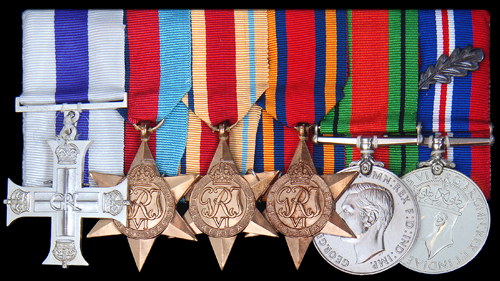
SOLD BY ORDER OF THE FAMILY An Exceptionally Rare November 1942 M.C. Group of Six for the Raid on Vichy French Held Oran Harbour to Major H.V. Holden-White, No. 2 Special Boat Section, Late Royal Sussex Regiment, Who Commanded the S.B.S. in Folboats (Canoes) From H.M.S. Walney, And Who Launched Small Torpedoes from his Canoe Against a French Destroyer. The Oran Harbour Attack Was the 1st British-American Combined Operation of the Second World War, Which Also Produced a Superb Victoria Cross for Walney´s Captain, And Was Described by Winston Churchill as ´The Finest British Naval Engagement Since Trafalgar´; As C/O of ´A´ Group SBS Holden-White Personally Led Several Daring Moonlight Canoe Sabotage and Reconnaissance Raids Against Japanese Positions on the Arakan Coast, 1944-45 a) Military Cross, G.VI.R., reverse officially dated ´1944´, and engraved ´H.V. Holden-White´ b) 1939-1945 Star c) Africa Star d) Burma Star e) Defence and War Medals, M.I.D. Oakleaf, generally very fine or better, mounted court style as originally worn, with the following related contemporary items and documents: - Recipient´s Identity Tags, Riband Bar and Rank ´Pips´ - Cloth Commando S.B.S. shoulder insignia - Commission appointing H.V. White Second Lieutenant, King´s Own Yorkshire Light Infantry, dated 25.9.1937 - M.I.D. Certificate, dated 27.9.1945 - Named Enclosure slip for recipient´s Military Cross; Enclosure slip for Campaign Awards - Identity Pass for Defence Headquarters, India. H.Q., S.A.C., S.E.A., complete with recipient´s photograph, dated 7.6.1945 - Named Release from Service Letter, informing recipient that he has been granted the honorary rank of Major, dated 16.7.1946 - Recipient´s Driving Licence, Passport and Old Comrades Association of the Special Service Brigade named Member´s Book - Diary, annotated by the recipient from 31.12.1945-11.5.1946 - Letter of congratulation from the Headmaster of Stowe School, to the recipient on the occasion of the award of his M.C., dated 18.1.1945, and addressed to White at ´A Group Special Boat Section, C/O Fleet Mail Office, Colombo, Ceylon´ - Letter of reference from Lieutenant-Colonel H.T. Tollemarche, dated 6.3.1947 - Eight photographs from varying stages of recipient´s service during the War - ´Introduction to the Jungle´, a typed document written and illustrated with several original drawings in ink, all by the recipient, which relates a journey by river through the dry zone jungle of Ceylon by ten officers and men of "A" Group Commando Special Boat Section, Summer 1944 - Two files of typed sheets, Parts 1 to 3 of Good Bye to Old Hat, A Memoir of Commando Life, by the recipient - various other items of ephemera including Movement Orders; Army Pay Office Documents; correspondence during the War years; correspondence undertaken in later life between the recipient and the S.B.S. in reference to the publication of his memoirs; an original copy of The Illustrated London News, dated 12.12.1942, featuring the raid on Oran; and an original copy of the recipient´s Obituary which appeared in The Daily Telegraph, 11.1.1999 (lot) Estimate £ 18,000-22,000 M.C. London Gazette 27.4.1944 T/Capt. Harold Vere Holden White Royal Sussex Regiment (162512) The Recommendation states: ´´Capt. Holden-White was in command of the Special Boat Section Unit, which was detailed to carry out dangerous and delicate operations in conjunction with the assault on the port of Oran. He was in charge of the party operating from H.M.S. Walney in folboats and displayed courage and initiative of a high order in attacking with small torpedoes a French destroyer which was leaving the port, and it is believed that one hit on the vessel was obtained.´´ Major Harold ´´Harry´´ Vere Holden-White, M.C., (1917-1999), born London; educated at Stowe School and in Switzerland; commissioned Second Lieutenant King´´s Own Yorkshire Light Infantry, 25.9.1937; transferred Royal Sussex Regiment, 21.12.1940; he volunteered for Special Duties in 1942, and ´´Before he knew what was happening, he was on his way to Scotland, where Jumbo Courtney was hastily assembling a contingent who would form 2 SBS, now that 1 SBS was under so much pressure at the eastern end of the Mediterranean. The new section would include some returned members of the original section, with new recruits such as Holden-White and the merging of 101 Troop, 8 Commando, the latter hand-picked by its Commanding Officer Captain Gerald Montaro.... Their billet was a private hotel in a suburb of Ardrossan, and soon Holden-White was being initiated into the gospel according to Jumbo.´´ (SBS The Inside Story of the Special Boat Service, J. Parker refers). At Ardrossan he was to primarily learn sabotage, reconnaissance of enemy coastlines, how to land agents behind enemy lines and how to live off the land. In the second week of October, ´´Harry - by then with the rank of Captain - was summoned to Lord Mountbatten´´s Combined Operations Headquarters in Whitehall, where Courtney also had an office. There was something big on. Hush-hush.´´ Operation Reservist The ´´big one´´ was to be Holden-White´´s first operational sortie with his new unit, he was to lead the S.B.S. part of Operation Reservist. The latter was a subsidiary part of Operation Torch, the massive invasion of North Africa in November 1942. Operation Reservist was an amphibious assault on Oran. The Vichy French held harbour was heavily protected by shore batteries and contained a number of the surviving vessels of the Vichy French Navy. Opposition inland was judged to be fairly minimal, ´´but the Vichy naval chiefs were still smarting over the sinking of part of the French Fleet [at Mers-el-Kebir]... by the British in 1940 and would take drastic measures to protect their remaining vessels.´´ (Ibid). The day of embarkation came, ´´Harry took five pairs of SBS canoeists to Greenock, where they loaded their stores, weapons and canoes aboard two converted American Coastguard cutters now under the Royal Navy flag and named H.M.S. Walney and H.M.S. Hartland.´´ (Ibid). Three pairs of canoeists were with Holden-White in H.M.S. Walney and the remaining two pairs with Lieutenant E.J.A. Lunn in H.M.S. Hartland. Once they reached Gibraltar they were to join a large convoy, which was to be under the protection of numerous destroyers and submarines, ´´there, the two ships would pick up 400 American troops, who were to mount a seaborne assault on Oran harbour and hold it until reinforcements arrived from inland. The SBS role in all of this was to go in first, blowing up shipping in the harbour with the still experimental torpedoes. Each pair of canoeists was to be given two torpedoes, which they were to release towards suitable targets as soon as feasibly possible. The torpedoes were to be collected in Gibraltar, they were told, where an officer would explain all.´´ The mini-torpedoes concerned were an experimental weapon invented by Sir Donald Campbell of land and water speed record fame. They were powered by a windscreen wiper engine and were approximately twenty-one inches long with twin opposed screws and a 1.5 pound cavity charge in the nose. They had of course been tested but only in the somewhat calm waters around the Hampshire coast rather than under rougher operational conditions. Upon arrival at Gibraltar Holden-White encountered the first of several problems that materialised during the course of this operation, ´´When we got to Gib, there was no bloody officer to explain it all, no bloody instructions, and the baby torpedoes were in bits. Luckily, I had Sergeant-Major J. Embelin with us, who was a demolition expert, and he was able to assemble them. But we still had only a vague idea about range and so on, and a greater surprise was to come on that score much later. Another problem for us was launching the canoes from ships. Normally, SBS crews are floated off submarines or lowered from MTBs. These cutters gaves us a drop of eight to ten feet and our flimsy folboats could have been damaged. So on the way out we decided to practice and unpacked the canoes we had brought aboard in kitbags to assemble them, staggering about the heaving deck like some mad ballet. Fortunately, the Walney´´s shipwright designed a sling to lower our boats into the water.´´ (Ibid). Holden-White´´s foreboding leading up to Operation Reservist is reflected in his memoirs and was noticed by Captain F.T. Peters, R.N., who was to be posthumously awarded the Victoria Cross for the raid on Oran, ´´In the evenings, amid the buzz of conversation and the clink of glasses of the pre-dinner get-together in the Wardroom, my gloom about the future of the operation would return, and, although I tried to hide it as much as possible, must, at times, have been apparent. Certainly, Captain Peters R.N., who was in overall command of Walney and Hartland noticed it. I can see him now, as, coming into the Wardroom for a drink and a chat with the assembled officers, he catches sight of my face as he passes the table where I am sitting. "Don´´t look so worried, Harry, it´´s going to be all right", and he gives me an encouraging slap on the back.´´ On the 8th November 1942 the British and American forces entered the area, Holden-White takes up the story, ´´As we sailed into Oran, it was evident that the harbour was a death-trap for a seaborne assault. Although the overall length of the harbour straddled the coast for about a mile, the opening to it was protected by a boom, which we knew about, of course. Once inside, there was no escape. Walney was supposed to ram the boom and, if that failed, Sergeant-Major Embelin, the demolition expert was to break open the boom with explosives. Sadly, he was subsequently killed by French machine-gun fire from the shore. Anyhow, as soon as we sailed in, the Vichy-French shore batteries started firing. The three SBS pairs on board Walney were virtually thrown overboard and started paddling towards the docks. Frankly, I was so bloody glad to be away from it. Soon that feeling turned to guilt as I and my number two, Corporal Ellis, paddled off to find suitable targets for our mini-torpedoes. We had not travelled far when there was a huge explosion. We looked back. Walney had been hit by shore batteries and was already sinking. Then Hartland was hit; they were being shot to pieces and eventually we learned that around half the men on board were lost. Sally Lunn had been unable to launch his pair of canoes because they were damaged by shells. They joined escaping US troops on Carley life rafts. Ellis and I paddled on. We had lost sight of our other chaps. We hid behind a barge to get our bearing, and as we did a ship loomed up out of the darkness coming towards us, a bloody great ship, absolutely enormous. Anyway... a suitable target, I thought. I fired one of my mini-torpedoes. There was no big bang, although the ship slowed down for a moment. Whether we hit it or not I do not know. She was eventually sunk outside the harbour by one of our subs. Then a submarine came out and I fired my second mini-torpedo at the sub. Unfortunately, my arm was jolted as I put it in the water, so that one went astray. We watched it go, streaking through the water, but at least it made a bang. It hit the harbour wall just below the lighthouse, which was not, of course, lit....... After that, there was nothing we could do but go on. The original plan, in the event of failure, was to paddle back out to sea and get aboard one of the many Allied ships outside the harbour. This was now impossible. Walney and Hartland, still ablaze and listing, blocked our route. There was no alternative but to go on to the harbour and try and make our escape there and link up with troops coming inland.´´ (Ibid). The harbour was swarming with Vichy-French troops, and as such, it was no great surprise when Holden-White and Ellis were captured shortly after landing their canoe, ´´we were only a few yards from the quay, where, as we emerged on to it, showering water, from the top of the steps, we were met by the impersonal stare of a Sergeant in the French Army. I instantly recognised him as yet another of those magisterial figures for whom the misdemeanours of such as myself held no surprises, and trembled in my shoes at the thought of his reaction, should he realise that Ellis and I had been trying to sabotage two of his country´´s ships.... Why weren´´t we wearing uniform, he asked, and then, cutting short my lame excuse that perhaps flotation suits were more suitable for canoeing, he informed us - dispassionately and quite correctly - that, as we weren´´t, we were liable to be shot as spies. "On peut vous fusiller", he said, to which I replied, horrified, ´´Si nous sommes fusilles, reprisaux, reprisaux", guessing wildly at the French word for reprisals. Unfortunately, this exchange was lost on Ellis who spoke even less French than I did, and he took this inappropriate moment to spit vigorously in the neighbourhood of the Sergeant´´s feet.´´ (Recipient´´s Memoirs refer). Luckily for them both the French Sergeant did not react and they were carted off to a makeshift POW camp outside of town where they were eventually reunited with the other SBS men on the mission and the survivors of the two sinking cutters. Whilst they were being marched off to the camp, Lunn, had been horrified to see one of the mini-torpedoes floating in the water near the quay where he was being marched away from. Captivity was short lived, ´´We were freed within five days when the troops [American] arrived from inland, but needless to say there was bloody confusion all over the place. We, the SBS, were told we would have to make our own way back to England, so I wandered around to the aerodrome to see if we could find a plane. We eventually got a lift to Gibraltar and linked up with Gruff Courtney. From there we hitched a ride on an American Fortress returning to England. We landed back in Cornwall, where we were immediately arrested. Bloody funny, really. We hadn´´t got any papers, of course, and wearing these odd clothes, the local police and immigration people surrounded us. We were interrogated for half an hour and eventually, after a few telephone calls, we were taken under close escort to London, where I was finally able to report on the mini-torpedo trials.´´ (SBS The Inside Story of the Special Boat Service, J. Parker refers). Holden-White and Lunn were summoned to the office of Lord Mountbatten to give their report on the operation. Mountbatten was disappointed by the performance of the torpedoes, for which he had had high hopes, ´´Holden-White pushed his personal concerns as far as he dare, hinting that his own bitter thoughts were directed towards ´´the shameful waste of life at Oran´´. Mountbatten glared at him but let the comment pass without comment.... Mountbatten now wanted Harry and Sally Lunn to agree to be interviewed by the BBC, as it was the first operation of its kind in which British and US troops had cooperated.´´ (Ibid) Although the assault on Oran had ended in catastrophe, the overall operation had been a huge success and Mountbatten wanted to publicize it. Despite enormous pressure from his superiors Holden-White refused to do the interview believing that it would be a betrayal to those who had lost their lives on the raid. It would be logical to assume that Holden-White had made a powerful enemy in the form of Mountbatten, however this was not to prove to be the case. Not only did Mountbatten sign the approval for Holden-White´´s Military Cross to be awarded for his gallant leadership during the raid, he also took him with him on his new enterprise. Mountbatten was appointed Supreme Commander in South East Asia, and in April 1944 he established the Small Operations Group (SOG) to bring together the skills of the several units involved largely in amphibious raiding, sabotage and reconnaissance work behind enemy lines. ´´A´´ Group SBS in Burma, 1944-45 Holden-White, ´´now a Major, found himself as officer commanding ´´A´´ Group, SBS, running operations against the Japanese on the Arakan coast of Burma. His was one of three SBS groups seconded to the SOG, along with Detachment 385 from the Royal Marines commando assault troops, four Sea Reconnaissance Units(SRUs) and four parties from Combined Operations Pilotage Parties (COPPs).´´ (Ibid). Initially a base was formed about ten miles from Jaffna on the northern end of Ceylon, in May 1944. ´´A´´ Group left the base for Parachute training near Rawalpindi in September moving on, ´´in early October 1944... for the Arakan front for attachment to 15 Indian Corps from 16 October until 14 December 1944. All their operations in the Arakan were carried out from motor launches (MLS) using the paddled Mark I canoe, the longstanding maid of all work of SBS and COPP.´´ (SBS In World War Two, G.B. Courtney refers). Corporal W.H. ´´Bill´´ Merryweather, SBS, provides the following eyewitness account of some of the operations undertaken by Holden-White´´s ´´A´´ Group: ´´By 3 October news came that operations were in the offing, and the group left Kankesanturai in the North of Ceylon by Dakotas to fly up the east coast of India to Calcutta.... The usual Commando enterprise produced two Dakotas for the following day, and the group moved to Chittagong where the men stayed at No 47 rest camp. From here Major Holden-White accompanied Commander Nicholls D.S.O., R.N. down the coast to Bawli Bazaar, where he met Major Eastwood of 15th Indian Corps and Major Drysdale RM Brigade, Major of 3SS Brigade. Details were worked out for a raid on the Japanese occupied island of Ramree just off the Arakan coast; and the following day he returned to Chittagong to pass on the good tidings. The canvas two-man folboats were assembled, grenades primed and tommy-gun magazines loaded, tides and moon phases worked out, and on 15 October 1944 the landing party consisting of Major Holden-White and Corporal Merryweather, Sergeant Hawkins and Corporal Westow, Sergeant Roberts and Lance-Corporal Edwards of the Burmese Intelligence Corps, set off on ML 412 to carry out a reconnaissance of Uga Chaung on the West coast of Ramree Island (Operation Gregory). Ramree Island was to prove to be a popular hunting ground for Holden-White. This was the first of two reconnaissance operations he led on the island, ´´About dusk, the ML cruised in between Cheduba Island and Ramree... the canoes were slipped over the side and loaded about 1.5 miles off shore.´´ (Ibid). As was standard procedure, the OCs canoe was the lead, and Holden-White and Merryweather´´s canoe went in first. After a tricky bit of navigation between some rocks the lead canoe scraped onto the beach, ´´the pair quickly nipped out and dragged it [the canoe] up a slope under the over-hanging trees. Signals were flashed out to sea for nearly ten minutes, but no other canoes arrived, so Major Holden-White and Corporal Merryweather decided to carry out the recce on their own. Following the left-hand bank of the river, they went inland about 600 yards and were halted by a mangrove swamp. It was obvious there was habitation on the right-hand bank, for glowing fire embers could be seen fifty yards away, and the smell of curry and burning coconut wood pervaded the night atmosphere. Retracing their steps, they decided to cut across the final bend of Chaung to where their canoe would be under the trees.´´ En route to his canoe, Holden-White came across the first piece of useful intelligence to be gathered on the recce mission, ´´As they stepped forward, a dark "hole" in the ground turned out on inspection to be the start of the defence system. It comprised a five-foot-deep trench some sixty yards long neatly riveted with timber along which were five rounded machine-gun pits covering the beach approaches. Above in the trees appeared to be a rope ladder leading to a tree-top platform, and at the seaward end above ground level was a coconut palm-leaved lean-to hut. This was shaken violently by the OC, but it was unoccupied. Climbing out over the front of the trench, they discovered that they had actually parked their canoe upside down on the Panjis [sharpened bamboo spears facing 45 degrees at groin height as defences against invaders] stuck in the front slope of the defence system.´´ The rest of Holden-White´´s party arrived and together they ´´snatched´´ a young Burman to lead them inland to where the Japanese appointed head man lived, ´´They entered the bamboo compound, but the headman was at Jap HQ. They questioned the occupants, information was disclosed that a four man Japanese police post was established about a mile along the track.... While the inhabitants were being questioned, two men crept into the compound and were captured. The building contained Japanese posters and propaganda leaflets, and a vast amount of information was obtained about enemy strength and positions.´´ (Ibid) Due to the amount of time elapsed on the interrogations Merryweather was sent back to prepare the canoes for a speedy get away. En route he discovered an anti-tank ditch and several observation towers before meeting with Corporal Westow who had been detailed to guard the canoes. A Japanese patrol had discovered the canoes in their absence, and headed in shore to investigate. Holden-White´´s party were lucky to get away without having made contact. On the 24th October Holden-White´´s ´´A´´ Group moved to a new base at Tek Naf, which at the time was the most forward Allied coastal base in the area. It was from here, with the information gleaned from the raid mentioned above, that Holden-White planned an ambitious follow-up raid on Ramree Island. This raid (Operation Profit), ´´was timed hoping the Japs would have finished their defence system, and the idea was that, as before, SBS would do the landing and carry out a search and recce. If all was well, they would signal out to sea, where another vessel carrying a contingent of No 5 Commando would come ashore and under the guidance of the SBS lay a host of mines and delayed booby-traps in the defences and make off quietly like the proverbial "cat that crept into the crypt, crapped and crept out again." They would then kick up a shindig hoping the Japs would race into their positions and do an assisted Hari Kari." (Ibid) The raiding force, that arrived off Ramree Island on the night of 15th November, consisted of MLs 412 and 413, two LCPs, a detachment of 4 Troop No 5 Commando along with the following members of the SBS: Major Holden-White, Corporal ´´Bill´´ Merryweather, Lieutenant Rodney and Corporal Les Bell, Sergeant Freddie Hawkins and Corporal Eddie Griffiths, Sergeant Harry Roberts and Sergeant Barney of BIC (Burma Intelligence Corps). Once again Holden-White set off in the lead canoe with Merryweather, and having landed on the beach, ´´stepped out to belay the canoe, while Merryweather scrambled up a large, smooth rock in his canvas gym-shoes to cover the spot where they knew the end of the Jap machine-gun trench was, with his tommy-gun and grenades. Just as the other canoes were about to beach, a sharp "Dong" sounded a few yards away, and a couple of seconds later a huge parachute flare burst right overhead, lighting up the whole party.´´ Holden-White, a veteran of these raids, kept a clear head and gave the order to re-embark. Another flare went up illuminating the sea and beacon fires were set alight on tree top platforms. By luck the canoes made it back to the Motor Launches, ´´the ML skippers in conjunction with SBS decided to have a shoot-up, but first of all they loaded a Carley Float with a "Mock Battle" (a series of detonators and explosives on a long fuse which when lit gives a good impression of rifle fire and grenade explosions for several minutes) and launched it to float down between Ramree and Cheduba Island to create a diversion.´´ The MLs with the Commandos and SBS on deck, cruised close to the Japanese held beach, ´´the lead ML fired a three-inch mortar parachute flare which burst right over the entrance to Uga Chaung. Immediately every gun and weapon on the vessels opened up on the targets designated by SBS who had them pin-pointed. The ship´´s crew had their twin Lewis guns, Bofors and 3-inch mortar, while the Commandos and SBS hosepiped the shore positions with Bren-gun and rifle fire - the tracers and incendiary bullets creating a continuous stream into the look-out posts and trenches..... The crews on the three-inch mortar lobbed HE bombs right onto the beach and really livened up the positions there.´´ The Japanese, although they managed to return fire, did not know what had hit them. Holden-White´´s previous recce on this position had given the Allied force such exact information on the enemy positions, that they smashed the Japanese opposition on this occasion. On the 23rd November Holden-White led another successful intelligence gathering raid this time in conjunction with ´´V´´ Force, 8 miles behind enemy lines in the Alethangyaw area. Early the following month on 2nd December Holden-White and party set off on ML 829 for Operation Hurry, ´´to do a recce-prisoner-snatch a mile west of Kyaukpanduywama.´´ Once again, under the cover of darkness, they landed their canoes and ´´acquired´´ a Burman who informed them that there was a Japanese soldier in a hut a quarter of a mile inland from the beach, ´´the party set out to get the Jap. As no Jap prisoner had been taken alive by any unit in Burma for nearly two years, a "Cosh" job was laid on. As the party were led into the darkness of the tress onto a track going north, Holden-White arranged for the lad to go into the Jap hut and say that he had seen suspected British soldiers landing down the coast, whereupon it was hoped he would come out and subsequently be captured. The boy warned the SBS party when it was about fifty yards from the Jap´´s hut..... the main party took up ambush positions on the track in a dark "tunnel" of trees.´´ The Burman bravely entered the hut and carried out his part of the plan, however, he brought out four men and not just the one that was expected, ´´as the party walked a few paces towards the cosh position, and the lad was almost level, he stopped, turned round and, as the followers shunted together, pointed to a short stocky figure in the middle, and cried "Japani-Japani". As the group began to scatter, all getting in each other´´s way, Merryweather threw his cosh to the ground, swapped the Colt .45 into his right hand and charged after the "Japani", who fled a few yards back along the track and was in the act of bolting over a high bank out into the open on the right. Unfortunately he wasn´´t quite fast enough, and as the .45 pistol shot rang out a few inches behind him, the dull flash seemed to light up the baggy white shirt in the middle of his back.´´ (Ibid) In the ´´scatter´´, a tommy gun was fired after the fleeing members of the party. The Japanese soldier and one other member of his party disappeared into the undergrowth. Time was limited as other Japanese would have doubtless heard the gunfire, ´´so the hut was searched. British mortar bomb boxes used for storing documents contained maps of the defence systems down the whole of the Arakan Coast - unit positions, a mixed collection of military documents, medicines, grenades, anti-VD pills and personal possessions, obviously looted from a British source.´´ (Ibid). Whilst the SBS had not managed to capture the Japanese soldier, they had managed to grab two of his party, ´´on interrogation back at base, it was discovered that all the individuals caught on the raid were employed by the Japs as Coast-Watchers, the three in the hut with the Jap being Sikhs who had "gone over" to the Japanese when captured earlier in the War. The post had only been established three days earlier (in all probability due to the raids carried out by SBS) and on their third night they had all been captured.´´ On the 20th December ´´C´´ Group SBS arrived to relieve Holden-White´´s men, who returned to Hammanhiel Camp in Ceylon for local leave and re-equipment. Holden-White was Mentioned in Despatches for his exploits on and off the Arakan Coast. In January 1945 Major E.J.A. Lunn (who had accompanied Holden-White on the Oran Raid), took over command of ´´A´´ Group. Holden-White had succumbed to the awful jungle conditions and due to ill-health, after a lengthy period of treatment in a naval hospital in Colombo, was posted to the Headquarters of South East Asia Command in Kandy as SOG Liaison Officer. Initially it appears that his new position did not appeal to him and that he would have rather returned to operational life, ´´Surely it was better, rather than serve a life sentence to the machine of modern scuffle to live in a hole in a rock on lentil porridge´´ (Diary included with lot refers). As months passed however he seems to have embraced all of the ´´opportunities´´ offered by the role, as the Diary entries for the 25th and 26th of March 1946 suggest, ´´Parties & Hangovers´´. The realities of war were never far from hand though, ´´Hear John Maxwell (taken prisoner Siam May ´´45) beheaded by Japs in July. When we were drinking in ´´H´´ Camp last July John, who had been drinking with us 2 months before, was lying condemned to death in an enemy prison. I wonder if he thought of us.´´ (Diary extract for 2.4.1946 refers). At the end of the War, Holden-White stayed on in Ceylon, as Garrison Adjutant successively at Colombo and Trincomalee, and then as a Troop Commander with 3 Commando Brigade in Hong Kong. After demobilisation, Holden-White studied painting at Chelsea School of Art and in Paris. He then went to live and paint in the south of France before he moved to Scotland to pursue one of his other passions, fishing. In later life he devoted a lot of his time to his memoirs and the preservation of the history of the SBS in general.
Sold for
£29,000

Watch, listen and bid as if you were in the room. Now available for auctions worldwide.
Click here to bid live
An exclusive and confidential service for the discerning collector or vendor.
View the Gallery
Download every Spink catalogue on your iPad, iPod or iPhone using free Spink app.
Download From iTunes© 2026 Spink & Son. All rights reserved.