
Auction: 8023 - Orders, Decorations, Medals & Militaria
Lot: 75
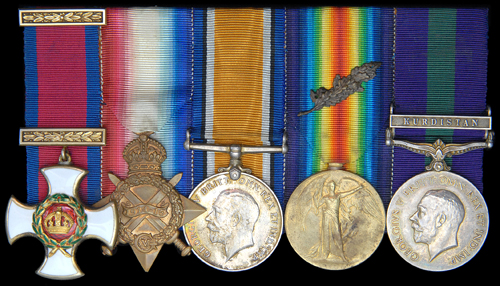
The Scarce Great War ´Aegean Theatre´ D.S.O. Group of Five to Sopwith Camel Pilot Squadron Leader F.J.E. Feeny, Royal Naval Air Service and Royal Air Force, ´A Skilful and Daring Pilot´ Who Commanded 220 Squadron in the Aegean from July to October 1918, He Shared in the Naval Prize Bounty When the German Cruiser Breslau was Sunk off the Island of Imbros, January 1918 a) Distinguished Service Order, G.V.R, silver-gilt and enamel, with integral top riband bar b) 1914-15 Star (Flt. S. Lt. F.J.E. Feeny, R.N.A.S.) c) British War and Victory Medals, M.I.D. Oakleaves (Major F.J.E. Feeny. R.A.F.) d) General Service 1918-62, G.V.R., one clasp, Kurdistan (F/O. F.J.E. Feeny. R.A.F.), generally good very fine, mounted court style as originally worn (5) Estimate £ 3,800-4,200 D.S.O. London Gazette 1.1.1919 Feeney [sic], Francis Joseph Edward, Capt. (Acting Major). M.I.D. London Gazette 1.1.1919 Capt. (A. Major) Francis Joseph Edward Feeney [sic] (Aegean) Squadron Leader Francis Joseph Edward Feeny, D.S.O., born 1892, a native of Birmingham; enlisted as Private in the 14th (Service) Battalion Royal Warwickshire Regiment; transferred as Flight Sub Lieutenant Royal Naval Air Service, 9.2.1915; qualified as Pilot (Licence no. 1172), in April of the same year; Commanded a Flight on the Western Front, 1916, before transferring for service in the Aegean; Feeny was 1 of 17 RNAS officers who left Malta, 22.8.1917, arriving at Mudros two days later; Mudros, on the Island of Lemnos, was the main store and repair base for the air units working in the Aegean, there was also an airship station for anti-submarine duties, a seaplane station for similar work and for the air defence of the port and the depot ship H.M.S. Ark Royal; Feeny´´s initial employment whilst based here was testing newly constructed aircraft, earning the following praise from his Commanding Officer, ´´has shown exceptional powers of command and organisation and is a skilful and daring pilot (service papers refer); posted as Acting Squadron Leader, Officer Commanding, Imbros Air Station, in the latter part of 1917, and it was whilst in this capacity that he shared in the Naval Prize Bounty for the sinking of the German Cruiser Breslau; in January of 1918 the Breslau and the Goeben left the Dardanelles to shell British shipping and positions at Imbros; all available aircraft of 2 (Naval) Wing were hurriedly drawn to the island, and attacks commenced on the two cruisers; a defensive air screen was formed around the German ships resulting in a number of aircraft shot down by enemy seaplanes; the Breslau was eventually harried into minefields and ostensibly destroyed, the Goeben grounded in shallow water and was subjected to five days of allied bombing attacks; she eventually made good her escape as the bombers were too lightly equipped to affect serious damage upon her; Feeny transferred to C Squadron R.N.A.S, (later 220 Squadron R.A.F.), Imbros (Sopwith Camels) the following year, Commanding the squadron, July-October 1918; for C Squadron, ´´Air reconnaissances of the Dardanelles and of the Gallipoli Peninsula were a daily routine of the Imbros Squadron, which had also to supply aircraft for anti-submarine patrols´´ (The War in the Air, H.A. Jones, Vol. V, refers); demobilised in 1919, re-engaged for service as Flying Officer, 29.7.1921; posted to 8 Squadron, Hinaidi, Iraq (de Havilland´´s), 13.12.1922, from where the squadron shared in the task of garrisoning the country; transferred to the Reserve of Officers, 1925, relinquishing his commission, 1933, but retaining the rank of Squadron Leader.
Sold for
£4,400


Watch, listen and bid as if you were in the room. Now available for auctions worldwide.
Click here to bid live
An exclusive and confidential service for the discerning collector or vendor.
View the Gallery
Download every Spink catalogue on your iPad, iPod or iPhone using free Spink app.
Download From iTunes© 2026 Spink & Son. All rights reserved.