
Auction: 8023 - Orders, Decorations, Medals & Militaria
Lot: 63
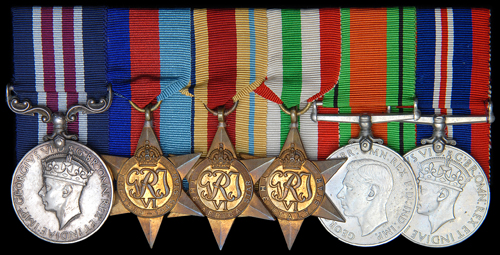
x A Superb Combined Operations Dieppe Raid M.M. Group of Six to Gunner, Anti-Tank Rifle Operative, T. McDonough, Royal Artillery Attached Lord Lovat´s No 4 Commando, For the Attack, Capture and Destruction of the ´Hess Battery´ Objective at Varengeville, 19.8.1942 a) Military Medal, G.VI.R. (2198211 Gnr. T. McDonough, R.A.) b) 1939-1945 Star c) Africa Star d) Italy Star e) Defence and War Medals, edge bruise to first, generally very fine or better, mounted court-style as originally worn (6) Estimate £ 3,500-4,000 M.M. London Gazette 2.10.1942 2198211 Gnr. T. McDonough R.A. (Attached 4 Commando), ´´In recognition of gallant and distinguished services in the combined attack on Dieppe´´ The Recommendation states: ´´Gunner McDonough fired no less than 60 rounds with the Anti-Tank Rifle at the Flak Towers (Pincer and Pieface). Each time he fired the Anti-Tank Rifle, heavy fire was immediately brought to bear on the flash from the muzzle of the rifle. McDonough repeatedly changed his position and continued to engage the enemy, each time incurring heavy enemy fire. He scored a great number of hits and his endurance was quite phenomenal.´´ 2198211 Gunner Thomas McDonough, M.M., a native of Liverpool, was attached to Lord Lovat´´s No. 4 Commando for the Combined Operations raid on Dieppe, 19.8.1942. No. 4 Commando were tasked with taking and destroying the ´´Hess´´ Battery (No. 813 Battery). This formidable battery, of six 150mm guns, was situated behind the village of Varengeville. The battery was ´´three and a half miles west of Dieppe and eleven hundred yards from the sea, which on that part of the iron coast of France washes steep cliffs, unscaleable except at one point. Each gun of the battery was mounted on a concrete platform, and behind the position there was an anti-aircraft gun on a flak tower. Wire surrounded the battery on three sides´´ (After the Battle Magazine, 1974, refers). Lovat decided to divide the Commando (252 men) into two groups for the purpose of the raid - Group 1 was made up of eighty-eight all ranks under the command of Major D. Mills-Roberts (Irish Guards). It comprised a headquarters, ´´C´´ Troop (of which McDonough was a part), a fighting patrol of ´´A´´ Troop, a mortar detachment and a signalling section. Mills-Roberts, ´´was ordered to land on ´´Orange 1´´ beach at a point on the coast where two precipitous gullies led the cliffs to wooded country which ran to within three hundred yards of the battery. He was to climb the cliffs, form a bridgehead, and from it engage the battery with small arms and mortar fire, but not to close it until it had been overrun by Group 2´´ (Ibid). The latter comprised of the remainder of the force under the command of Lord Lovat. Group 2 was to encircle the battery and attack them from the rear. Unlike No. 3 Commando, which was carried direct to the place it was to assault in Eureka landing craft, Lovat´´s men were to be taken within ten miles of the coast by an infantry assault ship, H.M.S. Prince Albert. They were then to go ashore in assault landing craft under the command of Lieutenant Commander H.H.H. Mulleneux, R.N, ´´Mills-Roberts and his men, put on shore at exactly the right spot, disembarked dryshod in successive waves.... the leading sub-section of ´´C´´ Troop made for the left-hand cleft but found it choked with fallen lumps of chalk and very heavily wired. The right gully seemed to be equally impassable, the wire was blown up with two Bangalore torpedoes, the noise of their explosion fortunately being drowned by the sound of heavy firing further down the coast and by the roar of British Fighters belonging to No. 129 Squadron, who at that moment engaged the battery with their cannon. ´´C´´ Troop, led by Lieutenant D.C.W. Style (Lancashire Fusiliers) and followed by Captain R.W.P. Dawson (The Loyal Regiment of North Lancashire), scrambled quickly up the cliff, and after searching a number of houses, moved through the wood and took up a position facing the battery. Here, while the fighting patrol from ´´A´´ Troop cut the telephone cables leading to the lighthouse, most of ´´C´´ Troop, entering the houses in the wood, began to snipe the German gunners from a range of some two hundred and fifty yards. They paid particular attention to one of the light anti-aircraft guns on the western flak tower, and killed three crews in succession which sought to serve.... Among ´´C´´ Troop were three snipers, under the command of Lance-Corporal R. Mann who, with face and hands painted green, took cover in some bushes a hundred and fifty yards from the enemy and fired repeatedly with deadly effect. These three, together with three Bren gunners, silenced three enemy machine gun positions, while Gunner T. McDonough fired no less than sixty rounds from his anti-tank rifle, mostly against the flak towers.´´ (The Green Beret, The Story of the Commandos 1940-1945, H. St. George Saunders, refers). Mills-Roberts had reached the German battery as it was firing it´´s first salvo against the British fleet, he takes up the story, ´´Suddenly a 20mm gun started firing from a high flak tower on stilts. It possessed an all-round traverse. We could see the streams of phosphorescent shells as they raked the edge of the wood and exploded against the tree-trunks....... Suddenly over farm buildings on the left of the battery came the phut, phut, phut of German mortars: soon the area resounded to the crash of shells.... Two other detachments were now ready and joined the fray - the anti-tank rifle, a ponderous but powerful weapon with penetrating power, and the handy little 2-inch mortar. The anti-tank rifle was to pierce the steelplated armour with which we knew the enemy perimeter defences were protected. Gunner McDonough firing this gun, with Private Davis as his No. 2, operated against the Flak Tower with great effect. It ceased to revolve and gave the appearance of a roundabout checked in full flight. Then he turned his attention to the German machine-guns, ably assisted by the Brens. The aim was deadly and the volume of fire seemed to be checked. Then our 2-inch mortar detachment started to shoot. Their first round fell midway between the barn and the target; the next was a good one and landed in a stack of cordite, behind No. 1 gun, which ignited with a stupendous crash, followed by shouts of pain. We could see the Germans as they rushed forward with buckets and fire extinguishers; every weapon was directed on this target. The fire grew; meanwhile the big guns remained silent.... any move in the battery was immediately answered by a burst from one or the other fire group. At this stage the German spotting improved, and retaliation swiftly followed. Several men were wounded..... one man, Fletcher, had all his equipment and half his clothes blown off by a mortar..... The Flak Tower opened up again; this time it swept the scrub more accurately. Again the anti-tank rifle returned its fire with effect. So far so good. But I was desperately anxious to know how Lovat´´s main assault force were getting on in their wide detour round the flank. We had been unable to get them on the air and did not even know if they had got ashore. Otherwise it would be our task also to carry out the assault on the battery at 6.30am after the cannon fighters had raked it with their guns. The German mortaring was becoming heavier, and the forward position more precarious when I received a signal that we were in touch with Lovat´´s party. They were actually in their forming up position behind the battery. There was not long to go, and magazine after magazine was slammed into the Bren guns, with sustained fire by the riflemen. The 3-inch mortar communications had got going and they came into action with a heartening crash. At 6.25am we deluged the battery area with smoke and saw the cannon fighters roar in for their two-minute strike at 6.28am.´´ At 6.30am Lovat fired three Verey Lights, signalling to Mills-Roberts that the assault was about to begin. Then he sounded his hunting horn, and with fixed bayonets his Commandos ran two hundred and fifty yards across open ground under heavy machine gun fire to ram home into the midst of the battery, they, ´´literally tore the German defenders, including the Battery Commander, to pieces: only four prisoners were taken, and one hundred Germans lay dead or grievously wounded, while a few ran off in terror.´´ (War Magazine, Vol. 7, May 1979). The Commandos blew up the guns, and then joined with Mills-Roberts´´ group as they retired to the beach. At 7.30am, on schedule, the raiders re-embarked on the waiting landing craft and successfully completed their withdrawal. Despite suffering approximately 45 casualties, including 2 officers and 10 other ranks killed, this action was the outstanding success of the Dieppe Raid. These casualty figures are relatively small in comparison with the overall numbers suffered by the combined British and Canadian troops, ´´On 19 August 1942, in the space of just six hours, a force of Canadian and British troops some 6,000 strong, engaged in assaulting the seaport of Dieppe on the Channel coast of France, lost 4,131 men, killed wounded or captured.... No other Allied operation of the Second World War saw such a loss in such a time.´´ (The Dieppe Raid, R. Neillands, refers). Lovat´´s Commandos were the only unit on the day to capture all of its objectives and Mills-Roberts, whilst under heavy and sustained fire, was party to what must have certainly been one of the most unusual and un-expected events of the entire raid, ´´These proceedings were watched with some surprise by a middle-aged Frenchman, who stood in the doorway of his cottage clad in a nightshirt and a pair of button boots. He was inclined to become indignant as more and more of his cabbages were trampled, but presently disappeared within and returned anon resplendent in a short black coat and striped trousers. Approaching Mills-Roberts, he shook him gravely by the hand and offered him a glass of wine.´´ (The Green Beret, The Story of the Commandos 1940-1945, H. St. George Saunders, refers). McDonough was awarded one of seven M.M.´´s to No. 4 Commando for the raid. He was presented with his medal by the King at Buckingham Palace, 27.10.1942. He died in 1980.
Sold for
£10,000


Watch, listen and bid as if you were in the room. Now available for auctions worldwide.
Click here to bid live
An exclusive and confidential service for the discerning collector or vendor.
View the Gallery
Download every Spink catalogue on your iPad, iPod or iPhone using free Spink app.
Download From iTunes© 2026 Spink & Son. All rights reserved.