
Auction: 8023 - Orders, Decorations, Medals & Militaria
Lot: 41
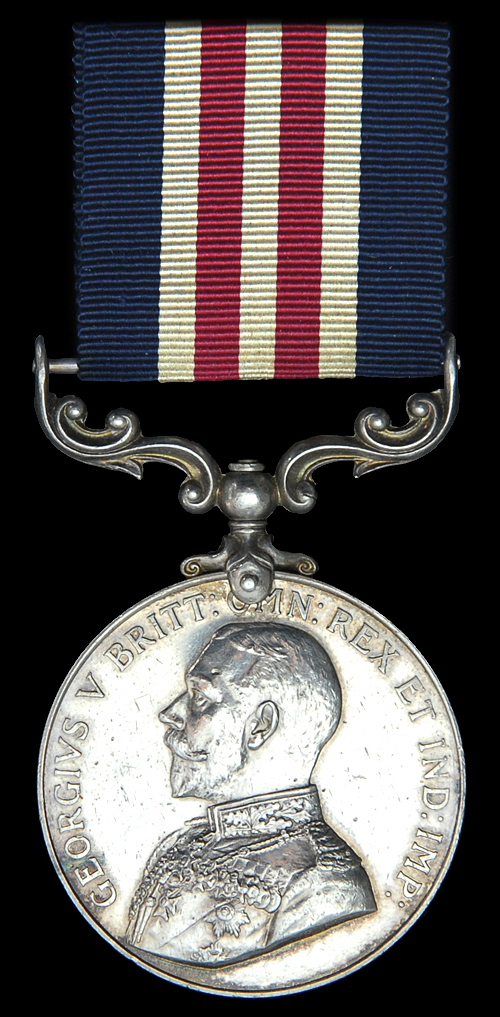
A Great War 1916 ´French Theatre´ M.M. to Sergeant C.W. Clark, Grenadier Guards, Later Second Lieutenant, Royal West Kent Regiment; Killed in Action on the 1st Day of the Battle of Cambrai, 20.11.1917 Military Medal, G.V.R. (18062 L.Sjt: C.W. Clark. 1/G:Gds:), light contact marks, therefore very fine Estimate £ 380-420 M.M. London Gazette 21.12.1916 18062 Lance Sergeant C.W. Clark, 1st Bn. G. Gds. Second Lieutenant Charles William Clark, M.M., served during the Great War with the 1st Battalion Grenadier Guards in the French Theatre of War from, 16.3.1915; Clark´´s Battalion were in action on the Somme during August-November 1916; they took part mainly in operations around the Lesboeufs area; Commissioned Temporary Second Lieutenant 6th Battalion Royal West Kent Regiment, 31.7.1917; the 6th Battalion Royal West Kent´´s took part in the attack on the Hindenburg Position on 1st Day of the Battle of Cambrai, 20.11.1917, ´´the morning of Tuesday the 20th November broke dull and misty..... It was still dark at 6.10am when the prevailing stillness was broken by the tanks as they moved forward into battle; but the sound could be distinguished by few German ears amid the noise of the British aircraft flying low over the lines. Ten minutes later the broad array, followed by the eager infantry, crossed the British front line, the figures of men and machines now becoming visible at a distance of nearly 200 yards in the first faint light of dawn. And at this moment, with a deafening roar, a thousand guns opened up on the German defences and battery positions between the two canals, smiting also the villages in the rear. Stunned by the devastating precision of this sudden storm of fire, the defenders were confronted with a new terror: the clattering onset of the tanks plunging through the gloom...... On the right the 6/Queen´´s and 6/R. West Kent set about establishing the defensive flank which was to run back in front of the Peronne road south-westward from Lateau Wood. During their advance both battalions had become involved in the fighting; and after the capture of the wood the West Kent´´s found that on the Cambrai road, over the brow of the hill to the north, the Germans were holding out in le Quennet Farm, another locality which had not been bombarded. A party of the battalion which succeeded in entering the farm was so reduced in numbers that it was overpowered and captured; and the Germans, who withdrew soon afterwards, took most of their prisoners with them (Major W.J. Alderman, commanding the West Kent´´s, had been mortally wounded after leading an attack, north of Lateau Wood, which resulted in the capture of a 5.9-inch battery). The two battalions dug posts, facing south-eastward, along the spur. Of six tanks from C Battalion which covered the operation three suffered direct hits by short-range artillery fire from the east.´´ (Official History of the War, Military Operations, France and Belgium, Imperial War Museum, refers); Clark was killed in action, 20.11.1917, and is buried in the Fifteen Ravine British Cemetery, Viller-Plouich, France.
Sold for
£500


Watch, listen and bid as if you were in the room. Now available for auctions worldwide.
Click here to bid live
An exclusive and confidential service for the discerning collector or vendor.
View the Gallery
Download every Spink catalogue on your iPad, iPod or iPhone using free Spink app.
Download From iTunes© 2026 Spink & Son. All rights reserved.