
Auction: 8023 - Orders, Decorations, Medals & Militaria
Lot: 37
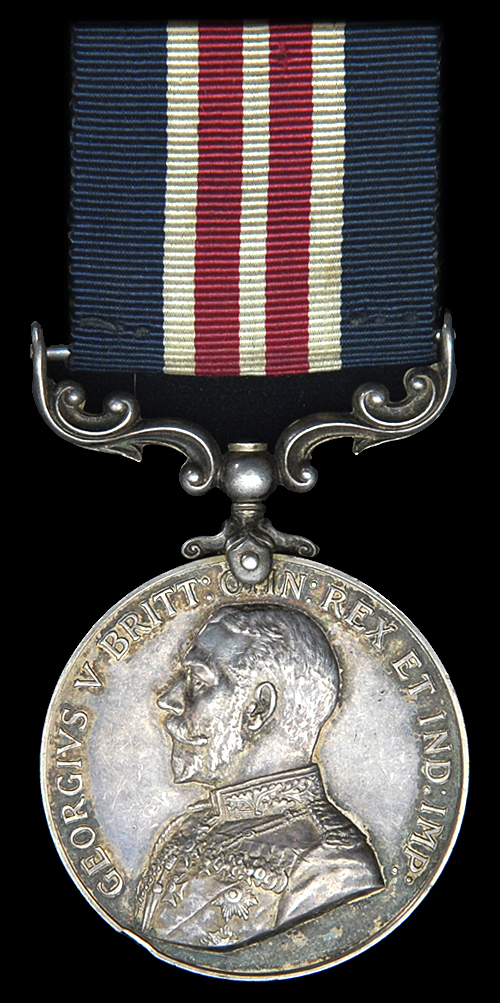
A Scarce Great War 1916 ´French Theatre´ M.M. to Sapper J. Simpson, 176th Tunnelling Company, Royal Engineers Military Medal, G.V.R. (102502 Sapr. J. Simpson. 176/T´Lg: Co:R.E.), edge bruise, good very fine Estimate £ 200-250 M.M. London Gazette 14.9.1916 102502 Sapper J. Simpson 176th Tun. Coy. R.E. 102502 Sapper John Simpson, M.M., served during the Great War with the 176th Tunnelling Company Royal Engineers in the French Theatre of War, from 12.6.1915; the latter had been founded at Lestrem, April 1915, comprising of 5 officers and 269 men under the command of Captain E.M. Momber; shortly after formation they moved to the Neuve Chapelle area facing Bois du Biez; from here they moved to Givenchy in June 1915 under the command of the 2nd Division on operations near Cuinchy; in April of the following year the 176th Tunnelling Company moved to Neuville St. Vaast/Vimy; XVII Corps under the command of Lieutenant-General Sir Julian Byng had taken over the area from the French Tenth Army in February and, ´´Whilst the Germans, as one officer puts it, had been smiling over the parapet, they had been pushing on below ground. The British had taken over an extensive mining system, but it was soon discovered that the enemy´´s work was much more further advanced, deeper, and in many places already under our front line...... The unfavourable mining situation having been revealed, it would no doubt have been wiser, since no offensive was intended in the Vimy area, to have abandoned the western slopes of Vimy ridge... In practice, this course could not be adopted: the great effort of our Allies would have been in vain; it would be revealed that pure defensive was intended on the Vimy front, while it was the special desire of the Commander-in-Chief that the imminence of a spring offensive should be suggested to the enemy - by means of mining and frequent raids - and that the principle of aggression should be instilled into the troops. For two to three months, therefore, a desperate struggle for mastery below ground went on, in which there were engaged at one time or other ten tunnelling companies - the 172nd, 175th, 176th, 181st, 182nd, 184th, 255th, the 23rd Division and the New Zealand Tunnelling Companies - assisted at first by five and later two French companies. Above ground when a mine was fired by either side, its infantry would rush forward and endeavour to consolidate the crater, or rather its near lip; the other side would respond by artillery fire, and both would open with machine guns..... The strain, both mental and physical, on the infantry garrison of the front trenches during this period was very severe. The 25th Division, in the sector on which the German attack was to fall on the 21st May, lost in the preceding five weeks 70 officers and 1,200 other ranks. Gradually the British miners established supremacy. In Carency sector on the 3rd May, at 4.45pm, four mines were fired by the British a little north of Ersatz Avenue, and the three big craters formed, whose lips gave splendid observation, were seized and consolidated by the 1/21st London (142nd Brigade), and the 2/3rd London Field Company R.E. of the 47th Division. They were named "Momber", "Love" and "Kennedy" Craters, after the tunnelling, field company and battalion commanders concerned in the operation.´´(Official History of the War, Military Operations, France and Belgium, Imperial War Museum, refers). The casualties for the latter operation, in which 176th Tunnelling Company took part, were 4 killed and 18 wounded.
Sold for
£300


Watch, listen and bid as if you were in the room. Now available for auctions worldwide.
Click here to bid live
An exclusive and confidential service for the discerning collector or vendor.
View the Gallery
Download every Spink catalogue on your iPad, iPod or iPhone using free Spink app.
Download From iTunes© 2026 Spink & Son. All rights reserved.