Auction: 8023 - Orders, Decorations, Medals & Militaria
Lot: 336
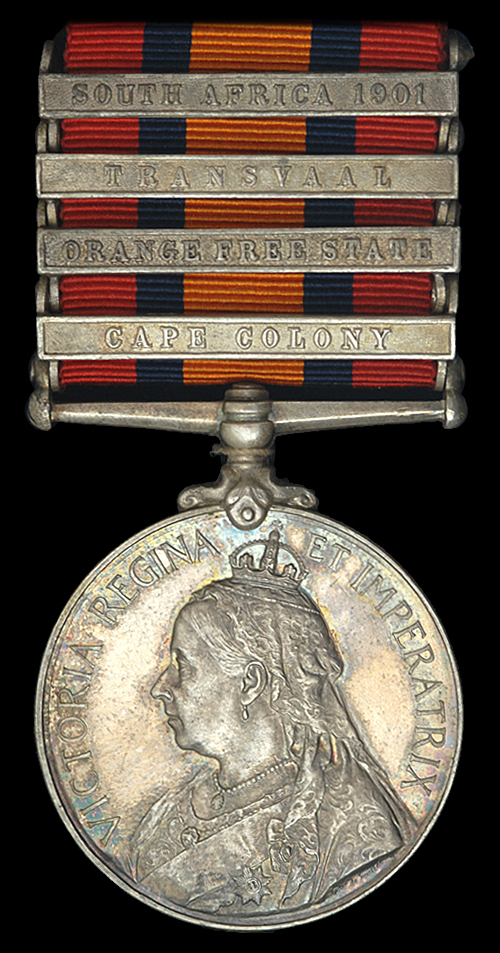
The Queen´s South Africa Medal to Private T.H. Evered, Imperial Yeomanry, Dangerously Wounded During the Boer Attack on Moedwil, 30.9.1901; For This Action Private William Bees Received the Victoria Cross Queen´s South Africa 1899-1902, four clasps, Cape Colony, Orange Free State, Transvaal, South Africa 1901 (27345 Pte T.H. Evered. 48th Coy. Imp. Yeo), extremely fine Estimate £ 150-180 27345 Private T.H. Evered, served during the Boer War with the 48th (North Somerset) Company, 7th Battalion Imperial Yeomanry; dangerously wounded at Moedwil, 30.9.1901. Action at Moedwil, 30th September 1901 Following the failure of the winter operations against the Boers in the Western Transvaal, the majority of the British forces were despatched to Natal. One column only, under the command of Colonel Kekewich, and comprising of 370 men of the Derbyshire Regiment, 400 men of the Scottish Horse, and 160 men of the Imperial Yeomanry, was left in the neighbourhood, with the aim of keeping the area quiet during the spring of 1901. On the afternoon of the 29th September, the column halted at Moedwil farm, on the banks of the Selons River, to make camp for the night. Protected on one side by a bend in the river, the camp was vulnerable through being overlooked on the other by rising ground heavily covered with patches of bush, and this vulnerability was compounded through the pickets being imperfectly placed. At 4:45am an enemy force 1000 strong under the command of General Jacobus de la Rey, who had been stalking Kekewich´´s column for the past week, launched a three-pronged attack. Two small Yeomanry pickets, resisting desperately, were cut to pieces, as was a stronger picket of thirteen Derbyshires under Sergeant Chambers, who were holding some rocks overlooking the main drift, and who suffered nine killed and three wounded. By break of dawn several hundred Boers could be seen charging through the burning camp. Despite the confusion, a firing line was set up, which, despite suffering heavy casualties, succeeded in stemming the tide of the Boer advances. A Maxim gun belonging to the Derbyshires came into action at the south-west corner of the camp, and was served with remarkable devotion- out of the detachment of nine men six were hit. Amid the confusion Private William Bees, Derbyshire Regiment, upon hearing his wounded comrades asking for water, went forward under heavy fire to a spruit held by the Boers 500 yards away, and brought back a kettle filled with water. Despite passing within 100 yards of some rocks also held by the enemy, and the kettle being hit by several bullets, Bees made it back to his gun-crew with the water, and continued to man his post. Colonel Kekewich himself was twice wounded, but continued to exercise command, and a British counter-attack forced the Boers back and threatened to enfilade and roll up the entire enemy line. At 6:00am de la Rey ordered his force to retire, and by 6:15am they had all but disappeared. Pursuit though was impracticable, with virtually every horse having been either killed or wounded. British casualties for the action were 214 Officers and men killed and wounded, almost a quarter of the column´´s fighting strength. The Boers themselves suffered approximately 60 casualties. For his gallantry in fetching water under enemy fire Private Bees was awarded the Victoria Cross; Sergeant Chambers, wounded in the pickets, where so many of the Imperial Yeomanry were killed or dangerously wounded, received the Distinguished Conduct Medal. For the Group of Six to Captain J.G.C. Evered see Lot 114.
Sold for
£420

Watch, listen and bid as if you were in the room. Now available for auctions worldwide.
Click here to bid live
An exclusive and confidential service for the discerning collector or vendor.
View the Gallery
Download every Spink catalogue on your iPad, iPod or iPhone using free Spink app.
Download From iTunes© 2026 Spink & Son. All rights reserved.