
Auction: 8010 - Orders, Decorations, Medals & Militaria
Lot: 3
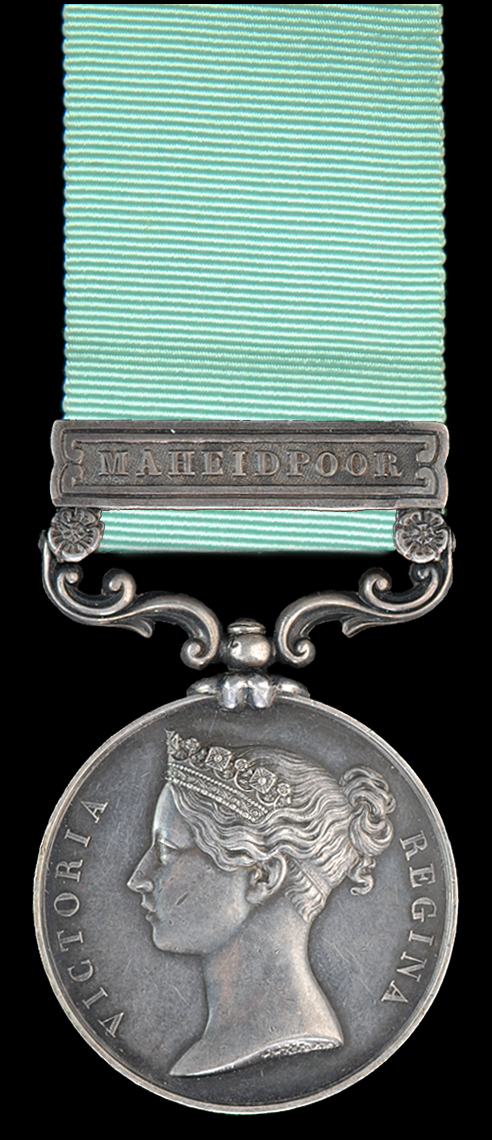
Army of India 1799-1826, short hyphen reverse die type, one clasp, Maheidpoor (Captn. J.G. Bonner, Brig. Maj. Arty.), officially impressed, good very fine Estimate £ 4,500-5,000 Colonel John George Bonner, commissioned Second Lieutenant Madras Horse Artillery, 1803, served with Lieutenant-General Sir Ian Hislop during the Pindari and Third Maharrata War 1817-19, including Hislop´´s assault and capture of Talneir Fort, for which Bonner was mentioned in despatches (London Gazette 28.8.1818). Talneir Fort was ceded by Holkar to the British Government, and was situated upon the Tapty, about 80 miles west of Burhanpoor. Hislop´´s despatch written the day after the capture of the fort, dated 28.2.1818, gives further incite into the assault and indeed the part played by Bonner and the Artillery, ´´having descended the Sindwah Ghaut without molestation from the Bheels, I reached Kurrone on the 26th instant, and moved towards the Tapty at this place yesterday; on the march I received an intimation that the Killedar of Talneir had determined upon resisting the occupation of his fort by the British troops, and this, on my arrival before the place, I found to be correct, as he had already commenced a fire from a few guns and a number of matchlocks from the walls, upon our advanced parties. On this I directed a reconnaissance to be made by the Quarter-Master-General, Lieutenant-Colonel Blacker, and the Officers of the Engineers, with a company of light infantry, the deep ravines round the place preventing its accessibility on the service by the cavalry piquets: I sent at the same time, a letter to the Killedar, warning him of the consequences which would ensue from his rebellion if persisted in; to this I received no answer... The reconnaissance being completed, I directed the ten six pounders (including the horse artillery guns), and two five and a half inch howitzers with some twelve pound rockets to be brought into position, so as to knock off, in as great a degree as such limited means would admit of, the defences of the gateway. These opened with admirable effect about eleven o´´clock from the heights on which the Pettah is situated, from about one hundred to three hundred yards distant from the walls, the enemy keeping up an occasional fire from his guns, and a sharp one from his matchlocks, by which several casualties occurred... I determined upon storming it... two six-pounders were accordingly brought, under cover, close to the gateway, and the flank companies of His Majesty´´s Royal Scots and Madras European Regiment, under Major Gordon, of the former corps, supported by the rifle battalion, the 3rd light infantry, and piquets, under Major Knowles, were brought from camp for this purpose. Meantime the Killedar, alarmed at these preparations, and at the effect of the batteries, sent to solicit terms. He was desired to open his gates, and to surrender himself and his garrison unconditionally, which he promised to do; some delay, however, taking place, and the day beginning to decline, the guns and Europeans were brought up to the first gate, which was, however, entered by the Europeans at the side by single files, without requiring to be blown open; the next gate was found open, at the third the Killedar came out by the wicket, with a number of banyans... and surrendered himself... The party advanced through another gate, and found the fifth, which led into the body of the place, shut, and the Arabs within still insisting upon terms. After some delay the wicket of this gate was opened from within, and Lieutenant-Colonel Macgregor Murray and Major Gordon entered by it with two or three officers and ten or twelve grenadiers of the Royal Scots, who were leading. I lament to state to your Lordship, that this gallant band was immediately attacked by the treacherous Arabs within... in a moment they were fired upon and struck down with spears and arrows. The intrepid Major Gordon and Captain Macgregor resigned their invaluable lives at this spot, and Lieutenant-Colonel Murray was wounded in several places with daggers before he had time to draw his sword... When the attack commenced at the inner gate, the outer one was directed by Lieutenant-Colonel Conway to be blown open, while fire from the batteries covered the assault: thirty or forty of the leading grenadiers having, in the mean time, succeeded in getting through the wicket, the garrison took shelter in the houses in the fort, whence they still opposed an obstinate resistance... the whole of the garrison, consisting of about three hundred men, of whom a considerable number were Arabs; were put to the sword, a severe example, indeed, but absolutely necessary... The Killedar I ordered to be hanged on one of the bastions immediately after the place fell.´´ 2 Officers and 5 men were killed in securing the capture of Talneir Fort. Bonner retired in 1829, but remained in the East Indies attaining the local rank of Colonel in 1843.
Sold for
£4,200


Watch, listen and bid as if you were in the room. Now available for auctions worldwide.
Click here to bid live
An exclusive and confidential service for the discerning collector or vendor.
View the Gallery
Download every Spink catalogue on your iPad, iPod or iPhone using free Spink app.
Download From iTunes© 2026 Spink & Son. All rights reserved.